Ciri dan struktur
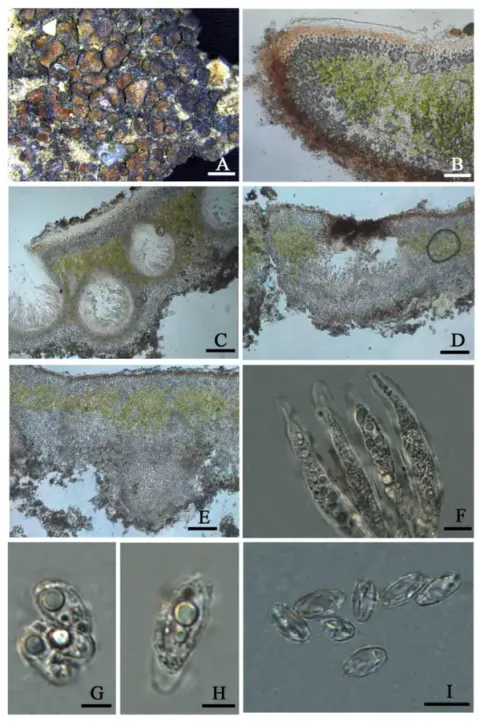
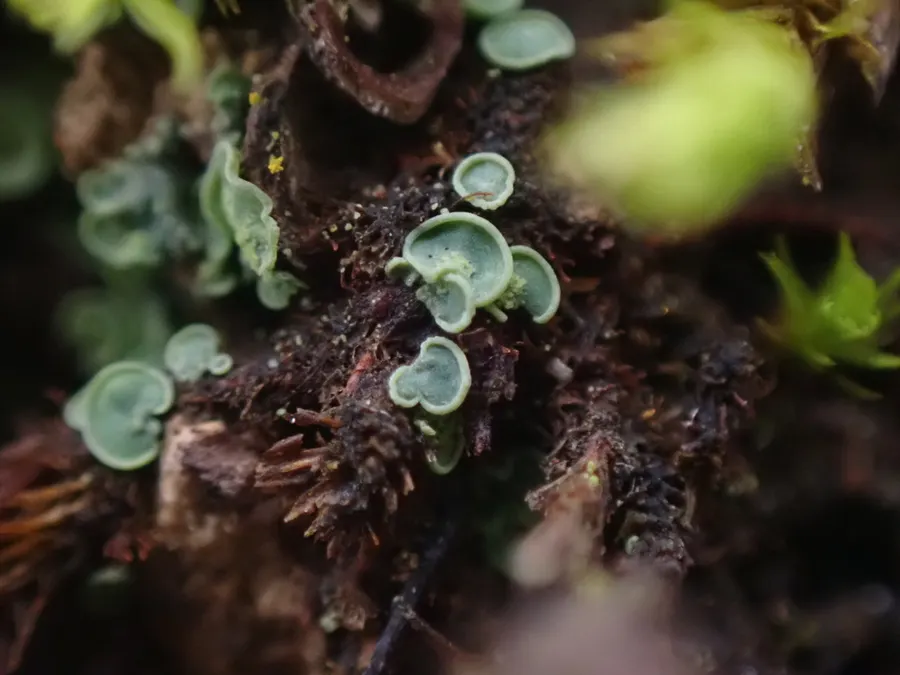
Normandina pulchella has a (scaly) thallus, composed of small, scale-like formations termed . The squamules display colours ranging from glaucous—a bluish-green or grey—to pale grey or greenish-grey, intensifying to a richer green when moistened. Each squamule can span up to 5 mm across and may include one or more broadly rounded , each up to 1.7 mm in diameter, reminiscent of shell or ear shapes. The upper surface of these lobes features concentric ridges, while the edges are sharply defined and raised, typically spanning 50–100 micrometres (μm) in width. The squamules may be dispersed or densely packed across the lichen's surface. The thallus is closely to the . Internally, the thallus shows a heteromerous structure, with distinct layering of fungal and algal components. The medulla contains transparent fungal filaments that form a network around clusters of algal cells. These fungal hyphae feature simple perforated septa with distinctive Woronin bodies, while the algal cells are characterised by thick cell walls and single lobate chloroplasts containing pyrenoids. For vegetative reproduction, N. pulchella develops soralia—structures on the lobe surfaces and edges—that discharge granular particles known as . These soralia are green or match the colour of the lobes and contain granular soredia measuring 40–80 μm in diameter. The underside of the lichen presents a whitish, slightly felted (tomentose) appearance and adheres to its substrate through numerous fungal strands, or hyphae. Rhizines do not occur in this species. Its spore-producing structures, or ascomata, appear as semi-immersed globular to slightly conical perithecia with moderate orange-brown pigmentation in the wall of textura angularis.
Habitat dan peran ekologis
Normandina pulchella has a cosmopolitan distribution, growing across diverse climates and regions. The Swedish lichenologist Gunnar Degelius, in his 1934 phytogeographical study, highlights the species' oceanic distribution in Europe. It predominantly occupies coastal areas in Northern Europe, including Scandinavia and the British Isles, and extends to both coastal and montane regions in Austria, Bavaria, France, Czechoslovakia (now the Czech Republic and Slovakia), and select Mediterranean locales. In contrast, William Louis Culberson and Mason Hale's 1966 analysis of its North American presence noted its prevalence in the mountainous western regions and the Appalachian foothills, without indicating an oceanic distribution pattern. Its range in North America extends north to Alaska, although in 2022 Alan Orange showed that some collections from there represent a different species found in the Americas, provisionally named N. americana. Ecologically, Normandina pulchella favours moss-covered deciduous trees and rocks within woodlands and parks, often colonising over mosses, bryophytes, and occasionally bare bark. It also often grows on other lichens, particularly those that contain cyanobacteria, such as Fuscopannaria, Pannaria, Parmeliella, Pectenia, and Peltigera.
- Habitat atau konteks temuan
- Informasi belum tersedia pada sumber rilis ini.
- Substrat
- Informasi belum tersedia pada sumber rilis ini.
- Peran atau konteks
- Pembentuk liken
Reproduksi
For vegetative reproduction, N. pulchella develops soralia—structures on the lobe surfaces and edges—that discharge granular particles known as . These soralia are green or match the colour of the lobes and contain granular soredia measuring 40–80 μm in diameter. The underside of the lichen presents a whitish, slightly felted (tomentose) appearance and adheres to its substrate through numerous fungal strands, or hyphae. Rhizines do not occur in this species. Its spore-producing structures, or ascomata, appear as semi-immersed globular to slightly conical perithecia with moderate orange-brown pigmentation in the wall of textura angularis. They are characterised by abundant , absence of and hymenial algae, and an I+ red/KI+ blue hymenial gel.
Catatan identitas dan cakupan
- Nama diterima mengikuti Catalogue of Life Base2026-09-11; uraian mempertahankan konsep dan nama sumber aslinya.
- Original geographic, specimen and life-cycle scope retained; source import awaits individual editorial review.
- Impor dan terjemahan otomatis belum diperiksa editorial per profil. Struktur reproduktif yang disebutkan tidak membuktikan seluruh siklus hidup diketahui.
- Pengukuran pada uraian mengikuti spesimen, kultur, dan metode sumber; angka tidak diperluas ke semua populasi.
Catatan distribusi dalam narasi mengikuti sumbernya. Dokumentasi spesimen atau foto mengikuti catatan sumber. Bukti wilayah Indonesia dan penilaian konservasi tidak disimpulkan dari gambar.
Melihat dengan konteks
Dokumentasi Normandina pulchella menurut asosiasi foto pada record takson iNaturalist. Kredit: Randal. Identitas mengikuti sumber; bukan penentuan spesimen independen.
- Jenis
- Fotografi
- Kredit
- no rights reserved, uploaded by Randal
- Lisensi
- CC0 1.0
- Sumber media
- Buka entri sumber
Sumber profil
- [1] Normandina pulchella — Wikipedia (en)
- [2] Catalogue of Life Base2026-09-11 — Normandina pulchella
- [3] Dokumentasi visual — Normandina pulchella
Rujukan halaman ini
Fungi. Normandina pulchella. Rilis data fungi-2026-10-12-expansion-2. https://fungi-atlas.mgadib.chatgpt.site/jamur/normandina-pulchella/.
Status: impor sumber; pemeriksaan editorial per profil belum selesai. Untuk klaim biologis, gunakan rujukan pada bagian terkait dan periksa konteks sumber aslinya.