01 / Morfologi

Ciri dan struktur

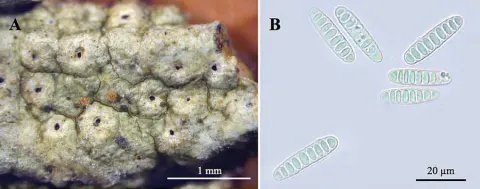
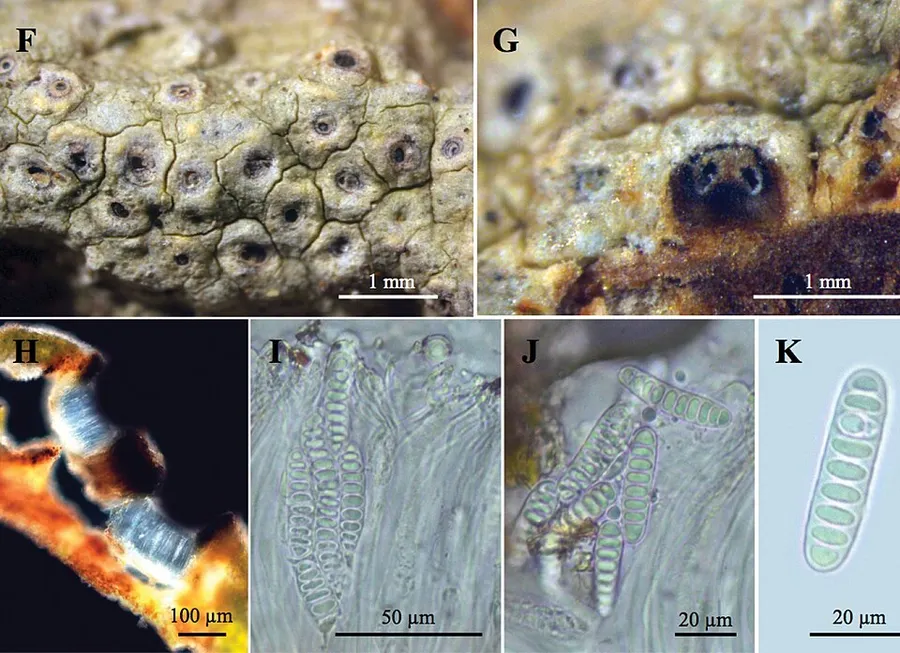
The body (thallus) grows on bark and forms a continuous crust up to about 5 cm across. Its surface is whitish gray and finely cracked (rimose), with a white inner tissue (medulla). No visible border zone () is present. In cross-section, the thallus is about 30–40 μm thick and consists of an outer skin () of interwoven, elongated cells (prosoplectenchymatous, about 5–10 μm thick), an (about 15–20 μm), and a medulla (about 20–25 μm) with scattered clusters of calcium oxalate crystals. The algal partner () is the green alga Trentepohlia, with cells about 7–9 × 6–8 μm. The fruiting bodies (ascomata) are rounded and sit within warty raised bumps (verrucae) that are surrounded by a black ring; they range from partly protruding () to sunken in the thallus and measure about 0.4–0.7 mm across and 0.15–0.2 mm high. The is hidden beneath a small pore-like opening about 0.05–0.1 mm wide, which is often partly filled by a central column () with a black tip, though the columella may be sunken below the surface. The outer wall of the fruiting body () is brown with a blackened () upper portion, and is fused with the surrounding thallus-derived rim (). A finger-like, blackened columella is present. The spore-bearing layer (hymenium) is clear and about 125–150 μm high. The asci are cylindrical to narrowly club-shaped (), about 110–115 × 12–15 μm, each containing eight colourless (hyaline) ascospores. The ascospores are divided into 7–10 cells (6–9-septate) and measure 25–38 × 7–8 μm, with thick cross-walls and lens-shaped internal spaces ( with lens-shaped ); they stain violet-blue with iodine.

Sebagian uraian ditampilkan dalam bahasa sumber; terjemahannya belum tersedia atau belum lolos pemeriksaan.

Rujukan: [1]

Pengukuran mengikuti objek, spesimen atau kultur, dan metode yang disebutkan sumber. Baca uraian asli untuk konteks lengkap.

02 / Kehidupan

Habitat dan peran ekologis

The species is known from Thailand (Ubon Ratchathani province), where the type collection was made in Pha Taem National Park at Sang Chan waterfall at 124 m elevation. It was found in dry evergreen forest growing on bark.

Sebagian uraian ditampilkan dalam bahasa sumber; terjemahannya belum tersedia atau belum lolos pemeriksaan.

Rujukan: [1]

Habitat atau konteks temuan
hutan
Substrat
kulit kayu
Peran atau konteks
Pembentuk liken
Temukan hubungan serupa
03 / Siklus hidup

Reproduksi

The fruiting bodies (ascomata) are rounded and sit within warty raised bumps (verrucae) that are surrounded by a black ring; they range from partly protruding () to sunken in the thallus and measure about 0.4–0.7 mm across and 0.15–0.2 mm high. The is hidden beneath a small pore-like opening about 0.05–0.1 mm wide, which is often partly filled by a central column () with a black tip, though the columella may be sunken below the surface. The outer wall of the fruiting body () is brown with a blackened () upper portion, and is fused with the surrounding thallus-derived rim (). A finger-like, blackened columella is present. The spore-bearing layer (hymenium) is clear and about 125–150 μm high. The asci are cylindrical to narrowly club-shaped (), about 110–115 × 12–15 μm, each containing eight colourless (hyaline) ascospores.

Sebagian uraian ditampilkan dalam bahasa sumber; terjemahannya belum tersedia atau belum lolos pemeriksaan.

Rujukan: [1]

04 / Batas informasi

Catatan identitas dan cakupan

  • Nama diterima mengikuti Catalogue of Life Base2026-09-11; uraian mempertahankan konsep dan nama sumber aslinya.
  • Original geographic, specimen and life-cycle scope retained; source import awaits individual editorial review.
  • Impor dan terjemahan otomatis belum diperiksa editorial per profil. Struktur reproduktif yang disebutkan tidak membuktikan seluruh siklus hidup diketahui.
  • Pengukuran pada uraian mengikuti spesimen, kultur, dan metode sumber; angka tidak diperluas ke semua populasi.

Catatan distribusi dalam narasi mengikuti sumbernya. Dokumentasi spesimen atau foto mengikuti catatan sumber. Bukti wilayah Indonesia dan penilaian konservasi tidak disimpulkan dari gambar.

05 / Dokumentasi

Melihat dengan konteks

Dokumentasi Ocellularia klinhomii dari Wikimedia Commons. Figure 3F ; Morphology and anatomy of Ocellularia klinhomii (F–K) F–G ascomata immersed in verrucae and surrounded by a black ring H cross-section of ascoma with carbonized columella and apically carbonized exiple I–K ascus and ascospores ( holotype ). Scale bar F–G = 1 mm, H = 100 µm, I = 50 µm, J–K = 20 µm. Identifikasi mengikuti record berkas sumber.

Jenis
Fotografi
Kredit
Naksuwankul K, Kraichak E, Parnmen S, Lücking R,Lumbsch TH (2016) Five new species of Graphidaceae (Ascomycota, Ostropales) from Thailand. MycoKeys 17: 47-63. https://doi.org/10.3897/mycokeys.17.10512
Lisensi
CC BY 4.0
Sumber media
Buka entri sumber

Gambar menunjukkan objek menurut identifikasi sumber, bukan verifikasi independen spesimen oleh Fungi. Tidak ada skala baru yang ditambahkan.

06 / Rujukan

Sumber profil

  1. [1] Ocellularia klinhomii — Wikipedia (en)Bagian sumber: Frozen revision 1341958988
    Tanggal penghimpunan sumber: 2026-10-12
    Teks sumber: CC BY-SA4.0 · Wikipedia contributors
  2. [2] Catalogue of Life Base2026-09-11 — Ocellularia klinhomiiBagian sumber: ColDP NameUsage.tsv ID 48CFC; accepted species; source 2073
    Tanggal penghimpunan sumber: 2026-10-12
  3. [3] Dokumentasi visual — Ocellularia klinhomiiBagian sumber: Individual media record; identification follows the source, not independent determination
    Tanggal penghimpunan sumber: 2026-10-12
    Media sumber: CC BY 4.0 · Naksuwankul K, Kraichak E, Parnmen S, Lücking R,Lumbsch TH (2016) Five new species of Graphidaceae (Ascomycota, Ostropales) from Thailand. MycoKeys 17: 47-63. https://doi.org/10.3897/mycokeys.17.10512

Adaptasi teks: CC BY-SA 4.0. Wikipedia contributors — Ocellularia klinhomii — Wikipedia (en)

Uraian asli dan riwayat sumber

Riwayat atau halaman sumber

Ringkasan sumber

Ocellularia klinhomii is a species of corticolous (bark-dwelling), crustose lichen-forming fungus in the family Graphidaceae. It is a whitish gray, bark-dwelling lichen with small fruiting bodies set within raised, dark-ringed bumps on the thallus surface, known from dry evergreen forest in northeastern Thailand. The species was described in 2016 and is named in honour of the Thai mycologist Winia Klinhom.

Revisi sumber

Morfologi sumber

The body (thallus) grows on bark and forms a continuous crust up to about 5 cm across. Its surface is whitish gray and finely cracked (rimose), with a white inner tissue (medulla). No visible border zone () is present. In cross-section, the thallus is about 30–40 μm thick and consists of an outer skin () of interwoven, elongated cells (prosoplectenchymatous, about 5–10 μm thick), an (about 15–20 μm), and a medulla (about 20–25 μm) with scattered clusters of calcium oxalate crystals. The algal partner () is the green alga Trentepohlia, with cells about 7–9 × 6–8 μm. The fruiting bodies (ascomata) are rounded and sit within warty raised bumps (verrucae) that are surrounded by a black ring; they range from partly protruding () to sunken in the thallus and measure about 0.4–0.7 mm across and 0.15–0.2 mm high. The is hidden beneath a small pore-like opening about 0.05–0.1 mm wide, which is often partly filled by a central column () with a black tip, though the columella may be sunken below the surface. The outer wall of the fruiting body () is brown with a blackened () upper portion, and is fused with the surrounding thallus-derived rim (). A finger-like, blackened columella is present. The spore-bearing layer (hymenium) is clear and about 125–150 μm high. The asci are cylindrical to narrowly club-shaped (), about 110–115 × 12–15 μm, each containing eight colourless (hyaline) ascospores. The ascospores are divided into 7–10 cells (6–9-septate) and measure 25–38 × 7–8 μm, with thick cross-walls and lens-shaped internal spaces ( with lens-shaped ); they stain violet-blue with iodine.

Revisi sumber

Ekologi sumber

The species is known from Thailand (Ubon Ratchathani province), where the type collection was made in Pha Taem National Park at Sang Chan waterfall at 124 m elevation. It was found in dry evergreen forest growing on bark.

Revisi sumber

Struktur reproduksi sumber

The fruiting bodies (ascomata) are rounded and sit within warty raised bumps (verrucae) that are surrounded by a black ring; they range from partly protruding () to sunken in the thallus and measure about 0.4–0.7 mm across and 0.15–0.2 mm high. The is hidden beneath a small pore-like opening about 0.05–0.1 mm wide, which is often partly filled by a central column () with a black tip, though the columella may be sunken below the surface. The outer wall of the fruiting body () is brown with a blackened () upper portion, and is fused with the surrounding thallus-derived rim (). A finger-like, blackened columella is present. The spore-bearing layer (hymenium) is clear and about 125–150 μm high. The asci are cylindrical to narrowly club-shaped (), about 110–115 × 12–15 μm, each containing eight colourless (hyaline) ascospores.

Revisi sumber

Rujukan halaman ini

Fungi. Ocellularia klinhomii. Rilis data fungi-2026-10-12-expansion-2. https://fungi-atlas.mgadib.chatgpt.site/jamur/ocellularia-klinhomii/.

Status: impor sumber; pemeriksaan editorial per profil belum selesai. Untuk klaim biologis, gunakan rujukan pada bagian terkait dan periksa konteks sumber aslinya.