01 / Morfologi

Ciri dan struktur

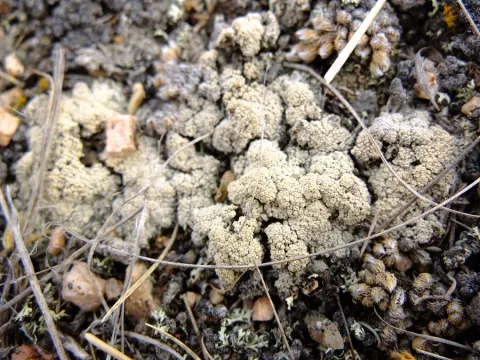
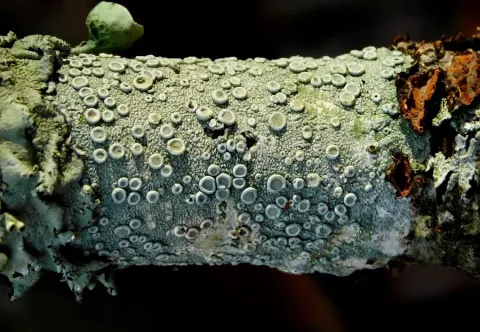
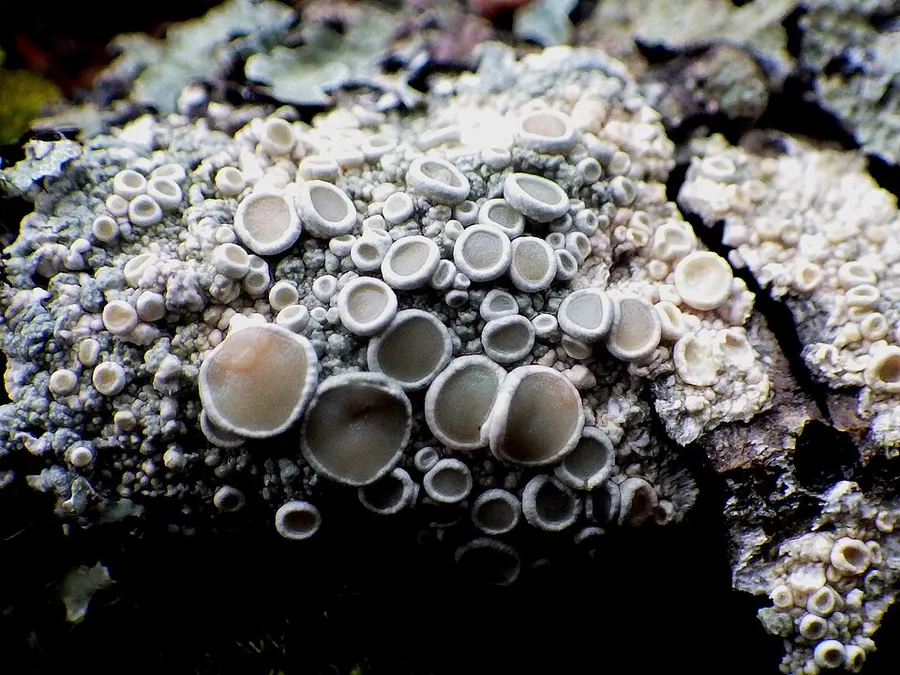
Ochrolechia tartarea has a thallus that can grow quite thick (for crustose lichens), up to 3 mm or more. The thallus ranges in colour from pale to dark grey and has a rough, and crumbly surface. Its surface is often uneven, marked by numerous irregular warts forming a corrugated crust. Occasionally, it has a paler zoned margin and a pale prothallus (the initial fungal growth stage of the lichen). The apothecia, or reproductive structures, are usually frequent. They start off immersed and closed, but eventually become rounded or irregular in shape. These apothecia can be scattered or densely packed and are , meaning they sit directly on the thallus without a stalk. The , which is the rim around the apothecia, is thick and wavy. The , or the central part of the apothecia, can reach up to 5 mm in diameter (sometimes up to 8 mm) and ranges in colour from pale brown to dull orange-pink. It can be concave to flat and is either not or only translucently so, with a surface that is often roughened (). The , the uppermost layer of cells in the apothecia, is and these granules dissolve in potassium hydroxide (K) solution. The ascospores of Ochrolechia tartarea are broadly ellipsoidal, measuring between 40 to 70 micrometres (μm) in length and 20 to 40 μm in width. In chemical spot tests, the thallus reacts as follows: C+ (orange-red), K+ (pale yellow), KC+ (red), and both Pd− and UV−. The apothecial disc is also C+ (red), K−, KC+ (red), and Pd−. These reactions are due to the presence of gyrophoric acid and trace amounts of lecanoric acid, along with other unknown compounds.

Sebagian uraian ditampilkan dalam bahasa sumber; terjemahannya belum tersedia atau belum lolos pemeriksaan.

Rujukan: [1]

Pengukuran mengikuti objek, spesimen atau kultur, dan metode yang disebutkan sumber. Baca uraian asli untuk konteks lengkap.

02 / Kehidupan

Habitat dan peran ekologis

Ochrolechia tartarea grows on acidic rocks and shallow soil in moist conditions, primarily at higher elevations. The species is documented from the Alpine regions of Austria, Switzerland, France, and Italy. In Britain and Ireland it forms thick crusts on boulders and other siliceous rock, may overgrow moss-lichen heaths, and is only occasional on leached, acid bark. It favours wind-exposed uplands and other oceanic or montane environments with high rainfall; it is widespread across Britain and Ireland but becomes rare or absent in central and south-east England. In Central Europe it occupies non-calcareous silicate rocks, often with a thin humus cover, at light but frequently shaded sites that are repeatedly and intensely wetted, for example relatively sheltered faces of otherwise exposed crags. Ecologically, it prefers acidic substrates and thrives in moist, rain-exposed habitats; it tolerates only moderate light and is often found in the plant community Parmelietum omphalodis. Continental lowland reports are prone to confusion with similar taxa; for example, all published records from Poland proved to be misidentifications. Within Germany it is recorded chiefly from upland and alpine regions (e.g. the Harz and Alps), with scattered or doubtful occurrences elsewhere.

Sebagian uraian ditampilkan dalam bahasa sumber; terjemahannya belum tersedia atau belum lolos pemeriksaan.

Rujukan: [1]

Habitat atau konteks temuan
Informasi belum tersedia pada sumber rilis ini.
Substrat
Informasi belum tersedia pada sumber rilis ini.
Peran atau konteks
Pembentuk liken
Temukan hubungan serupa
03 / Siklus hidup

Reproduksi

The apothecia, or reproductive structures, are usually frequent. They start off immersed and closed, but eventually become rounded or irregular in shape. These apothecia can be scattered or densely packed and are , meaning they sit directly on the thallus without a stalk. The , which is the rim around the apothecia, is thick and wavy. The , or the central part of the apothecia, can reach up to 5 mm in diameter (sometimes up to 8 mm) and ranges in colour from pale brown to dull orange-pink. It can be concave to flat and is either not or only translucently so, with a surface that is often roughened (). The , the uppermost layer of cells in the apothecia, is and these granules dissolve in potassium hydroxide (K) solution.

Sebagian uraian ditampilkan dalam bahasa sumber; terjemahannya belum tersedia atau belum lolos pemeriksaan.

Rujukan: [1]

Sinonim menurut acuan taksonomi rilis: Lecanora pallescens var. tartarea; Lecanora tartarea; Lecanora tartarea f. grandinosa; Lecanora tartarea var. grandinosa; Lichen tartareus; Ochrolechia erichsenii; Ochrolechia frigida f. grandinosa; Ochrolechia frigida var. grandinosa; Ochrolechia tartarea var. grandinosa; Ochrolechia tartarea var. pycnidiifera; Parmelia parella var. tartarea; Parmelia tartarea; Patellaria tartarea; Pertusaria gyrocheila; Pertusaria tartarea; Pertusaria tumidula; Rinodina grandinosa; Rinodina tartarea; Scutellaria tartarea; Verrucaria tartarea
04 / Batas informasi

Catatan identitas dan cakupan

  • Nama diterima mengikuti Catalogue of Life Base2026-09-11; uraian mempertahankan konsep dan nama sumber aslinya.
  • Original geographic, specimen and life-cycle scope retained; source import awaits individual editorial review.
  • Impor dan terjemahan otomatis belum diperiksa editorial per profil. Struktur reproduktif yang disebutkan tidak membuktikan seluruh siklus hidup diketahui.
  • Pengukuran pada uraian mengikuti spesimen, kultur, dan metode sumber; angka tidak diperluas ke semua populasi.

Catatan distribusi dalam narasi mengikuti sumbernya. Dokumentasi spesimen atau foto mengikuti catatan sumber. Bukti wilayah Indonesia dan penilaian konservasi tidak disimpulkan dari gambar.

05 / Dokumentasi

Melihat dengan konteks

Dokumentasi Ochrolechia tartarea dari Wikimedia Commons. For more information about this, see the observation page at Mushroom Observer. Identifikasi mengikuti record berkas sumber.

Jenis
Fotografi
Kredit
This image was created by user zaca at Mushroom Observer , a source for mycological images. You can contact this user here .
Sumber media
Buka entri sumber

Gambar menunjukkan objek menurut identifikasi sumber, bukan verifikasi independen spesimen oleh Fungi. Tidak ada skala baru yang ditambahkan.

06 / Rujukan

Sumber profil

  1. [1] Ochrolechia tartarea — Wikipedia (en)Bagian sumber: Frozen revision 1330482365
    Tanggal penghimpunan sumber: 2026-10-12
    Teks sumber: CC BY-SA4.0 · Wikipedia contributors
  2. [2] Catalogue of Life Base2026-09-11 — Ochrolechia tartareaBagian sumber: ColDP NameUsage.tsv ID 48DZT; accepted species; source 2073
    Tanggal penghimpunan sumber: 2026-10-12
  3. [3] Dokumentasi visual — Ochrolechia tartareaBagian sumber: Individual media record; identification follows the source, not independent determination
    Tanggal penghimpunan sumber: 2026-10-12
    Media sumber: CC BY-SA 3.0 · This image was created by user zaca at Mushroom Observer , a source for mycological images. You can contact this user here .

Adaptasi teks: CC BY-SA 4.0. Wikipedia contributors — Ochrolechia tartarea — Wikipedia (en)

Uraian asli dan riwayat sumber

Riwayat atau halaman sumber

Ringkasan sumber

Ochrolechia tartarea is a species of saxicolous (rock-dwelling) crustose lichen in the family Ochrolechiaceae. It forms thick, greyish crusts with a rough, crumbly surface marked by irregular warts, typically found on acidic rocks in moist, upland environments across Europe and parts of Asia. The lichen produces distinctive reproductive structures (apothecia) that appear as rounded, pale brown to orange-pink discs up to 5 mm across, often densely packed across its surface. Originally described by Carl Linnaeus in 1753 as Lichen tartareus, it was historically significant as the source of cudbear, a red dye that was commercially important in 18th-century Scotland before overharvesting led to population declines.

Revisi sumber

Morfologi sumber

Ochrolechia tartarea has a thallus that can grow quite thick (for crustose lichens), up to 3 mm or more. The thallus ranges in colour from pale to dark grey and has a rough, and crumbly surface. Its surface is often uneven, marked by numerous irregular warts forming a corrugated crust. Occasionally, it has a paler zoned margin and a pale prothallus (the initial fungal growth stage of the lichen). The apothecia, or reproductive structures, are usually frequent. They start off immersed and closed, but eventually become rounded or irregular in shape. These apothecia can be scattered or densely packed and are , meaning they sit directly on the thallus without a stalk. The , which is the rim around the apothecia, is thick and wavy. The , or the central part of the apothecia, can reach up to 5 mm in diameter (sometimes up to 8 mm) and ranges in colour from pale brown to dull orange-pink. It can be concave to flat and is either not or only translucently so, with a surface that is often roughened (). The , the uppermost layer of cells in the apothecia, is and these granules dissolve in potassium hydroxide (K) solution. The ascospores of Ochrolechia tartarea are broadly ellipsoidal, measuring between 40 to 70 micrometres (μm) in length and 20 to 40 μm in width. In chemical spot tests, the thallus reacts as follows: C+ (orange-red), K+ (pale yellow), KC+ (red), and both Pd− and UV−. The apothecial disc is also C+ (red), K−, KC+ (red), and Pd−. These reactions are due to the presence of gyrophoric acid and trace amounts of lecanoric acid, along with other unknown compounds.

Revisi sumber

Ekologi sumber

Ochrolechia tartarea grows on acidic rocks and shallow soil in moist conditions, primarily at higher elevations. The species is documented from the Alpine regions of Austria, Switzerland, France, and Italy. In Britain and Ireland it forms thick crusts on boulders and other siliceous rock, may overgrow moss-lichen heaths, and is only occasional on leached, acid bark. It favours wind-exposed uplands and other oceanic or montane environments with high rainfall; it is widespread across Britain and Ireland but becomes rare or absent in central and south-east England. In Central Europe it occupies non-calcareous silicate rocks, often with a thin humus cover, at light but frequently shaded sites that are repeatedly and intensely wetted, for example relatively sheltered faces of otherwise exposed crags. Ecologically, it prefers acidic substrates and thrives in moist, rain-exposed habitats; it tolerates only moderate light and is often found in the plant community Parmelietum omphalodis. Continental lowland reports are prone to confusion with similar taxa; for example, all published records from Poland proved to be misidentifications. Within Germany it is recorded chiefly from upland and alpine regions (e.g. the Harz and Alps), with scattered or doubtful occurrences elsewhere.

Revisi sumber

Struktur reproduksi sumber

The apothecia, or reproductive structures, are usually frequent. They start off immersed and closed, but eventually become rounded or irregular in shape. These apothecia can be scattered or densely packed and are , meaning they sit directly on the thallus without a stalk. The , which is the rim around the apothecia, is thick and wavy. The , or the central part of the apothecia, can reach up to 5 mm in diameter (sometimes up to 8 mm) and ranges in colour from pale brown to dull orange-pink. It can be concave to flat and is either not or only translucently so, with a surface that is often roughened (). The , the uppermost layer of cells in the apothecia, is and these granules dissolve in potassium hydroxide (K) solution.

Revisi sumber

Rujukan halaman ini

Fungi. Ochrolechia tartarea. Rilis data fungi-2026-10-12-expansion-2. https://fungi-atlas.mgadib.chatgpt.site/jamur/ochrolechia-tartarea/.

Status: impor sumber; pemeriksaan editorial per profil belum selesai. Untuk klaim biologis, gunakan rujukan pada bagian terkait dan periksa konteks sumber aslinya.