Ciri dan struktur
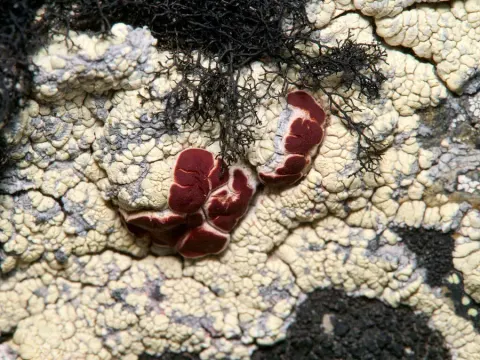
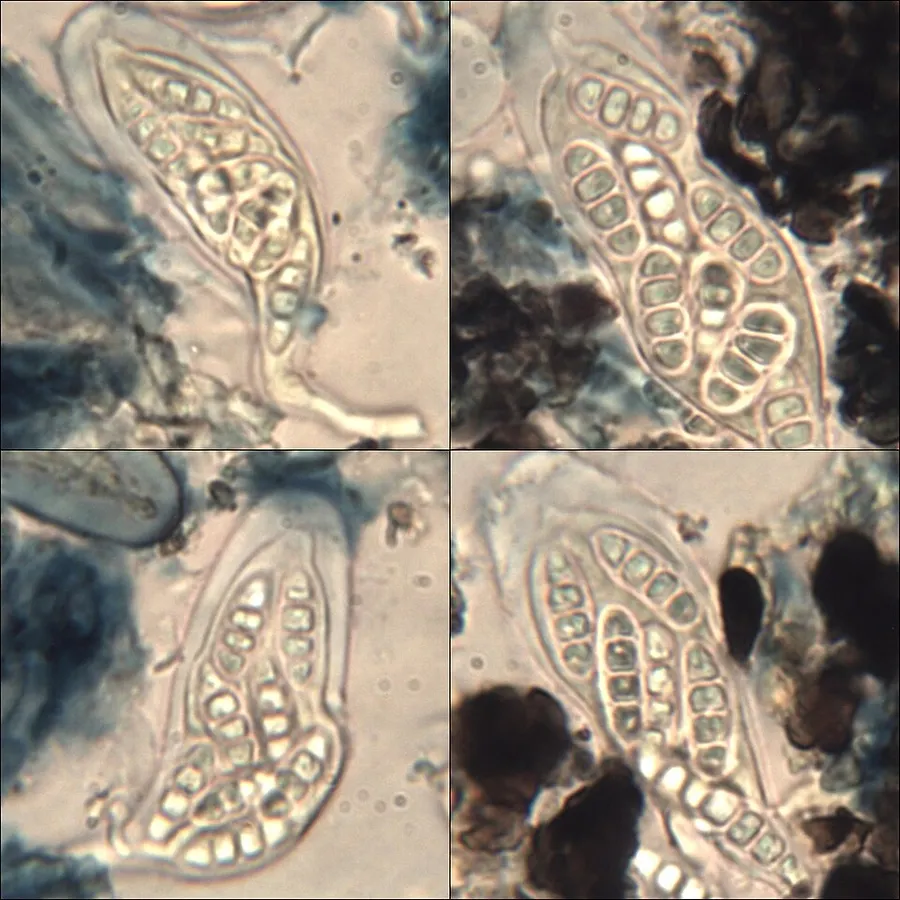
Opegrapha physciaria is a minute fungus that lives parasymbiotically on the common sunburst lichen (Xanthoria parietina). It threads its colourless hyphae through the host's tissue rather than forming a thallus of its own; the only part visible to the naked eye is its reproductive bodies. These begin life submerged in the lichen, then burst through the surface as tiny, black, non-powdery (ascomata) about 0.7 mm across. When first exposed the discs are roughly circular, but they may elongate slightly with age; several often crowd together in dense patches, while others remain solitary. A firm, continuous wall () surrounds each disc and merges below them, measuring roughly 40–45 μm in height. Inside, a clear hymenium about 65 μm tall is threaded with branched, gel-coated filaments () whose swollen brown tips form a pseudo-epithecium that roofs the spore layer. Treatment with iodine after a mild alkali wash turns the hymenium blue, indicating the presence of starch-like compounds. The asci are —built from two separable walls that pop apart to discharge the spores—and are club-shaped, 45–50 × 18 μm, each producing eight spores. Unlike many relatives they lack the dark, starch-positive ring usually seen at the ascus apex and instead possess a small, pale ocular chamber through which the spores escape. The ascospores themselves are smooth, ellipsoid and three-celled (containing two internal cross-walls), measuring 12–16 × 6–8 μm. They start out hyaline (colourless) but darken to a warm brown as minute pigment granules accumulate on the outer coat (), which is only about 1 μm thick.
Habitat dan peran ekologis
Opegrapha physciaria has been recorded from Europe and North America. It is an obligate lichenicolous fungus that grows on the thallus of the widespread sunburst lichen Xanthoria parietina. Verified material shows it is most frequently encountered in oceanic or sub-Mediterranean woodlands where Xanthoria forms bright orange patches on rough bark. A recently documented Iberian population occurred at 950 m elevation in open juniper–holm-oak forest, where the host lichen coated old trunks of Juniperus oxycedrus within a community classed as Juniperion thuriferae–Quercetum rotundifoliae. Earlier collections place the species in Atlantic north-Spanish woodland on a solitary poplar (Populus sp.), and on mature deciduous or conifer bark in lowland Britain and Sweden, indicating a preference for well-lit, nutrient-enriched bark of trees that also favour Xanthoria. Although the fungus was described from the Paris area in 1827, confusion with look-alikes such as O. parasitica has long obscured its true range. Critical re-examination of herbarium specimens finds reliable nineteenth- and twentieth-century records from France (Paris, Marennes, Fontainebleau), Germany (as Celidium varium), Sweden and northern Spain.
- Habitat atau konteks temuan
- hutan
- Substrat
- Informasi belum tersedia pada sumber rilis ini.
- Peran atau konteks
- Pembentuk liken
Reproduksi
Opegrapha physciaria is a minute fungus that lives parasymbiotically on the common sunburst lichen (Xanthoria parietina). It threads its colourless hyphae through the host's tissue rather than forming a thallus of its own; the only part visible to the naked eye is its reproductive bodies. These begin life submerged in the lichen, then burst through the surface as tiny, black, non-powdery (ascomata) about 0.7 mm across. When first exposed the discs are roughly circular, but they may elongate slightly with age; several often crowd together in dense patches, while others remain solitary. A firm, continuous wall () surrounds each disc and merges below them, measuring roughly 40–45 μm in height. Inside, a clear hymenium about 65 μm tall is threaded with branched, gel-coated filaments () whose swollen brown tips form a pseudo-epithecium that roofs the spore layer.
Catatan identitas dan cakupan
- Nama diterima mengikuti Catalogue of Life Base2026-09-11; uraian mempertahankan konsep dan nama sumber aslinya.
- Original geographic, specimen and life-cycle scope retained; source import awaits individual editorial review.
- Impor dan terjemahan otomatis belum diperiksa editorial per profil. Struktur reproduktif yang disebutkan tidak membuktikan seluruh siklus hidup diketahui.
- Pengukuran pada uraian mengikuti spesimen, kultur, dan metode sumber; angka tidak diperluas ke semua populasi.
Catatan distribusi dalam narasi mengikuti sumbernya. Dokumentasi spesimen atau foto mengikuti catatan sumber. Bukti wilayah Indonesia dan penilaian konservasi tidak disimpulkan dari gambar.
Melihat dengan konteks
Dokumentasi Opegrapha physciaria dari Wikimedia Commons. Asci and ascopores of the lichenicolous (lichen-dwelling) fungus "Opegrapha physciaria" (Nyl.) D. Hawksw. & Coppins (730143), 1000x magnification, in lugol. The fungus was growing on the lichen Xanthoria parietina , which was growing on a fig tree in Cordão dunar Consolação-Peniche, Portugal. Identifikasi mengikuti record berkas sumber.
- Jenis
- Fotografi
- Kredit
- zaca (Zaca Lepista)
- Lisensi
- CC BY-SA 3.0
- Sumber media
- Buka entri sumber
Sumber profil
- [1] Opegrapha physciaria — Wikipedia (en)
- [2] Catalogue of Life Base2026-09-11 — Opegrapha physciaria
- [3] Dokumentasi visual — Opegrapha physciaria
Rujukan halaman ini
Fungi. Opegrapha physciaria. Rilis data fungi-2026-10-12-expansion-2. https://fungi-atlas.mgadib.chatgpt.site/jamur/opegrapha-physciaria/.
Status: impor sumber; pemeriksaan editorial per profil belum selesai. Untuk klaim biologis, gunakan rujukan pada bagian terkait dan periksa konteks sumber aslinya.