Ciri dan struktur
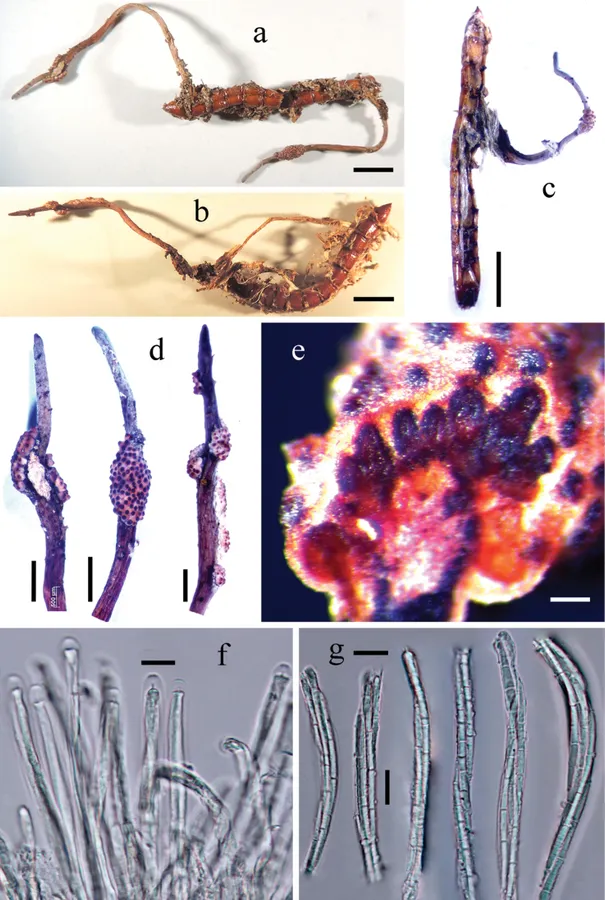
Parasitising Elateroidea larvae (Coleoptera) living in fallen wood. The larvae are cylindrical, 11 mm long and 1.1–1.3 mm thick, yellowish-brown; their body cavity stuffed with milky yellow mycelia and their intersegmental membranes covered with many milky yellow and flocculent funiculi. Stromata arising from any part of larval body, single or paired, unbranched. Stipe grey, slender and cylindrical, fibrous and flexible, curved more or less, 10–13 mm long and 0.25–0.6 mm thick, surface relatively smooth but with many longitudinal wrinkles, apex pointed. Fertile part irregularly attached on one side of the surface of distal part of stipe, which resembles a mass of insect eggs that are clustered together or separated into several lumps; substrate layer milky white, surface milky yellow accompanied by lavender and dotted with numerous black ostioles. Perithecia immersed, densely arranged, obliquely or at right angles to the surface of stipe, pyriform, neck unconspicuous, 220–290 × 120–150 µm and their tops obtuse; walls dark brown and 25–32 µm thick; ostioles slightly thickened and slightly protruding over the surface of fertile part. Asci cylindrical, 6–8 µm in diameter; caps hemispherical, 5–6 (x – = 5.5, n = 30) µm wide and 3.5–5 (x – = 4.2, n = 30) µm high. Ascospores filiform and elongate, multi-septate (far more than 3), not easy to break into part-spores; part-spores cylindrical, truncated at both ends, 10–15 (x – = 12.2, n = 30) × 2 μm. Asexual morph. Unknown. The new species is morphologically similar to O. purpureostromata (≡ C. purpureostromata), but their stipes and ascospores are distinct.
Habitat dan peran ekologis
Growing on Elateroidea larvae (Coleoptera) living in fallen wood in a deciduous forest.
- Habitat atau konteks temuan
- hutan
- Substrat
- Informasi belum tersedia pada sumber rilis ini.
- Peran atau konteks
- Belum dikategorikan pada rilis ini.
Reproduksi
Parasitising Elateroidea larvae (Coleoptera) living in fallen wood. The larvae are cylindrical, 11 mm long and 1.1–1.3 mm thick, yellowish-brown; their body cavity stuffed with milky yellow mycelia and their intersegmental membranes covered with many milky yellow and flocculent funiculi. Stromata arising from any part of larval body, single or paired, unbranched. Stipe grey, slender and cylindrical, fibrous and flexible, curved more or less, 10–13 mm long and 0.25–0.6 mm thick, surface relatively smooth but with many longitudinal wrinkles, apex pointed. Fertile part irregularly attached on one side of the surface of distal part of stipe, which resembles a mass of insect eggs that are clustered together or separated into several lumps; substrate layer milky white, surface milky yellow accompanied by lavender and dotted with numerous black ostioles.
Catatan identitas dan cakupan
- Nama diterima mengikuti Catalogue of Life Base2026-09-11; uraian mempertahankan konsep dan nama sumber aslinya.
- Preserve original treatment localities, hosts and substrate scope. Materials examined describe documented specimens, not the full global range.
- Impor dan terjemahan otomatis belum diperiksa editorial per profil. Struktur reproduktif yang disebutkan tidak membuktikan seluruh siklus hidup diketahui.
- Pengukuran pada uraian mengikuti spesimen, kultur, dan metode sumber; angka tidak diperluas ke semua populasi.
Catatan distribusi dalam narasi mengikuti sumbernya. Dokumentasi spesimen atau foto mengikuti catatan sumber. Bukti wilayah Indonesia dan penilaian konservasi tidak disimpulkan dari gambar.
Melihat dengan konteks
Ophiocordyceps borealis a–c stromata arising from the different parts of larval bodies d apical ends of stromata e transverse section of fertile part, on which densely arranged perithecia are shown f asci g ascospores. Scale bars: 2 mm (a–c); 1 mm (d); 100 µm (e), 10 µm (f, g).
- Jenis
- Pelat ilmiah
- Kredit
- Ling-Sheng Zha, Vadim Yu Kryukov, Jian-Hua Ding, Rajesh Jeewon, Putarak Chomnunti
- Lisensi
- CC BY 4.0
- Sumber media
- Buka entri sumber
Sumber profil
- [1] Novel taxa and species diversity of Cordyceps sensu lato (Hypocreales, Ascomycota) developing on wireworms (Elateroidea and Tenebrionoidea, Coleoptera) — Ophiocordyceps borealis
- [2] Catalogue of Life Base2026-09-11 — Ophiocordyceps borealis
- [3] Dokumentasi visual — Ophiocordyceps borealis
Rujukan halaman ini
Fungi. Ophiocordyceps borealis. Rilis data fungi-2026-10-12-expansion-2. https://fungi-atlas.mgadib.chatgpt.site/jamur/ophiocordyceps-borealis/.
Status: impor sumber; pemeriksaan editorial per profil belum selesai. Untuk klaim biologis, gunakan rujukan pada bagian terkait dan periksa konteks sumber aslinya.