Ciri dan struktur
Basidiomes coralloid/filiform, up to 35 mm high, branched, erect, monoaxial with adventitious branches, yellow (10YR 8/6), solitary or gregarious. Stipe up to 13 × 0.3–0.7 mm, glabrous, concolorous with the rest of the basidiomes, attached to a small resupinate base up to 3 mm wide. Branches up to 1.3 × 0.2 mm, tapering upwards, rarely with branchlets. Habitat: On dead twigs, petioles, leaves or seeds in the forest. Hyphal system dimitic. Generative hyphae up to 7 μm wide thin-walled, without clamps. Skeletal hyphae 2–7 μm wide, thick-walled (up to 1.3 μm), rarely branched. Abundant dextrinoid dichophyses, up to 30 μm wide, slightly thick-walled (0.5–1 μm), branching with filiform ends, tips less than 0.5 μm wide. Resupinate patch not well-developed in the studied material but with abundant dichophyses. Basidia not observed. Gloeocystidia up to 65 μm long, clavate to lanceolate/subulate, thin-walled, with numerous internal droplets, IKI-. Basidiospores (12–)13.4–16.8(–17) × 3–3.5 μm (n = 19), hyaline, smooth, elongate, subfusiform, apex obtuse, base acute with small apiculus (0.3 μm), thin-walled and slightly amyloid, scarce in all the collected samples.
Habitat dan peran ekologis
Basidiomes coralloid/filiform, up to 35 mm high, branched, erect, monoaxial with adventitious branches, yellow (10YR 8/6), solitary or gregarious. Stipe up to 13 × 0.3–0.7 mm, glabrous, concolorous with the rest of the basidiomes, attached to a small resupinate base up to 3 mm wide. Branches up to 1.3 × 0.2 mm, tapering upwards, rarely with branchlets. Habitat: On dead twigs, petioles, leaves or seeds in the forest. Hyphal system dimitic. Generative hyphae up to 7 μm wide thin-walled, without clamps. Skeletal hyphae 2–7 μm wide, thick-walled (up to 1.3 μm), rarely branched. Abundant dextrinoid dichophyses, up to 30 μm wide, slightly thick-walled (0.5–1 μm), branching with filiform ends, tips less than 0.5 μm wide. Resupinate patch not well-developed in the studied material but with abundant dichophyses. Basidia not observed. Gloeocystidia up to 65 μm long, clavate to lanceolate/subulate, thin-walled, with numerous internal droplets, IKI-. Basidiospores (12–)13.4–16.8(–17) × 3–3.5 μm (n = 19), hyaline, smooth, elongate, subfusiform, apex obtuse, base acute with small apiculus (0.3 μm), thin-walled and slightly amyloid, scarce in all the collected samples.
- Habitat atau konteks temuan
- hutan
- Substrat
- Informasi belum tersedia pada sumber rilis ini.
- Peran atau konteks
- Belum dikategorikan pada rilis ini.
Reproduksi
Basidiomes coralloid/filiform, up to 35 mm high, branched, erect, monoaxial with adventitious branches, yellow (10YR 8/6), solitary or gregarious. Stipe up to 13 × 0.3–0.7 mm, glabrous, concolorous with the rest of the basidiomes, attached to a small resupinate base up to 3 mm wide. Branches up to 1.3 × 0.2 mm, tapering upwards, rarely with branchlets. Habitat: On dead twigs, petioles, leaves or seeds in the forest. Hyphal system dimitic. Generative hyphae up to 7 μm wide thin-walled, without clamps. Skeletal hyphae 2–7 μm wide, thick-walled (up to 1.3 μm), rarely branched. Abundant dextrinoid dichophyses, up to 30 μm wide, slightly thick-walled (0.5–1 μm), branching with filiform ends, tips less than 0.5 μm wide.
Catatan identitas dan cakupan
- Nama diterima mengikuti Catalogue of Life Base2026-09-11; uraian mempertahankan konsep dan nama sumber aslinya.
- Preserve original treatment localities, hosts and substrate scope. Materials examined describe documented specimens, not the full global range.
- Impor dan terjemahan otomatis belum diperiksa editorial per profil. Struktur reproduktif yang disebutkan tidak membuktikan seluruh siklus hidup diketahui.
- Pengukuran pada uraian mengikuti spesimen, kultur, dan metode sumber; angka tidak diperluas ke semua populasi.
Catatan distribusi dalam narasi mengikuti sumbernya. Dokumentasi spesimen atau foto mengikuti catatan sumber. Bukti wilayah Indonesia dan penilaian konservasi tidak disimpulkan dari gambar.
Melihat dengan konteks
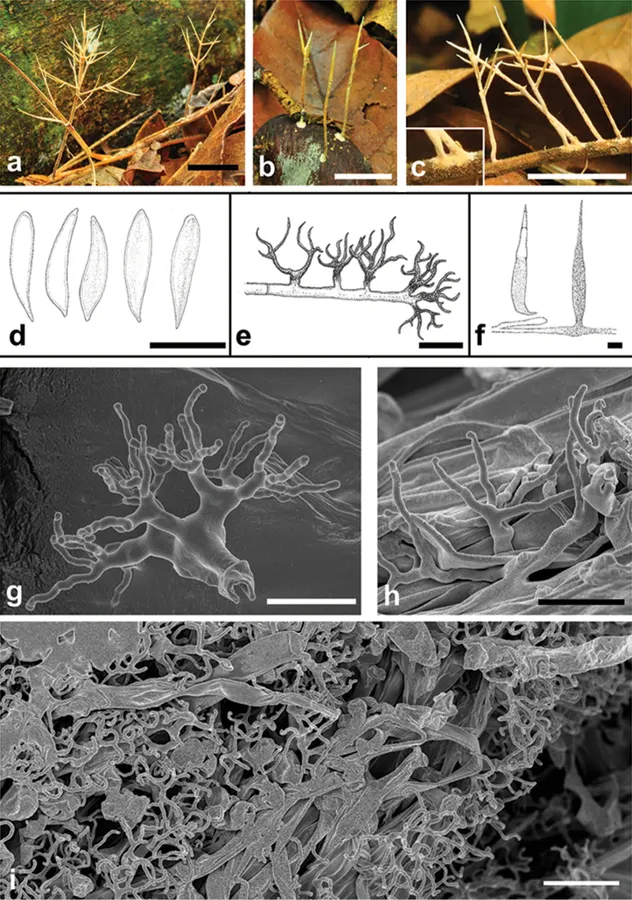
Parapterulicium subarbusculum: a–c basidiomes in the field. The detail in c shows the developing corticioid patch d basidiospores e dichophyses f gloeocystidia g, h SEM images of dichophyses; i. SEM images of basidiome surface with abundant dichophyses. Scale bars: a–c = 1 cm; d–f, i = 10 μm; g, h = 5 μm.
- Jenis
- Pelat ilmiah
- Kredit
- Caio A. Leal-Dutra, Maria Alice Neves, Gareth W. Griffith, Mateus A. Reck, Lina A. Clasen, Bryn T. M. Dentinger
- Lisensi
- CC BY 4.0
- Sumber media
- Buka entri sumber
Sumber profil
- [1] Reclassification of Parapterulicium Corner (Pterulaceae, Agaricales), contributions to Lachnocladiaceae and Peniophoraceae (Russulales) and introduction of Baltazaria gen. nov. — Parapterulicium subarbusculum
- [2] Catalogue of Life Base2026-09-11 — Parapterulicium subarbusculum
- [3] Dokumentasi visual — Parapterulicium subarbusculum
Rujukan halaman ini
Fungi. Parapterulicium subarbusculum. Rilis data fungi-2026-10-12-expansion-2. https://fungi-atlas.mgadib.chatgpt.site/jamur/parapterulicium-subarbusculum/.
Status: impor sumber; pemeriksaan editorial per profil belum selesai. Untuk klaim biologis, gunakan rujukan pada bagian terkait dan periksa konteks sumber aslinya.