Ciri dan struktur
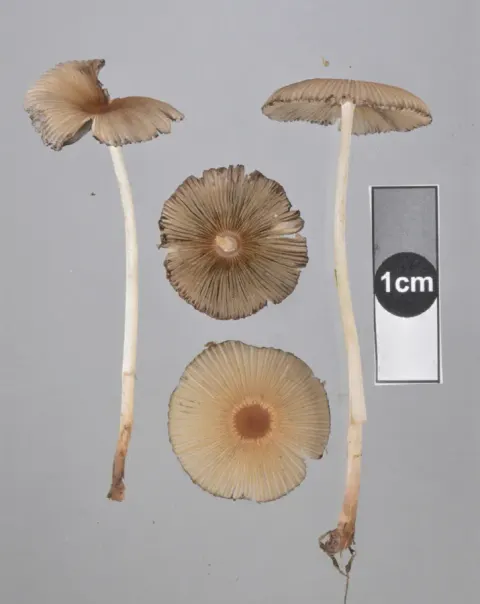
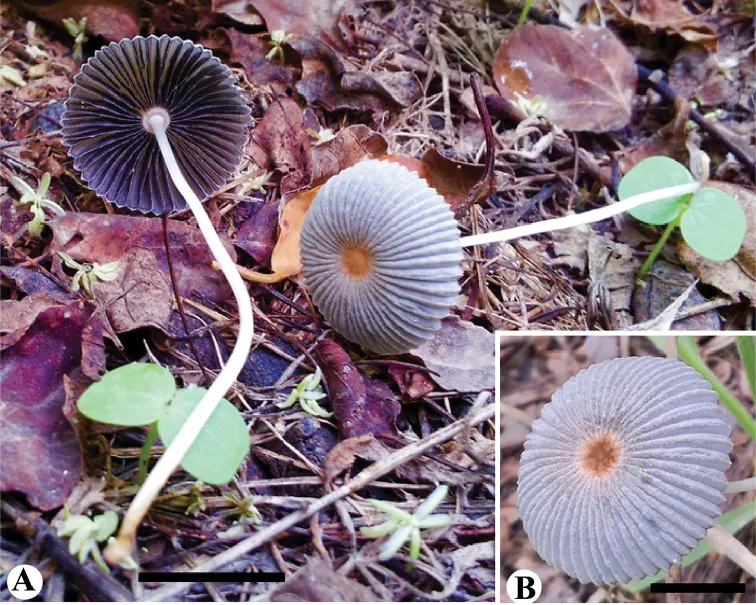
The diagnostic features of Parasola glabra are grayish pileus, deeply plicate towards margin; disc slightly depressed, strong reddish orange; lamellae free, separated from the stipe by pseudocollarium; basidiospores 14.5–16.5 × 9.5–11.5 × 8.0–10.5 µm, in front view broadly ovoid to oblong, some with rhomboidal outline, in side view ellipsoid, with eccentric germ-pore of 1.5 µm diam. Pileus 20–30 mm diam, initially subglobose, later convex to hemispheric; at first smooth, without veil, the center glabrous at maturity, becoming deeply plicate towards the margin; light gray (2.5R 6/2) to moderate gray (7.5R 6/2); disc slightly depressed, strong reddish orange (7.5R 5/12). Lamellae free, fairly crowded, separated from the stipe by pseudocollarium, 0–2 lamellulae, regular, initially whitish, then dark brown becoming black at maturity, finally losing turgor and collapsing. Stipe 30–60 × 2–3 mm, central, equal, smooth, slightly sub-bulbous at the base, hollow, white, fragile, without annulus. Basidiospores (13)14.5–16.5(18) × (7.5)9.5–11.5(15) × (9)8.0–10.5(11.5) µm, on average 15.8 × 10.9 × 10.1 µm, Q 1 = 1.3–1.5, Q 2 = 1.4–1.6, avQ = 1.4; in face view broadly ovoid to oblong, some with rhomboidal outline, in side view ellipsoid, germ-pore eccentric and upto 1.5 µm diam; wall upto 1.5 µm thick, dark brown to blackish in KOH. Basidia 28–41 × 10–13 µm, clavate to cylindrical, 4-spored, hyaline in KOH. Cheilocystidia 50–63 × 17–23 µm, oblong, ellipsoid, narrowly to broadly utriform, hyaline. Pleurocystidia 60–75 × 22–38 µm, clavate to broadly lageniform, hyaline. Pileipellis hymeniform, consisting of clavate cells 47–60 × 13–16 µm, bright yellow at the base in KOH.
Habitat dan peran ekologis
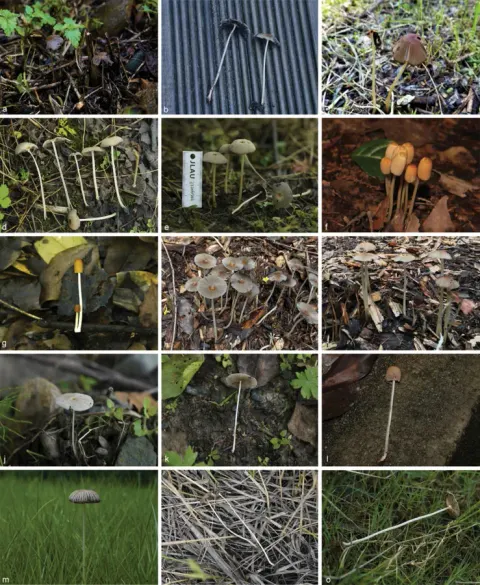
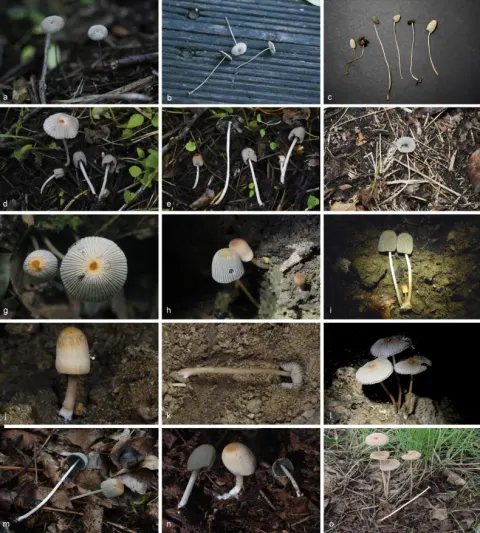
Saprotrophic, scattered under herbaceous plants on grass land. So far only known from the lowland of northern Pakistan. This species is, however, common in lowland northwest Pakistan.
- Habitat atau konteks temuan
- Informasi belum tersedia pada sumber rilis ini.
- Substrat
- Informasi belum tersedia pada sumber rilis ini.
- Peran atau konteks
- Pengurai
Reproduksi
The diagnostic features of Parasola glabra are grayish pileus, deeply plicate towards margin; disc slightly depressed, strong reddish orange; lamellae free, separated from the stipe by pseudocollarium; basidiospores 14.5–16.5 × 9.5–11.5 × 8.0–10.5 µm, in front view broadly ovoid to oblong, some with rhomboidal outline, in side view ellipsoid, with eccentric germ-pore of 1.5 µm diam. Pileus 20–30 mm diam, initially subglobose, later convex to hemispheric; at first smooth, without veil, the center glabrous at maturity, becoming deeply plicate towards the margin; light gray (2.5R 6/2) to moderate gray (7.5R 6/2); disc slightly depressed, strong reddish orange (7.5R 5/12). Lamellae free, fairly crowded, separated from the stipe by pseudocollarium, 0–2 lamellulae, regular, initially whitish, then dark brown becoming black at maturity, finally losing turgor and collapsing.
Catatan identitas dan cakupan
- Nama diterima mengikuti Catalogue of Life Base2026-09-11; uraian mempertahankan konsep dan nama sumber aslinya.
- Preserve original treatment localities, hosts and substrate scope. Materials examined describe documented specimens, not the full global range.
- Impor dan terjemahan otomatis belum diperiksa editorial per profil. Struktur reproduktif yang disebutkan tidak membuktikan seluruh siklus hidup diketahui.
- Pengukuran pada uraian mengikuti spesimen, kultur, dan metode sumber; angka tidak diperluas ke semua populasi.
Catatan distribusi dalam narasi mengikuti sumbernya. Dokumentasi spesimen atau foto mengikuti catatan sumber. Bukti wilayah Indonesia dan penilaian konservasi tidak disimpulkan dari gambar.
Melihat dengan konteks
Basidiomata of Parasola glabra sp. nov. A, B Collection SHP-5 (HOLOTYPE LAH -SHP-5). Scale bars: 20 mm.
- Jenis
- Pelat ilmiah
- Kredit
- Shah Hussain, Habib Ahmad, Sadiq Ullah, Najam-Ul-Sehar Afshan, Donald H. Pfister, Hassan Sher, Haidar Ali, Abdul N. Khalid
- Lisensi
- CC BY 4.0
- Sumber media
- Buka entri sumber
Dokumentasi tambahan
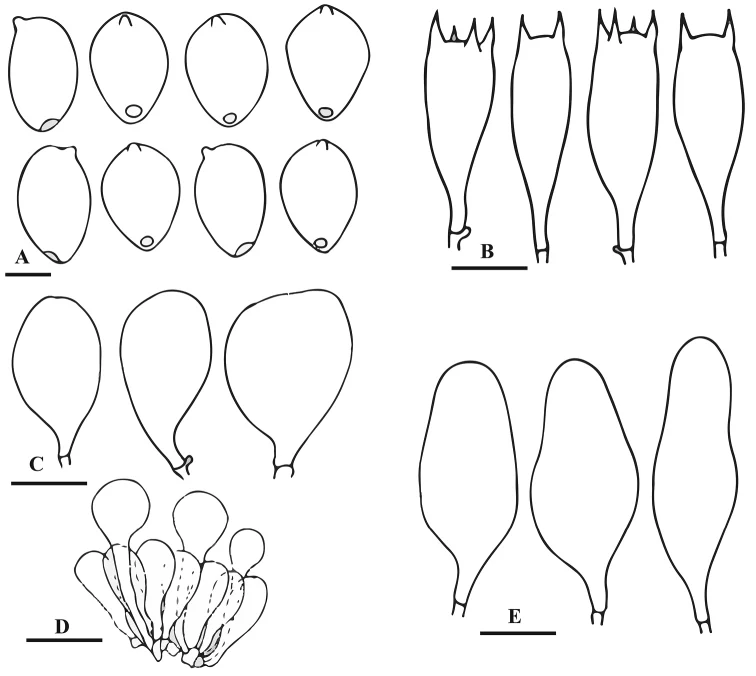
Anatomical features of Parasola glabra sp. nov. (LAH -SHP-5). A Basidiospres B Basidia C Pleurocystidia D Pileipellis E Cheilocystidia. Scale bars: 12 µm (A), 20 µm (B–E).
Kredit dan penggunaan
Shah Hussain, Habib Ahmad, Sadiq Ullah, Najam-Ul-Sehar Afshan, Donald H. Pfister, Hassan Sher, Haidar Ali, Abdul N. Khalid
Ukuran dan format gambar disesuaikan tanpa pemotongan, retus, atau penambahan skala. Lisensi sumber dipertahankan.
Sumber profil
- [1] The genus Parasola in Pakistan with the description of two new species — Parasola glabra
- [2] Catalogue of Life Base2026-09-11 — Parasola glabra
- [3] Dokumentasi visual — Parasola glabra
- [4] Dokumentasi visual — Parasola glabra
Rujukan halaman ini
Fungi. Parasola glabra. Rilis data fungi-2026-10-12-expansion-2. https://fungi-atlas.mgadib.chatgpt.site/jamur/parasola-glabra/.
Status: impor sumber; pemeriksaan editorial per profil belum selesai. Untuk klaim biologis, gunakan rujukan pada bagian terkait dan periksa konteks sumber aslinya.