01 / Morfologi

Ciri dan struktur

Perenniporia corticola and P. dipterocarpicola Hattori & S.S. Lee were described from Malaysia (Corner 1989; Hattori and Lee 1999). Decock (2001a) restudied the types of the two taxa and treated P. dipterocarpicola as a synonym of P. corticola. Perenniporia corticola grows on Dipterocarpus in lowland forests of Southeast Asia (Decock 2001a; Hattori and Lee 1999) and was not phylogenetically analysed. In this study, P. corticola is closely related to P. citrinoalba and P. pseudotephropora. However, P. citrinoalba has larger basidiospores, 5.5–6 ×4.7–5.2 µm (Cui et al. 2019); while basidiospores are 4.6–5(–5.1) × 3.5–4(–4.1) μm in P. corticola (4.4–5 × 3.4–4 μm from the type, Decock 2001a). Perenniporia pseudotephropora differs from P. corticola by resupinate or effused-reflexed to pileate basidiocarps with greyish to pale brown pores, absence of dendrohyphidia and larger basidiospores (4.9–5.2 × 4–4.8 μm vs. 4.6–5 × 3.5–4 μm).

Sebagian uraian ditampilkan dalam bahasa sumber; terjemahannya belum tersedia atau belum lolos pemeriksaan.

Rujukan: [1]

Pengukuran mengikuti objek, spesimen atau kultur, dan metode yang disebutkan sumber. Baca uraian asli untuk konteks lengkap.

02 / Kehidupan

Habitat dan peran ekologis

Perenniporia corticola and P. dipterocarpicola Hattori & S.S. Lee were described from Malaysia (Corner 1989; Hattori and Lee 1999). Decock (2001a) restudied the types of the two taxa and treated P. dipterocarpicola as a synonym of P. corticola. Perenniporia corticola grows on Dipterocarpus in lowland forests of Southeast Asia (Decock 2001a; Hattori and Lee 1999) and was not phylogenetically analysed. In this study, P. corticola is closely related to P. citrinoalba and P. pseudotephropora. However, P. citrinoalba has larger basidiospores, 5.5–6 ×4.7–5.2 µm (Cui et al. 2019); while basidiospores are 4.6–5(–5.1) × 3.5–4(–4.1) μm in P. corticola (4.4–5 × 3.4–4 μm from the type, Decock 2001a). Perenniporia pseudotephropora differs from P. corticola by resupinate or effused-reflexed to pileate basidiocarps with greyish to pale brown pores, absence of dendrohyphidia and larger basidiospores (4.9–5.2 × 4–4.8 μm vs. 4.6–5 × 3.5–4 μm).

Sebagian uraian ditampilkan dalam bahasa sumber; terjemahannya belum tersedia atau belum lolos pemeriksaan.

Rujukan: [1]

Habitat atau konteks temuan
Informasi belum tersedia pada sumber rilis ini.
Substrat
Informasi belum tersedia pada sumber rilis ini.
Peran atau konteks
Belum dikategorikan pada rilis ini.
Temukan hubungan serupa
03 / Siklus hidup

Reproduksi

Perenniporia corticola and P. dipterocarpicola Hattori & S.S. Lee were described from Malaysia (Corner 1989; Hattori and Lee 1999). Decock (2001a) restudied the types of the two taxa and treated P. dipterocarpicola as a synonym of P. corticola. Perenniporia corticola grows on Dipterocarpus in lowland forests of Southeast Asia (Decock 2001a; Hattori and Lee 1999) and was not phylogenetically analysed. In this study, P. corticola is closely related to P. citrinoalba and P. pseudotephropora. However, P. citrinoalba has larger basidiospores, 5.5–6 ×4.7–5.2 µm (Cui et al. 2019); while basidiospores are 4.6–5(–5.1) × 3.5–4(–4.1) μm in P. corticola (4.4–5 × 3.4–4 μm from the type, Decock 2001a). Perenniporia pseudotephropora differs from P. corticola by resupinate or effused-reflexed to pileate basidiocarps with greyish to pale brown pores, absence of dendrohyphidia and larger basidiospores (4.9–5.2 × 4–4.8 μm vs. 4.6–5 × 3.5–4 μm).

Sebagian uraian ditampilkan dalam bahasa sumber; terjemahannya belum tersedia atau belum lolos pemeriksaan.

Rujukan: [1]

Sinonim menurut acuan taksonomi rilis: Perenniporia corticola
04 / Batas informasi

Catatan identitas dan cakupan

  • Nama diterima mengikuti Catalogue of Life Base2026-09-11; uraian mempertahankan konsep dan nama sumber aslinya.
  • Preserve original treatment localities, hosts and substrate scope. Materials examined describe documented specimens, not the full global range.
  • Impor dan terjemahan otomatis belum diperiksa editorial per profil. Struktur reproduktif yang disebutkan tidak membuktikan seluruh siklus hidup diketahui.
  • Pengukuran pada uraian mengikuti spesimen, kultur, dan metode sumber; angka tidak diperluas ke semua populasi.

Catatan distribusi dalam narasi mengikuti sumbernya. Dokumentasi spesimen atau foto mengikuti catatan sumber. Bukti wilayah Indonesia dan penilaian konservasi tidak disimpulkan dari gambar.

05 / Dokumentasi

Melihat dengan konteks

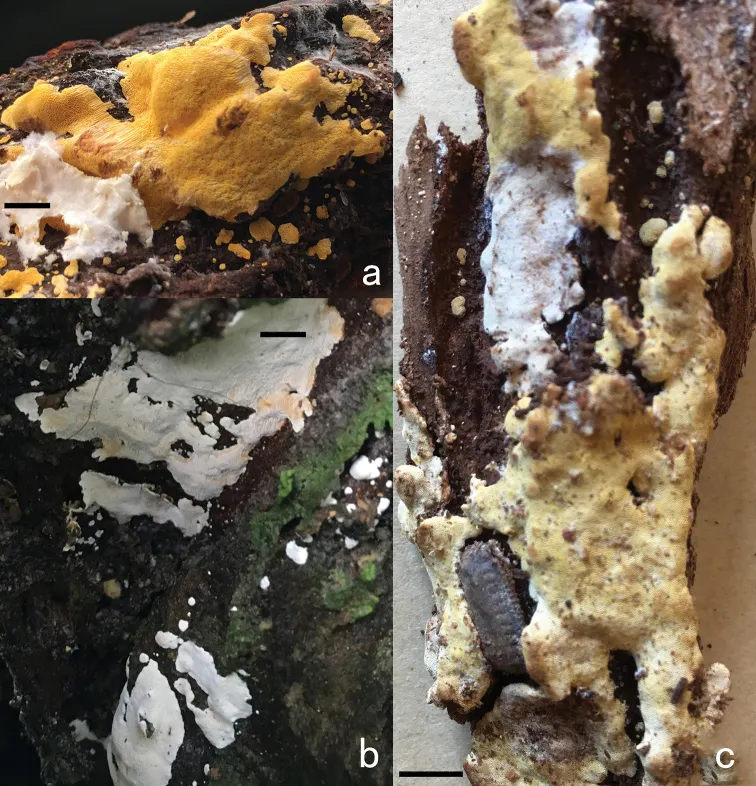
Basidiocarps of Perenniporia corticola a Dai 18641 b Dai 18633 c Dai 17778. Scale bars: 1 cm. Photos by Yu-Cheng Dai.

Jenis
Pelat ilmiah
Kredit
Chao-Ge Wang, Shi-Liang Liu, Fang Wu
Lisensi
CC BY 4.0
Sumber media
Buka entri sumber

Gambar menunjukkan objek menurut identifikasi sumber, bukan verifikasi independen spesimen oleh Fungi. Tidak ada skala baru yang ditambahkan.

06 / Rujukan

Sumber profil

  1. [1] Two new species of Perenniporia (Polyporales, Basidiomycota) — Perenniporia corticolaBagian sumber: PMC7367893_section_26
    Tanggal penghimpunan sumber: 2026-10-12
    Teks sumber: CC BY 4.0 · Wang CG, Liu SL, Wu F.
  2. [2] Catalogue of Life Base2026-09-11 — Parmastomyces corticolaBagian sumber: ColDP NameUsage.tsv ID 4DNFQ; accepted species; source 2073
    Tanggal penghimpunan sumber: 2026-10-12
  3. [3] Dokumentasi visual — Perenniporia corticolaBagian sumber: Individual media record; identification follows the source, not independent determination
    Tanggal penghimpunan sumber: 2026-10-12
    Media sumber: CC BY 4.0 · Chao-Ge Wang, Shi-Liang Liu, Fang Wu

Adaptasi teks: CC BY 4.0. Wang CG, Liu SL, Wu F. — Two new species of Perenniporia (Polyporales, Basidiomycota) — Perenniporia corticola

Uraian asli dan riwayat sumber

Riwayat atau halaman sumber

Ringkasan sumber

Perenniporia corticola and P. dipterocarpicola Hattori & S.S. Lee were described from Malaysia (Corner 1989; Hattori and Lee 1999). Decock (2001a) restudied the types of the two taxa and treated P. dipterocarpicola as a synonym of P. corticola. Perenniporia corticola grows on Dipterocarpus in lowland forests of Southeast Asia (Decock 2001a; Hattori and Lee 1999) and was not phylogenetically analysed. In this study, P. corticola is closely related to P. citrinoalba and P. pseudotephropora. However, P. citrinoalba has larger basidiospores, 5.5–6 ×4.7–5.2 µm (Cui et al. 2019); while basidiospores are 4.6–5(–5.1) × 3.5–4(–4.1) μm in P. corticola (4.4–5 × 3.4–4 μm from the type, Decock 2001a).

Revisi sumber

Morfologi sumber

Perenniporia corticola and P. dipterocarpicola Hattori & S.S. Lee were described from Malaysia (Corner 1989; Hattori and Lee 1999). Decock (2001a) restudied the types of the two taxa and treated P. dipterocarpicola as a synonym of P. corticola. Perenniporia corticola grows on Dipterocarpus in lowland forests of Southeast Asia (Decock 2001a; Hattori and Lee 1999) and was not phylogenetically analysed. In this study, P. corticola is closely related to P. citrinoalba and P. pseudotephropora. However, P. citrinoalba has larger basidiospores, 5.5–6 ×4.7–5.2 µm (Cui et al. 2019); while basidiospores are 4.6–5(–5.1) × 3.5–4(–4.1) μm in P. corticola (4.4–5 × 3.4–4 μm from the type, Decock 2001a). Perenniporia pseudotephropora differs from P. corticola by resupinate or effused-reflexed to pileate basidiocarps with greyish to pale brown pores, absence of dendrohyphidia and larger basidiospores (4.9–5.2 × 4–4.8 μm vs. 4.6–5 × 3.5–4 μm).

Revisi sumber

Ekologi sumber

Perenniporia corticola and P. dipterocarpicola Hattori & S.S. Lee were described from Malaysia (Corner 1989; Hattori and Lee 1999). Decock (2001a) restudied the types of the two taxa and treated P. dipterocarpicola as a synonym of P. corticola. Perenniporia corticola grows on Dipterocarpus in lowland forests of Southeast Asia (Decock 2001a; Hattori and Lee 1999) and was not phylogenetically analysed. In this study, P. corticola is closely related to P. citrinoalba and P. pseudotephropora. However, P. citrinoalba has larger basidiospores, 5.5–6 ×4.7–5.2 µm (Cui et al. 2019); while basidiospores are 4.6–5(–5.1) × 3.5–4(–4.1) μm in P. corticola (4.4–5 × 3.4–4 μm from the type, Decock 2001a). Perenniporia pseudotephropora differs from P. corticola by resupinate or effused-reflexed to pileate basidiocarps with greyish to pale brown pores, absence of dendrohyphidia and larger basidiospores (4.9–5.2 × 4–4.8 μm vs. 4.6–5 × 3.5–4 μm).

Revisi sumber

Struktur reproduksi sumber

Perenniporia corticola and P. dipterocarpicola Hattori & S.S. Lee were described from Malaysia (Corner 1989; Hattori and Lee 1999). Decock (2001a) restudied the types of the two taxa and treated P. dipterocarpicola as a synonym of P. corticola. Perenniporia corticola grows on Dipterocarpus in lowland forests of Southeast Asia (Decock 2001a; Hattori and Lee 1999) and was not phylogenetically analysed. In this study, P. corticola is closely related to P. citrinoalba and P. pseudotephropora. However, P. citrinoalba has larger basidiospores, 5.5–6 ×4.7–5.2 µm (Cui et al. 2019); while basidiospores are 4.6–5(–5.1) × 3.5–4(–4.1) μm in P. corticola (4.4–5 × 3.4–4 μm from the type, Decock 2001a). Perenniporia pseudotephropora differs from P. corticola by resupinate or effused-reflexed to pileate basidiocarps with greyish to pale brown pores, absence of dendrohyphidia and larger basidiospores (4.9–5.2 × 4–4.8 μm vs. 4.6–5 × 3.5–4 μm).

Revisi sumber

Rujukan halaman ini

Fungi. Parmastomyces corticola. Rilis data fungi-2026-10-12-expansion-2. https://fungi-atlas.mgadib.chatgpt.site/jamur/parmastomyces-corticola/.

Status: impor sumber; pemeriksaan editorial per profil belum selesai. Untuk klaim biologis, gunakan rujukan pada bagian terkait dan periksa konteks sumber aslinya.