01 / Morfologi

Ciri dan struktur

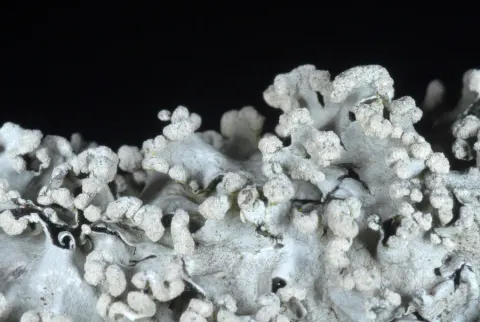
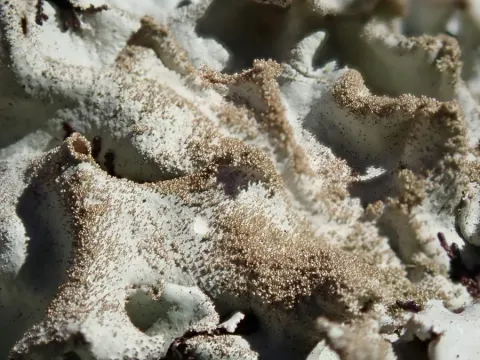
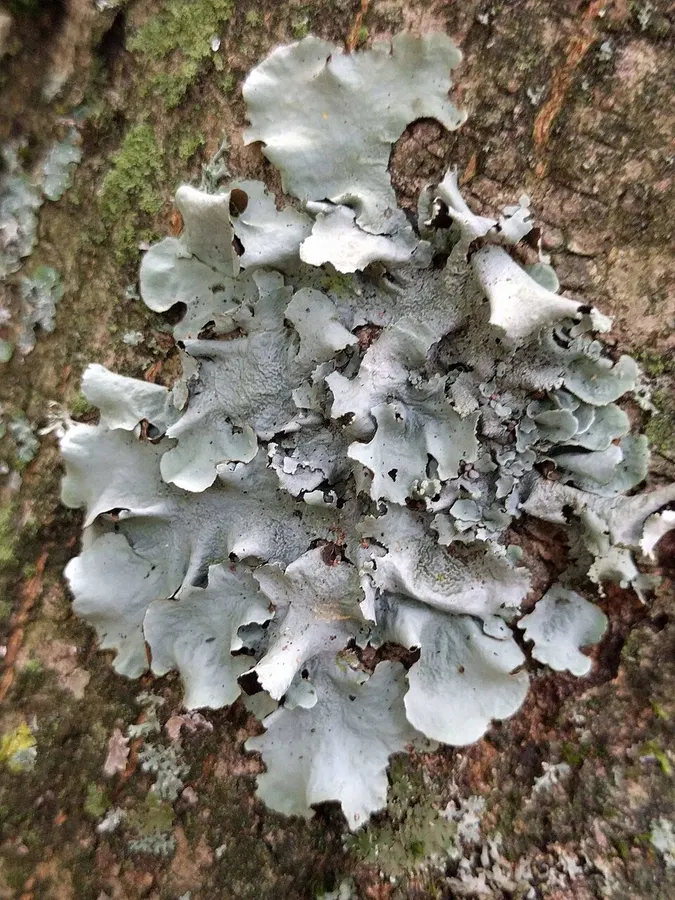
Parmotrema perlatum has a thallus that ranges from loosely to tightly attached to the surface it grows on, forming expansive, spreading colonies that often merge together. Individual thalli typically measure up to 10 – 15 cm in diameter. The upper thallus surface is greenish-grey, blue-grey, or yellowish-grey in colour, lacking and either free of spots (), or with few maculae. This species develops soredia, a type of asexual reproductive structure, aiding in its propagation. The of this lichen vary from 1.5 to 10 mm in width, with a wave-like () or ruffled pattern and overlapping () arrangement. The tips and edges of these lobes are generally smooth and round, sometimes notched () or incised, often curling up or inward, revealing the paler brown to black underside adorned with hair-like structures () up to 2.5 mm in length. Rhizines are common on the underside of the thallus, except for a brown border near the edges. The soredia found in this species are and appear white or may become grey due to wear. They are located within specifically structured groups called soralia, which can be linear to oval in shape, often positioned at the edges of the lobes. The presence of soredia causes the lobe margins to curl back and form soralia. The upper surface of the lichen is typically whitish grey to pale greenish-grey, and can be either smooth or slightly wrinkled, without spots (), featuring scattered, shallow cracks. Isidia are absent in this species. Apothecia (fruiting bodies) are rare in Parmotrema perlatum. When present, they measure 4–8 mm across and are somewhat stalked and funnel-shaped with a brown, concave .

Sebagian uraian ditampilkan dalam bahasa sumber; terjemahannya belum tersedia atau belum lolos pemeriksaan.

Rujukan: [1]

Pengukuran mengikuti objek, spesimen atau kultur, dan metode yang disebutkan sumber. Baca uraian asli untuk konteks lengkap.

02 / Kehidupan

Habitat dan peran ekologis

Parmotrema perlatum biasanya tumbuh di daerah dengan cahaya yang cukup, lebih menyukai pohon berdaun lebar yang netral dan sedikit berkalung asam. Hal ini biasanya ditemukan di batuan dan dinding silik, serta batuan pesisir yang berlumut, umumnya tumbuh di tempat dengan sinar matahari yang sedang hingga kuat. Di Great Smoky Mountains National Park in Amerika Serikat, Parmotrema perlatum sangat banyak di cabang-cabang di habitat lembab dan tinggi. Demikian pula, di Afrika Timur, tumbuh di lingkungan yang berkabut dari gunung-gunung, hutan pegunungan, dan habitat yang didominasi Erica, biasanya ditemukan antara 1400 dan 3100 m di atas permukaan laut. Spesies ini tersebar di seluruh dunia, ditemukan di wilayah tempuh dan tropis. It has been reported across numerous European countries including Austria, Belgium, the Czech Republic, France, Germany, Great Britain, Ireland, Italy, Luxembourg, the Netherlands, Portugal, Scandinavia, Slovakia, Spain, and Ukraine. Although it jarang ditemukan di Eropa Timur, tetapi banyak didistribusikan di kedua negara Rusia Asian and European parts. Selain Eropa, ia juga ada di Makaronesia, Afrika, Australia, Amerika Utara, dan Amerika Selatan. Asian distribution mencakup India, Jepang, Taiwan, dan Korea Selatan.

Sebagian uraian ditampilkan dalam bahasa sumber; terjemahannya belum tersedia atau belum lolos pemeriksaan.

Rujukan: [1]

Habitat atau konteks temuan
hutan
Substrat
kayu
Peran atau konteks
Pembentuk liken
Temukan hubungan serupa
03 / Siklus hidup

Reproduksi

Parmotrema perlatum has a thallus that ranges from loosely to tightly attached to the surface it grows on, forming expansive, spreading colonies that often merge together. Individual thalli typically measure up to 10 – 15 cm in diameter. The upper thallus surface is greenish-grey, blue-grey, or yellowish-grey in colour, lacking and either free of spots (), or with few maculae. This species develops soredia, a type of asexual reproductive structure, aiding in its propagation. The of this lichen vary from 1.5 to 10 mm in width, with a wave-like () or ruffled pattern and overlapping () arrangement. The tips and edges of these lobes are generally smooth and round, sometimes notched () or incised, often curling up or inward, revealing the paler brown to black underside adorned with hair-like structures () up to 2.5 mm in length.

Sebagian uraian ditampilkan dalam bahasa sumber; terjemahannya belum tersedia atau belum lolos pemeriksaan.

Rujukan: [1]

Sinonim menurut acuan taksonomi rilis: Imbricaria ciliata; Imbricaria perlata; Imbricaria perlata var. ciliata; Imbricaria perlata var. innocua; Lobaria perlata; Lobaria perlata var. ciliata; Parmelia coniocarpa; Parmelia crinita var. ciliata; Parmelia perlata; Parmelia perlata f. ciliata; Parmelia perlata subsp. ciliata; Parmelia perlata subvar. ciliata; Parmelia perlata var. ciliata; Parmelia perlata var. innocua; Parmelia perlata var. trichotera; Parmelia trichotera; Parmelia trichotera f. ciliata; Parmelia urceolata f. ciliata; Parmotrema perlatum var. ciliatum; Parmotrema trichoterum; Platisma perlatum; Platysma perlatum
04 / Batas informasi

Catatan identitas dan cakupan

  • Nama diterima mengikuti Catalogue of Life Base2026-09-11; uraian mempertahankan konsep dan nama sumber aslinya.
  • Original geographic, specimen and life-cycle scope retained; source import awaits individual editorial review.
  • Impor dan terjemahan otomatis belum diperiksa editorial per profil. Struktur reproduktif yang disebutkan tidak membuktikan seluruh siklus hidup diketahui.
  • Pengukuran pada uraian mengikuti spesimen, kultur, dan metode sumber; angka tidak diperluas ke semua populasi.

Catatan distribusi dalam narasi mengikuti sumbernya. Dokumentasi spesimen atau foto mengikuti catatan sumber. Bukti wilayah Indonesia dan penilaian konservasi tidak disimpulkan dari gambar.

05 / Dokumentasi

Melihat dengan konteks

Dokumentasi Parmotrema perlatum dari Wikimedia Commons. Black Stone Flower ( Parmotrema perlatum ) Identifikasi mengikuti record berkas sumber.

Jenis
Fotografi
Kredit
Michel Langeveld
Sumber media
Buka entri sumber

Gambar menunjukkan objek menurut identifikasi sumber, bukan verifikasi independen spesimen oleh Fungi. Tidak ada skala baru yang ditambahkan.

06 / Rujukan

Sumber profil

  1. [1] Parmotrema perlatum — Wikipedia (en)Bagian sumber: Frozen revision 1353398793
    Tanggal penghimpunan sumber: 2026-10-12
    Teks sumber: CC BY-SA4.0 · Wikipedia contributors
  2. [2] Catalogue of Life Base2026-09-11 — Parmotrema perlatumBagian sumber: ColDP NameUsage.tsv ID 6TRBX; accepted species; source 2073
    Tanggal penghimpunan sumber: 2026-10-12
  3. [3] Dokumentasi visual — Parmotrema perlatumBagian sumber: Individual media record; identification follows the source, not independent determination
    Tanggal penghimpunan sumber: 2026-10-12
    Media sumber: CC BY-SA 4.0 · Michel Langeveld

Adaptasi teks: CC BY-SA 4.0. Wikipedia contributors — Parmotrema perlatum — Wikipedia (en)

Uraian asli dan riwayat sumber

Riwayat atau halaman sumber

Ringkasan sumber

Parmotrema perlatum, commonly known as the powdered ruffle lichen, is a common species of foliose lichen in the family Parmeliaceae. The species has a cosmopolitan distribution and occurs throughout the Northern and Southern Hemispheres. Parmotrema perlatum is a prominent and widely recognised species within its genus across primarily temperate zones, preferring humid, oceanic-suboceanic habitats. It is found in diverse geographic areas including Africa, North and South America, Asia, Australasia, Europe, and islands in the Atlantic and Pacific oceans.

Revisi sumber

Morfologi sumber

Parmotrema perlatum has a thallus that ranges from loosely to tightly attached to the surface it grows on, forming expansive, spreading colonies that often merge together. Individual thalli typically measure up to 10 – 15 cm in diameter. The upper thallus surface is greenish-grey, blue-grey, or yellowish-grey in colour, lacking and either free of spots (), or with few maculae. This species develops soredia, a type of asexual reproductive structure, aiding in its propagation. The of this lichen vary from 1.5 to 10 mm in width, with a wave-like () or ruffled pattern and overlapping () arrangement. The tips and edges of these lobes are generally smooth and round, sometimes notched () or incised, often curling up or inward, revealing the paler brown to black underside adorned with hair-like structures () up to 2.5 mm in length. Rhizines are common on the underside of the thallus, except for a brown border near the edges. The soredia found in this species are and appear white or may become grey due to wear. They are located within specifically structured groups called soralia, which can be linear to oval in shape, often positioned at the edges of the lobes. The presence of soredia causes the lobe margins to curl back and form soralia. The upper surface of the lichen is typically whitish grey to pale greenish-grey, and can be either smooth or slightly wrinkled, without spots (), featuring scattered, shallow cracks. Isidia are absent in this species. Apothecia (fruiting bodies) are rare in Parmotrema perlatum. When present, they measure 4–8 mm across and are somewhat stalked and funnel-shaped with a brown, concave .

Revisi sumber

Ekologi sumber

Parmotrema perlatum typically grows in areas with ample light, favouring neutral to slightly acidic-barked broad-leaved trees. It is commonly found on siliceous rocks and walls, as well as mossy coastal rocks, generally growing in places with moderate to strong sunlight. In the Great Smoky Mountains National Park in the United States, Parmotrema perlatum is especially abundant on branches in humid, high-elevation habitats. Similarly, in East Africa, it grows in the misty environments of inselbergs, montane forests, and Erica-dominated habitats, typically found between 1400 and 3100 m above sea level. The species is globally distributed, found in both temperate and tropical regions. It has been reported across numerous European countries including Austria, Belgium, the Czech Republic, France, Germany, Great Britain, Ireland, Italy, Luxembourg, the Netherlands, Portugal, Scandinavia, Slovakia, Spain, and Ukraine. Although it is rare in Eastern Europe, it is widely distributed in both the Asian and European parts of Russia. Beyond Europe, it is also present in Macaronesia, Africa, Australia, North America, and South America. Its Asian distribution includes India, Japan, Taiwan, and South Korea.

Revisi sumber

Struktur reproduksi sumber

Parmotrema perlatum has a thallus that ranges from loosely to tightly attached to the surface it grows on, forming expansive, spreading colonies that often merge together. Individual thalli typically measure up to 10 – 15 cm in diameter. The upper thallus surface is greenish-grey, blue-grey, or yellowish-grey in colour, lacking and either free of spots (), or with few maculae. This species develops soredia, a type of asexual reproductive structure, aiding in its propagation. The of this lichen vary from 1.5 to 10 mm in width, with a wave-like () or ruffled pattern and overlapping () arrangement. The tips and edges of these lobes are generally smooth and round, sometimes notched () or incised, often curling up or inward, revealing the paler brown to black underside adorned with hair-like structures () up to 2.5 mm in length.

Revisi sumber

Rujukan halaman ini

Fungi. Parmotrema perlatum. Rilis data fungi-2026-10-12-expansion-2. https://fungi-atlas.mgadib.chatgpt.site/jamur/parmotrema-perlatum/.

Status: impor sumber; pemeriksaan editorial per profil belum selesai. Untuk klaim biologis, gunakan rujukan pada bagian terkait dan periksa konteks sumber aslinya.