01 / Morfologi

Ciri dan struktur

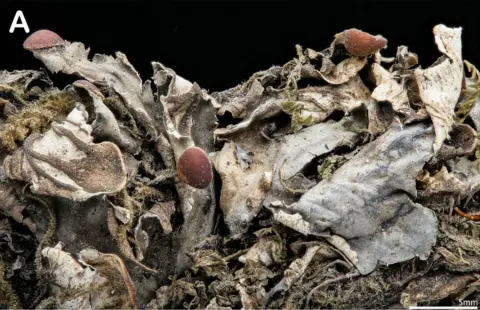
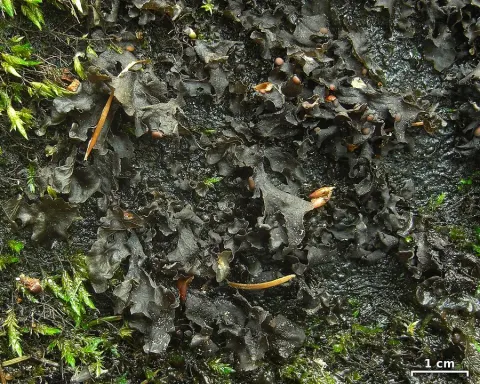
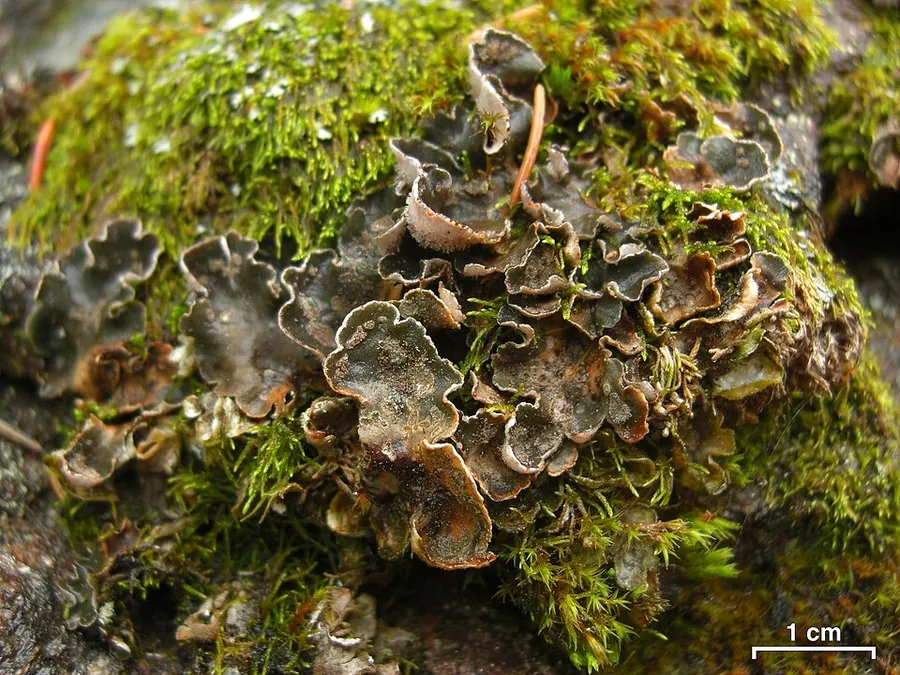
Peltigera castanea can be differentiated from other species within its genus by several distinctive features of its thallus, a term which refers to the body of the lichen. The thallus of Peltigera castanea is foliose, meaning it is leaf-like and loosely attached to its , covering areas up to 6 – 8 cm across, although individuals up to 30 cm have been recorded. The individual comprising the thallus are stiff, fragile, and not much longer than they are wide, with a strong concavity or sometimes flat appearance, featuring loosely overlapping and irregularly branched patterns. They are generally 1.5 – 3 cm in diameter. The tips of the lobes are rounded and tend to curl upwards. The upper surface of the thallus is notable for its dark chestnut-brown colour, which becomes a pale bluish grey when sheltered. The surface is more or less shiny and smooth except for being tomentose (covered with short, soft hairs) near the lobe tips. This surface is also characterised by the presence of soredia—granular reproductive structures that help in vegetative reproduction—found in rounded to irregularly shaped soralia (structures that house the soredia). The lower surface of the lichen is densely , gradually shifting from white at the edges to brown or black near the centre. The rhizines (root-like structures underneath the lichen) are abundant, tufted, and become flocculent (woolly) towards the centre of the thallus, matching the colour of the veins. They are up to about 1 cm long, and although usually unbranched, they are often split at the tips. In contrast, closely related species such as Peltigera praetextata have a smoother, more uniformly grey thallus with less prominent veining on the lower surface and a lack of strong colour contrast.

Sebagian uraian ditampilkan dalam bahasa sumber; terjemahannya belum tersedia atau belum lolos pemeriksaan.

Rujukan: [1]

Pengukuran mengikuti objek, spesimen atau kultur, dan metode yang disebutkan sumber. Baca uraian asli untuk konteks lengkap.

02 / Kehidupan

Habitat dan peran ekologis

Peltigera castanea predominantly inhabits mountainous forests and alpine heaths, typically growing in open, south-facing outcrops with ideal microclimate conditions. It is often found growing on xerophytic moss mats, suggesting an affinity for drier, well-drained habitats. It has also been recorded growing directly on soil, rotten logs, or on soil or moss on top of rock. In Estonian alvar communities, it is commonly found with mosses such as Abietinella abietina, Bryum argentatum, Ceratodon purpureus, and Tortula ruralis, sharing its habitat with several rare, ground-dwelling lichens of arcto-alpine distribution. Originally known only from northwestern North America, Peltigera castaneas range includes terricolous and muscicolous growth on rock outcrops from Alaska's Chilkoot Trail to Glacier Bay, extending east to the Yukon and south to Alberta's Rocky Mountains. It tends to become rare in the southern parts of its North American distribution. Subsequent research has revealed its presence as far northeast as Greenland and even the Antarctic Peninsula, marking the species' adaptability to a wide range of cold environments. It also occurs in Russia and Estonia. In 2023, the species was documented in Mount Xiaowutai, Hebei, China, and its 2020 discovery on James Ross Island in the Antarctic Peninsula marked the first record of the lichen in the Southern Hemisphere.

Sebagian uraian ditampilkan dalam bahasa sumber; terjemahannya belum tersedia atau belum lolos pemeriksaan.

Rujukan: [1]

Habitat atau konteks temuan
hutan
Substrat
tanah
Peran atau konteks
Pembentuk liken
Temukan hubungan serupa
03 / Siklus hidup

Reproduksi

The upper surface of the thallus is notable for its dark chestnut-brown colour, which becomes a pale bluish grey when sheltered. The surface is more or less shiny and smooth except for being tomentose (covered with short, soft hairs) near the lobe tips. This surface is also characterised by the presence of soredia—granular reproductive structures that help in vegetative reproduction—found in rounded to irregularly shaped soralia (structures that house the soredia). The absence of apothecia (fruiting bodies) and the presence of frequent, marginal pycnidia (structures that produce asexual spores) containing ellipsoid (asexual spores) further help in distinguishing Peltigera castanea from its congeners.

Sebagian uraian ditampilkan dalam bahasa sumber; terjemahannya belum tersedia atau belum lolos pemeriksaan.

Rujukan: [1]

04 / Batas informasi

Catatan identitas dan cakupan

  • Nama diterima mengikuti Catalogue of Life Base2026-09-11; uraian mempertahankan konsep dan nama sumber aslinya.
  • Original geographic, specimen and life-cycle scope retained; source import awaits individual editorial review.
  • Impor dan terjemahan otomatis belum diperiksa editorial per profil. Struktur reproduktif yang disebutkan tidak membuktikan seluruh siklus hidup diketahui.
  • Pengukuran pada uraian mengikuti spesimen, kultur, dan metode sumber; angka tidak diperluas ke semua populasi.

Catatan distribusi dalam narasi mengikuti sumbernya. Dokumentasi spesimen atau foto mengikuti catatan sumber. Bukti wilayah Indonesia dan penilaian konservasi tidak disimpulkan dari gambar.

05 / Dokumentasi

Melihat dengan konteks

Dokumentasi Peltigera castanea dari Wikimedia Commons. For more information about this, see the observation page at Mushroom Observer. Identifikasi mengikuti record berkas sumber.

Jenis
Fotografi
Kredit
This image was created by user Jason Hollinger (jason) at Mushroom Observer , a source for mycological images. You can contact this user here .
Sumber media
Buka entri sumber

Gambar menunjukkan objek menurut identifikasi sumber, bukan verifikasi independen spesimen oleh Fungi. Tidak ada skala baru yang ditambahkan.

06 / Rujukan

Sumber profil

  1. [1] Peltigera castanea — Wikipedia (en)Bagian sumber: Frozen revision 1374839858
    Tanggal penghimpunan sumber: 2026-10-12
    Teks sumber: CC BY-SA4.0 · Wikipedia contributors
  2. [2] Catalogue of Life Base2026-09-11 — Peltigera castaneaBagian sumber: ColDP NameUsage.tsv ID 76F8X; accepted species; source 2073
    Tanggal penghimpunan sumber: 2026-10-12
  3. [3] Dokumentasi visual — Peltigera castaneaBagian sumber: Individual media record; identification follows the source, not independent determination
    Tanggal penghimpunan sumber: 2026-10-12
    Media sumber: CC BY-SA 3.0 · This image was created by user Jason Hollinger (jason) at Mushroom Observer , a source for mycological images. You can contact this user here .

Adaptasi teks: CC BY-SA 4.0. Wikipedia contributors — Peltigera castanea — Wikipedia (en)

Uraian asli dan riwayat sumber

Riwayat atau halaman sumber

Ringkasan sumber

Peltigera castanea is a species of terricolous and muscicolous (ground- and moss-dwelling), foliose lichen in the family Peltigeraceae. Described as a new species in 2003, it is part of the taxonomically challenging species complex centred around Peltigera didactyla. Recognised based on phylogenetic studies that highlighted its unique genetic markers, P. castanea is distinguished by its dark, chestnut-coloured upper surface, which inspired its vernacular name, chestnut pelt lichen. Its known distribution includes North America (British Columbia, Western Canada), Asia (China and Siberia), Europe (Estonia), Greenland, and the Antarctic.

Revisi sumber

Morfologi sumber

Peltigera castanea can be differentiated from other species within its genus by several distinctive features of its thallus, a term which refers to the body of the lichen. The thallus of Peltigera castanea is foliose, meaning it is leaf-like and loosely attached to its , covering areas up to 6 – 8 cm across, although individuals up to 30 cm have been recorded. The individual comprising the thallus are stiff, fragile, and not much longer than they are wide, with a strong concavity or sometimes flat appearance, featuring loosely overlapping and irregularly branched patterns. They are generally 1.5 – 3 cm in diameter. The tips of the lobes are rounded and tend to curl upwards. The upper surface of the thallus is notable for its dark chestnut-brown colour, which becomes a pale bluish grey when sheltered. The surface is more or less shiny and smooth except for being tomentose (covered with short, soft hairs) near the lobe tips. This surface is also characterised by the presence of soredia—granular reproductive structures that help in vegetative reproduction—found in rounded to irregularly shaped soralia (structures that house the soredia). The lower surface of the lichen is densely , gradually shifting from white at the edges to brown or black near the centre. The rhizines (root-like structures underneath the lichen) are abundant, tufted, and become flocculent (woolly) towards the centre of the thallus, matching the colour of the veins. They are up to about 1 cm long, and although usually unbranched, they are often split at the tips. In contrast, closely related species such as Peltigera praetextata have a smoother, more uniformly grey thallus with less prominent veining on the lower surface and a lack of strong colour contrast.

Revisi sumber

Ekologi sumber

Peltigera castanea predominantly inhabits mountainous forests and alpine heaths, typically growing in open, south-facing outcrops with ideal microclimate conditions. It is often found growing on xerophytic moss mats, suggesting an affinity for drier, well-drained habitats. It has also been recorded growing directly on soil, rotten logs, or on soil or moss on top of rock. In Estonian alvar communities, it is commonly found with mosses such as Abietinella abietina, Bryum argentatum, Ceratodon purpureus, and Tortula ruralis, sharing its habitat with several rare, ground-dwelling lichens of arcto-alpine distribution. Originally known only from northwestern North America, Peltigera castaneas range includes terricolous and muscicolous growth on rock outcrops from Alaska's Chilkoot Trail to Glacier Bay, extending east to the Yukon and south to Alberta's Rocky Mountains. It tends to become rare in the southern parts of its North American distribution. Subsequent research has revealed its presence as far northeast as Greenland and even the Antarctic Peninsula, marking the species' adaptability to a wide range of cold environments. It also occurs in Russia and Estonia. In 2023, the species was documented in Mount Xiaowutai, Hebei, China, and its 2020 discovery on James Ross Island in the Antarctic Peninsula marked the first record of the lichen in the Southern Hemisphere.

Revisi sumber

Struktur reproduksi sumber

The upper surface of the thallus is notable for its dark chestnut-brown colour, which becomes a pale bluish grey when sheltered. The surface is more or less shiny and smooth except for being tomentose (covered with short, soft hairs) near the lobe tips. This surface is also characterised by the presence of soredia—granular reproductive structures that help in vegetative reproduction—found in rounded to irregularly shaped soralia (structures that house the soredia). The absence of apothecia (fruiting bodies) and the presence of frequent, marginal pycnidia (structures that produce asexual spores) containing ellipsoid (asexual spores) further help in distinguishing Peltigera castanea from its congeners.

Revisi sumber

Rujukan halaman ini

Fungi. Peltigera castanea. Rilis data fungi-2026-10-12-expansion-2. https://fungi-atlas.mgadib.chatgpt.site/jamur/peltigera-castanea/.

Status: impor sumber; pemeriksaan editorial per profil belum selesai. Untuk klaim biologis, gunakan rujukan pada bagian terkait dan periksa konteks sumber aslinya.