01 / Morfologi

Ciri dan struktur

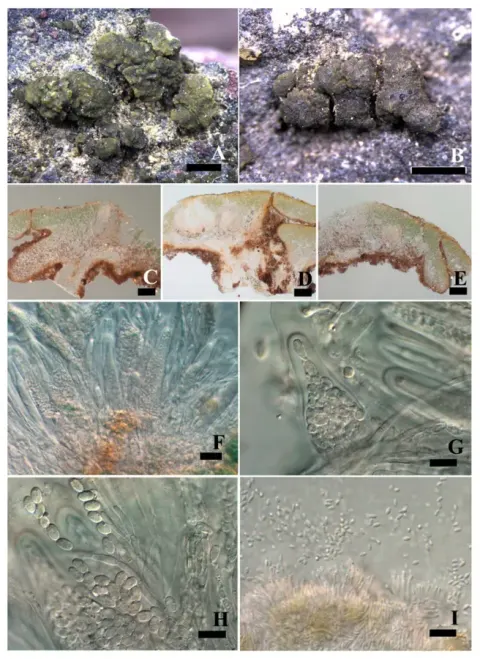
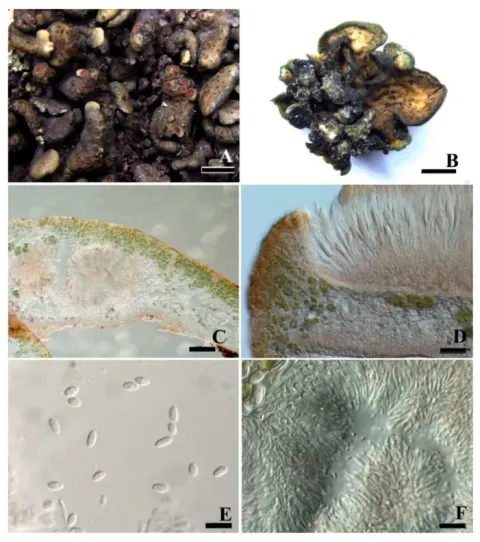
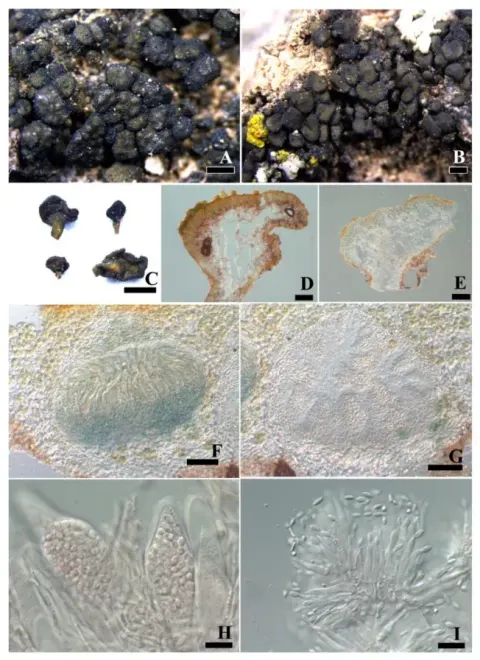
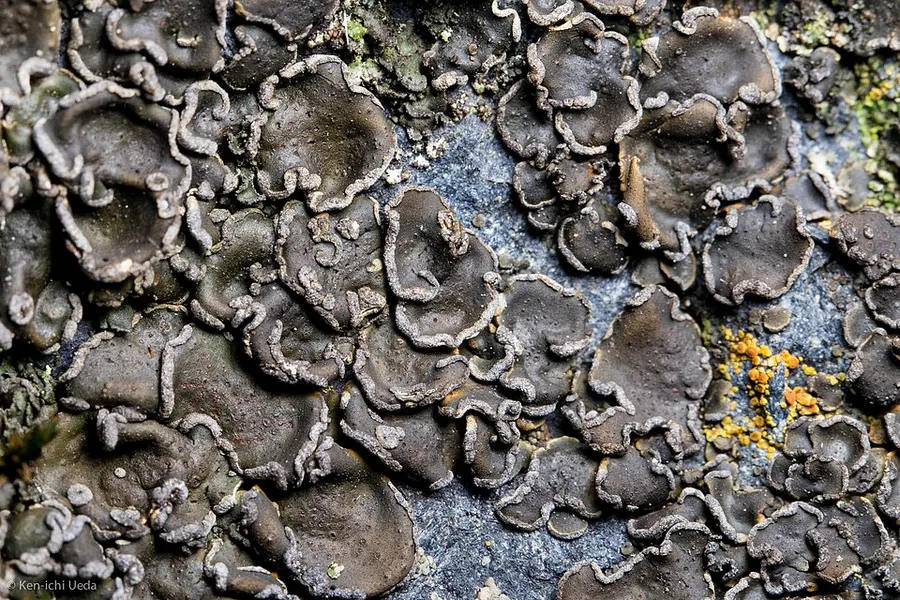
Peltula euploca is a squamulose cyanolichen with a distinctive (shield-like) thallus. Individual peltate are usually only a few millimetres across but can reach about 12 mm in diameter in well-developed material. The upper surface is dull to slightly shiny olive to olive-brown when moist, becoming darker and browner when dry, and the margins are often bent downwards or somewhat . The squamule edges carry bluish-grey (floury) soralia that are normally on the margins but can extend onto the upper surface; the resulting soredia are the main means of vegetative reproduction, as apothecia are infrequent. The lower surface is paler and lacks rhizines, and the thallus is attached at a single central (a holdfast) that anchors it tightly to the rock. Its apothecia (sexual fruiting structures) are rarely seen. When present, they appear as tiny immersed in the thallus surface. The discs are reddish, brown, or black. Inside each apothecium, the asci are club-shaped and polysporous – containing dozens of ascospores (typically 32 to over 100 per ascus, rather than the usual 8). The ascospores are hyaline, ellipsoid to rod-shaped, about 6–9 micrometres (μm) long by 3–5 μm wide. P. euploca also has tiny pycnidia (asexual spore-producing structures) immersed in the thallus; these produce slender fusiform (spindle-shaped) conidia about 3 × 1 μm. In cross-section, P. euploca has a thin upper of dead cells but no true upper . Beneath this is a distinct (about 70–150 μm thick) containing a zone of unicellular cyanobacteria, and a medulla with loosely woven hyphae and many air spaces. A well-developed lower cortex (18–90 μm thick) of tissue is present on the underside, except at the central attaching point.

Sebagian uraian ditampilkan dalam bahasa sumber; terjemahannya belum tersedia atau belum lolos pemeriksaan.

Rujukan: [1]

Pengukuran mengikuti objek, spesimen atau kultur, dan metode yang disebutkan sumber. Baca uraian asli untuk konteks lengkap.

02 / Kehidupan

Habitat dan peran ekologis

Peltula euploca is an arid-land saxicolous lichen that grows on rock surfaces. It grows on acidic rocks and only rarely on calcareous substrates. The typical habitat is open, dry terrain – for example, sun-exposed boulders and outcrops in deserts, semi-deserts, and other sparsely vegetated areas. In the American Southwest, it occurs on non-calcareous rock in extremely dry sites, but it can also occupy somewhat shaded or intermittently damp microhabitats such as canyon walls that remain arid most of the time. In the Upper Douro valley of north-east Portugal, P. euploca is common on vertical schist outcrops in hot, dry Mediterranean river gorges, where summer temperatures can approach 50 °C and annual rainfall is often below 300 mm. There it colonises almost all sheltered to fully exposed schist faces and is a dominant species in siliceous "rain-track" lichen communities on seepage tracks of the rock walls. In the Côa Valley (Portugal) it forms widespread squamulose populations on vertical schist surfaces. With a cosmopolitan distribution, Peltula euploca is the most widespread species of Peltula: it has been recorded from all continents except Antarctica and is especially common in subtropical and tropical arid regions.

Sebagian uraian ditampilkan dalam bahasa sumber; terjemahannya belum tersedia atau belum lolos pemeriksaan.

Rujukan: [1]

Habitat atau konteks temuan
Informasi belum tersedia pada sumber rilis ini.
Substrat
Informasi belum tersedia pada sumber rilis ini.
Peran atau konteks
Pembentuk liken
Temukan hubungan serupa
03 / Siklus hidup

Reproduksi

Peltula euploca is a squamulose cyanolichen with a distinctive (shield-like) thallus. Individual peltate are usually only a few millimetres across but can reach about 12 mm in diameter in well-developed material. The upper surface is dull to slightly shiny olive to olive-brown when moist, becoming darker and browner when dry, and the margins are often bent downwards or somewhat . The squamule edges carry bluish-grey (floury) soralia that are normally on the margins but can extend onto the upper surface; the resulting soredia are the main means of vegetative reproduction, as apothecia are infrequent. The lower surface is paler and lacks rhizines, and the thallus is attached at a single central (a holdfast) that anchors it tightly to the rock.

Sebagian uraian ditampilkan dalam bahasa sumber; terjemahannya belum tersedia atau belum lolos pemeriksaan.

Rujukan: [1]

Sinonim menurut acuan taksonomi rilis: Endocarpon euplocum; Endocarpon fluviatile var. euplocum; Endocarpon miniatum f. euplocum; Endocarpon miniatum var. euplocum; Heppia euploca; Lichen euplocus; Lichen hepaticus euplocum; Verrucaria euploca
04 / Batas informasi

Catatan identitas dan cakupan

  • Nama diterima mengikuti Catalogue of Life Base2026-09-11; uraian mempertahankan konsep dan nama sumber aslinya.
  • Original geographic, specimen and life-cycle scope retained; source import awaits individual editorial review.
  • Impor dan terjemahan otomatis belum diperiksa editorial per profil. Struktur reproduktif yang disebutkan tidak membuktikan seluruh siklus hidup diketahui.
  • Pengukuran pada uraian mengikuti spesimen, kultur, dan metode sumber; angka tidak diperluas ke semua populasi.

Catatan distribusi dalam narasi mengikuti sumbernya. Dokumentasi spesimen atau foto mengikuti catatan sumber. Bukti wilayah Indonesia dan penilaian konservasi tidak disimpulkan dari gambar.

05 / Dokumentasi

Melihat dengan konteks

Dokumentasi Peltula euploca dari Wikimedia Commons. Peltula euploca Identifikasi mengikuti record berkas sumber.

Jenis
Fotografi
Kredit
Ken-ichi Ueda
Lisensi
CC BY 4.0
Sumber media
Buka entri sumber

Gambar menunjukkan objek menurut identifikasi sumber, bukan verifikasi independen spesimen oleh Fungi. Tidak ada skala baru yang ditambahkan.

06 / Rujukan

Sumber profil

  1. [1] Peltula euploca — Wikipedia (en)Bagian sumber: Frozen revision 1348861517
    Tanggal penghimpunan sumber: 2026-10-12
    Teks sumber: CC BY-SA4.0 · Wikipedia contributors
  2. [2] Catalogue of Life Base2026-09-11 — Peltula euplocaBagian sumber: ColDP NameUsage.tsv ID 76FZV; accepted species; source 2073
    Tanggal penghimpunan sumber: 2026-10-12
  3. [3] Dokumentasi visual — Peltula euplocaBagian sumber: Individual media record; identification follows the source, not independent determination
    Tanggal penghimpunan sumber: 2026-10-12
    Media sumber: CC BY 4.0 · Ken-ichi Ueda

Adaptasi teks: CC BY-SA 4.0. Wikipedia contributors — Peltula euploca — Wikipedia (en)

Uraian asli dan riwayat sumber

Riwayat atau halaman sumber

Ringkasan sumber

Peltula euploca, the powdery rock-olive, is a species of lichen-forming fungus in the family Peltulaceae. First described in 1799 by the Swedish lichenologist Erik Acharius, the species was later transferred through several genera before molecular studies confirmed its placement in Peltula, the sole genus in Peltulaceae. Its overall appearance is that of a powdery-edged, olive-green rosette closely pressed to the substrate. In dry conditions it often becomes dull and brownish but can quickly rehydrate and turn green when moistened.

Revisi sumber

Morfologi sumber

Peltula euploca is a squamulose cyanolichen with a distinctive (shield-like) thallus. Individual peltate are usually only a few millimetres across but can reach about 12 mm in diameter in well-developed material. The upper surface is dull to slightly shiny olive to olive-brown when moist, becoming darker and browner when dry, and the margins are often bent downwards or somewhat . The squamule edges carry bluish-grey (floury) soralia that are normally on the margins but can extend onto the upper surface; the resulting soredia are the main means of vegetative reproduction, as apothecia are infrequent. The lower surface is paler and lacks rhizines, and the thallus is attached at a single central (a holdfast) that anchors it tightly to the rock. Its apothecia (sexual fruiting structures) are rarely seen. When present, they appear as tiny immersed in the thallus surface. The discs are reddish, brown, or black. Inside each apothecium, the asci are club-shaped and polysporous – containing dozens of ascospores (typically 32 to over 100 per ascus, rather than the usual 8). The ascospores are hyaline, ellipsoid to rod-shaped, about 6–9 micrometres (μm) long by 3–5 μm wide. P. euploca also has tiny pycnidia (asexual spore-producing structures) immersed in the thallus; these produce slender fusiform (spindle-shaped) conidia about 3 × 1 μm. In cross-section, P. euploca has a thin upper of dead cells but no true upper . Beneath this is a distinct (about 70–150 μm thick) containing a zone of unicellular cyanobacteria, and a medulla with loosely woven hyphae and many air spaces. A well-developed lower cortex (18–90 μm thick) of tissue is present on the underside, except at the central attaching point.

Revisi sumber

Ekologi sumber

Peltula euploca is an arid-land saxicolous lichen that grows on rock surfaces. It grows on acidic rocks and only rarely on calcareous substrates. The typical habitat is open, dry terrain – for example, sun-exposed boulders and outcrops in deserts, semi-deserts, and other sparsely vegetated areas. In the American Southwest, it occurs on non-calcareous rock in extremely dry sites, but it can also occupy somewhat shaded or intermittently damp microhabitats such as canyon walls that remain arid most of the time. In the Upper Douro valley of north-east Portugal, P. euploca is common on vertical schist outcrops in hot, dry Mediterranean river gorges, where summer temperatures can approach 50 °C and annual rainfall is often below 300 mm. There it colonises almost all sheltered to fully exposed schist faces and is a dominant species in siliceous "rain-track" lichen communities on seepage tracks of the rock walls. In the Côa Valley (Portugal) it forms widespread squamulose populations on vertical schist surfaces. With a cosmopolitan distribution, Peltula euploca is the most widespread species of Peltula: it has been recorded from all continents except Antarctica and is especially common in subtropical and tropical arid regions.

Revisi sumber

Struktur reproduksi sumber

Peltula euploca is a squamulose cyanolichen with a distinctive (shield-like) thallus. Individual peltate are usually only a few millimetres across but can reach about 12 mm in diameter in well-developed material. The upper surface is dull to slightly shiny olive to olive-brown when moist, becoming darker and browner when dry, and the margins are often bent downwards or somewhat . The squamule edges carry bluish-grey (floury) soralia that are normally on the margins but can extend onto the upper surface; the resulting soredia are the main means of vegetative reproduction, as apothecia are infrequent. The lower surface is paler and lacks rhizines, and the thallus is attached at a single central (a holdfast) that anchors it tightly to the rock.

Revisi sumber

Rujukan halaman ini

Fungi. Peltula euploca. Rilis data fungi-2026-10-12-expansion-2. https://fungi-atlas.mgadib.chatgpt.site/jamur/peltula-euploca/.

Status: impor sumber; pemeriksaan editorial per profil belum selesai. Untuk klaim biologis, gunakan rujukan pada bagian terkait dan periksa konteks sumber aslinya.