01 / Morfologi

Ciri dan struktur

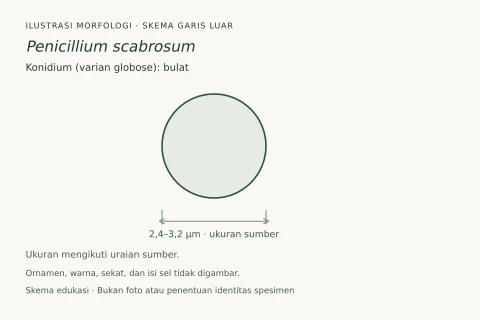
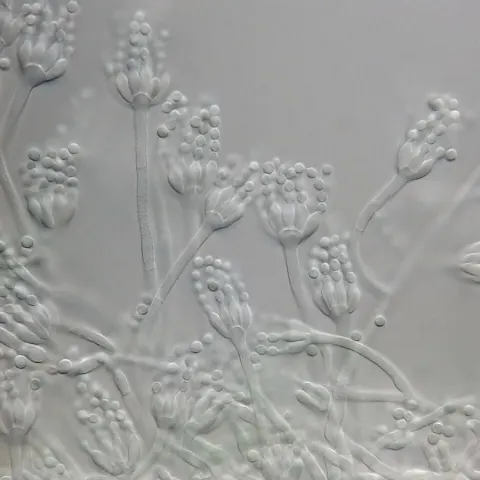
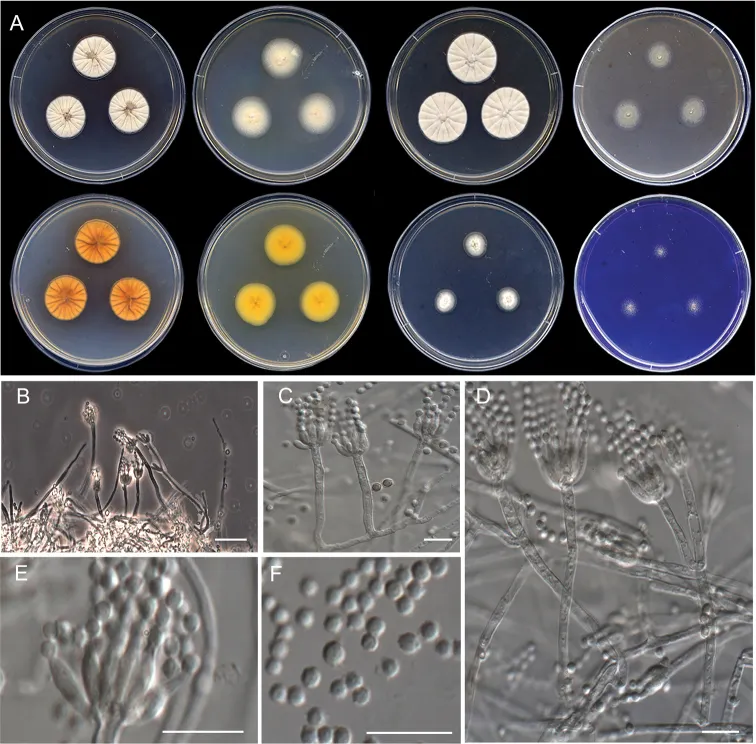
Mycelium superficial and immersed composed of septate, smooth-walled, hyaline hyphae of 1.5–2.5 μm wide. Conidiophores monoverticillate, rarely biverticillate and divaricate; stipes smooth-walled, vesiculate, 22.5–103 × 1.5–2.5 μm (vesicle up to 4.5 µm); metulae divergent 2–3, unequal in length, 7–37 × 1.5–3 µm; phialides 2–5 per stipe/metula, ampulliform, 6–8.5 × 2–2.5 μm; conidia smooth- or finely roughened, globose, 2–2.5 × 2–2.5 μm. Colonies on CYA, 20–22 mm diam., slightly raised, velvety, radially sulcate, dull red (8C3) at center to light yellow (4A5) and white (1A1) towards periphery, margins slightly undulate, sporulation sparse, conidial masses grayish green (28B3); reverse brownish orange (5C6); with reddish soluble pigment. On MEA, 24–27 mm diam., slightly elevated, velvety, light yellow (4A5) and pale orange (5A2) at periphery, margins low and entire, sporulation sparse, conidial masses grayish green (27C4); reverse golden yellow (5B7) and reddish-yellow (4A6) at periphery; soluble pigment absent. On YES, 30–32 mm diam., slightly raised at center, velvety, radially sulcate, pale yellow (3A3) to white (1A1) and brownish orange (5C3) towards periphery, margins slightly undulate, sporulation abundant, conidial masses grayish green (28B3); reverse brownish yellow (5C8); soluble pigment absent. On OA, 18–20 mm diam., flattened, velvety, dark green (28F4) to light gray (25D1) and white (1A1) towards periphery, margins low and entire, sporulation abundant, conidial masses dull green (25D3); reverse brown (6E4) and yellowish gray (4B2) at periphery; soluble pigment absent.

Sebagian uraian ditampilkan dalam bahasa sumber; terjemahannya belum tersedia atau belum lolos pemeriksaan.

Rujukan: [1]

Pengukuran mengikuti objek, spesimen atau kultur, dan metode yang disebutkan sumber. Baca uraian asli untuk konteks lengkap.

02 / Kehidupan

Habitat dan peran ekologis

Penicillium vaccaeorum and P. lacussarmientei, two species described from sandy soils in Spain and Chile (Quintanilla 1982; Ramírez 1986), respectively, were considered synonyms of P. roseopurpureum by Frisvad et al. (1990), noting that both species were fast growing variants of P. roseopurpureum. Later on, based on that criterion and the lack of morphological differences, Houbraken et al. (2011) considered the two former species synonyms of P. sanguifluum despite some sequence variation where P. vaccaeorum and P. lacussarmientei clustered together in a clade sister to that of P. sanguifluum. Our phylogeny correlates with Houbraken et al. (2011) who found the same topology. Having the opportunity to examine specimens from both monophyletic sister clades (Fig. 8), we observed consistent phenotypic features to distinguish them. For instance, isolates of P. vaccaeorum had longer stipes (up to 103 μm; up to 120 μm in the protologue of the species) (Quintanilla 1982), they were able to grow on CYA at 35 °C (6–11 mm diam. after 7 d), had good sporulation and faster growth on YES agar (30–32 mm diam. 7 d) and more restricted on DG18 (12–13 mm diam. 7 d). In contrast, isolates of the P. sanguifluum clade showed considerably shorter conidiophores (15–50 µm long), they were unable to grow above 30 °C, and the colonies on YES and DG18 showed sparsely or absent sporulation and attained 18–28 mm and 16–22 mm diam., respectively (Houbraken et al. 2011).

Sebagian uraian ditampilkan dalam bahasa sumber; terjemahannya belum tersedia atau belum lolos pemeriksaan.

Rujukan: [1]

Habitat atau konteks temuan
kultur yang didokumentasikan
Substrat
Informasi belum tersedia pada sumber rilis ini.
Peran atau konteks
Belum dikategorikan pada rilis ini.
Temukan hubungan serupa
03 / Siklus hidup

Reproduksi

Mycelium superficial and immersed composed of septate, smooth-walled, hyaline hyphae of 1.5–2.5 μm wide. Conidiophores monoverticillate, rarely biverticillate and divaricate; stipes smooth-walled, vesiculate, 22.5–103 × 1.5–2.5 μm (vesicle up to 4.5 µm); metulae divergent 2–3, unequal in length, 7–37 × 1.5–3 µm; phialides 2–5 per stipe/metula, ampulliform, 6–8.5 × 2–2.5 μm; conidia smooth- or finely roughened, globose, 2–2.5 × 2–2.5 μm. Colonies on CYA, 20–22 mm diam., slightly raised, velvety, radially sulcate, dull red (8C3) at center to light yellow (4A5) and white (1A1) towards periphery, margins slightly undulate, sporulation sparse, conidial masses grayish green (28B3); reverse brownish orange (5C6); with reddish soluble pigment.

Sebagian uraian ditampilkan dalam bahasa sumber; terjemahannya belum tersedia atau belum lolos pemeriksaan.

Rujukan: [1]

Sinonim menurut acuan taksonomi rilis: Penicillium vaccaeorum
04 / Batas informasi

Catatan identitas dan cakupan

  • Nama diterima mengikuti Catalogue of Life Base2026-09-11; uraian mempertahankan konsep dan nama sumber aslinya.
  • Preserve original treatment localities, hosts and substrate scope. Materials examined describe documented specimens, not the full global range.
  • Impor dan terjemahan otomatis belum diperiksa editorial per profil. Struktur reproduktif yang disebutkan tidak membuktikan seluruh siklus hidup diketahui.
  • Pengukuran pada uraian mengikuti spesimen, kultur, dan metode sumber; angka tidak diperluas ke semua populasi.

Catatan distribusi dalam narasi mengikuti sumbernya. Dokumentasi spesimen atau foto mengikuti catatan sumber. Bukti wilayah Indonesia dan penilaian konservasi tidak disimpulkan dari gambar.

05 / Dokumentasi

Melihat dengan konteks

Morphological characters of Penicillium vaccaeorum (FMR 17967). A colonies from left to right (top row) CYA, MEA, YES, and OA; (bottom row) CYA reverse, MEA reverse, DG18, and CREA B–E conidiophores on MEA F conidia. Scale Bars: 25 μm (B), 10 μm (C–F).

Jenis
Pelat ilmiah
Kredit
Daniel Torres-Garcia, Josepa Gené, Dania García
Lisensi
CC BY 4.0
Sumber media
Buka entri sumber

Gambar menunjukkan objek menurut identifikasi sumber, bukan verifikasi independen spesimen oleh Fungi. Tidak ada skala baru yang ditambahkan.

06 / Rujukan

Sumber profil

  1. [1] New and interesting species of Penicillium (Eurotiomycetes, Aspergillaceae) in freshwater sediments from Spain — Penicillium vaccaeorumBagian sumber: PMC8825427_section_69
    Tanggal penghimpunan sumber: 2026-10-12
    Teks sumber: CC BY 4.0 · Torres-Garcia D, Gené J, García D.
  2. [2] Catalogue of Life Base2026-09-11 — Penicillium roseopurpureumBagian sumber: ColDP NameUsage.tsv ID 76JD4; accepted species; source 2073
    Tanggal penghimpunan sumber: 2026-10-12
  3. [3] Dokumentasi visual — Penicillium vaccaeorumBagian sumber: Individual media record; identification follows the source, not independent determination
    Tanggal penghimpunan sumber: 2026-10-12
    Media sumber: CC BY 4.0 · Daniel Torres-Garcia, Josepa Gené, Dania García

Adaptasi teks: CC BY 4.0. Torres-Garcia D, Gené J, García D. — New and interesting species of Penicillium (Eurotiomycetes, Aspergillaceae) in freshwater sediments from Spain — Penicillium vaccaeorum

Uraian asli dan riwayat sumber

Riwayat atau halaman sumber

Ringkasan sumber

Mycelium superficial and immersed composed of septate, smooth-walled, hyaline hyphae of 1.5–2.5 μm wide. Conidiophores monoverticillate, rarely biverticillate and divaricate; stipes smooth-walled, vesiculate, 22.5–103 × 1.5–2.5 μm (vesicle up to 4.5 µm); metulae divergent 2–3, unequal in length, 7–37 × 1.5–3 µm; phialides 2–5 per stipe/metula, ampulliform, 6–8.5 × 2–2.5 μm; conidia smooth- or finely roughened, globose, 2–2.5 × 2–2.5 μm. Colonies on CYA, 20–22 mm diam., slightly raised, velvety, radially sulcate, dull red (8C3) at center to light yellow (4A5) and white (1A1) towards periphery, margins slightly undulate, sporulation sparse, conidial masses grayish green (28B3); reverse brownish orange (5C6); with reddish soluble pigment.

Revisi sumber

Morfologi sumber

Mycelium superficial and immersed composed of septate, smooth-walled, hyaline hyphae of 1.5–2.5 μm wide. Conidiophores monoverticillate, rarely biverticillate and divaricate; stipes smooth-walled, vesiculate, 22.5–103 × 1.5–2.5 μm (vesicle up to 4.5 µm); metulae divergent 2–3, unequal in length, 7–37 × 1.5–3 µm; phialides 2–5 per stipe/metula, ampulliform, 6–8.5 × 2–2.5 μm; conidia smooth- or finely roughened, globose, 2–2.5 × 2–2.5 μm. Colonies on CYA, 20–22 mm diam., slightly raised, velvety, radially sulcate, dull red (8C3) at center to light yellow (4A5) and white (1A1) towards periphery, margins slightly undulate, sporulation sparse, conidial masses grayish green (28B3); reverse brownish orange (5C6); with reddish soluble pigment. On MEA, 24–27 mm diam., slightly elevated, velvety, light yellow (4A5) and pale orange (5A2) at periphery, margins low and entire, sporulation sparse, conidial masses grayish green (27C4); reverse golden yellow (5B7) and reddish-yellow (4A6) at periphery; soluble pigment absent. On YES, 30–32 mm diam., slightly raised at center, velvety, radially sulcate, pale yellow (3A3) to white (1A1) and brownish orange (5C3) towards periphery, margins slightly undulate, sporulation abundant, conidial masses grayish green (28B3); reverse brownish yellow (5C8); soluble pigment absent. On OA, 18–20 mm diam., flattened, velvety, dark green (28F4) to light gray (25D1) and white (1A1) towards periphery, margins low and entire, sporulation abundant, conidial masses dull green (25D3); reverse brown (6E4) and yellowish gray (4B2) at periphery; soluble pigment absent.

Revisi sumber

Ekologi sumber

Penicillium vaccaeorum and P. lacussarmientei, two species described from sandy soils in Spain and Chile (Quintanilla 1982; Ramírez 1986), respectively, were considered synonyms of P. roseopurpureum by Frisvad et al. (1990), noting that both species were fast growing variants of P. roseopurpureum. Later on, based on that criterion and the lack of morphological differences, Houbraken et al. (2011) considered the two former species synonyms of P. sanguifluum despite some sequence variation where P. vaccaeorum and P. lacussarmientei clustered together in a clade sister to that of P. sanguifluum. Our phylogeny correlates with Houbraken et al. (2011) who found the same topology. Having the opportunity to examine specimens from both monophyletic sister clades (Fig. 8), we observed consistent phenotypic features to distinguish them. For instance, isolates of P. vaccaeorum had longer stipes (up to 103 μm; up to 120 μm in the protologue of the species) (Quintanilla 1982), they were able to grow on CYA at 35 °C (6–11 mm diam. after 7 d), had good sporulation and faster growth on YES agar (30–32 mm diam. 7 d) and more restricted on DG18 (12–13 mm diam. 7 d). In contrast, isolates of the P. sanguifluum clade showed considerably shorter conidiophores (15–50 µm long), they were unable to grow above 30 °C, and the colonies on YES and DG18 showed sparsely or absent sporulation and attained 18–28 mm and 16–22 mm diam., respectively (Houbraken et al. 2011).

Revisi sumber

Struktur reproduksi sumber

Mycelium superficial and immersed composed of septate, smooth-walled, hyaline hyphae of 1.5–2.5 μm wide. Conidiophores monoverticillate, rarely biverticillate and divaricate; stipes smooth-walled, vesiculate, 22.5–103 × 1.5–2.5 μm (vesicle up to 4.5 µm); metulae divergent 2–3, unequal in length, 7–37 × 1.5–3 µm; phialides 2–5 per stipe/metula, ampulliform, 6–8.5 × 2–2.5 μm; conidia smooth- or finely roughened, globose, 2–2.5 × 2–2.5 μm. Colonies on CYA, 20–22 mm diam., slightly raised, velvety, radially sulcate, dull red (8C3) at center to light yellow (4A5) and white (1A1) towards periphery, margins slightly undulate, sporulation sparse, conidial masses grayish green (28B3); reverse brownish orange (5C6); with reddish soluble pigment.

Revisi sumber

Rujukan halaman ini

Fungi. Penicillium roseopurpureum. Rilis data fungi-2026-10-12-expansion-2. https://fungi-atlas.mgadib.chatgpt.site/jamur/penicillium-roseopurpureum/.

Status: impor sumber; pemeriksaan editorial per profil belum selesai. Untuk klaim biologis, gunakan rujukan pada bagian terkait dan periksa konteks sumber aslinya.