01 / Morfologi

Ciri dan struktur

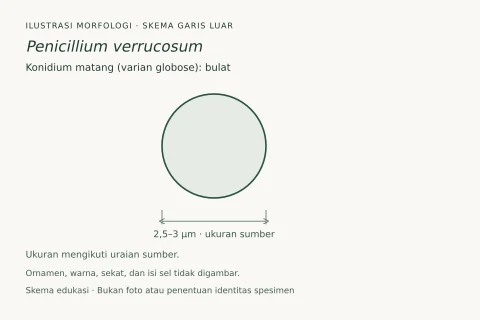
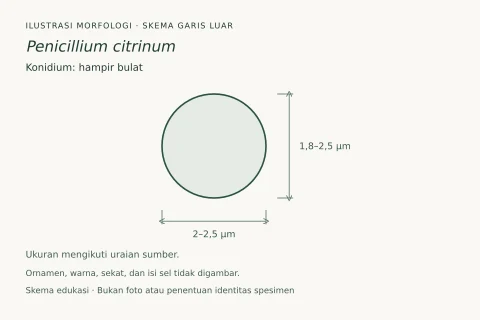
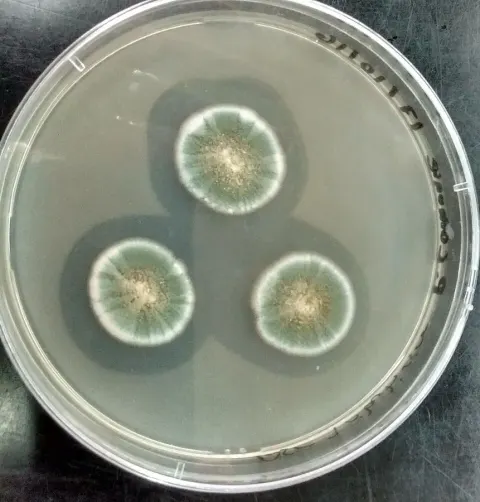
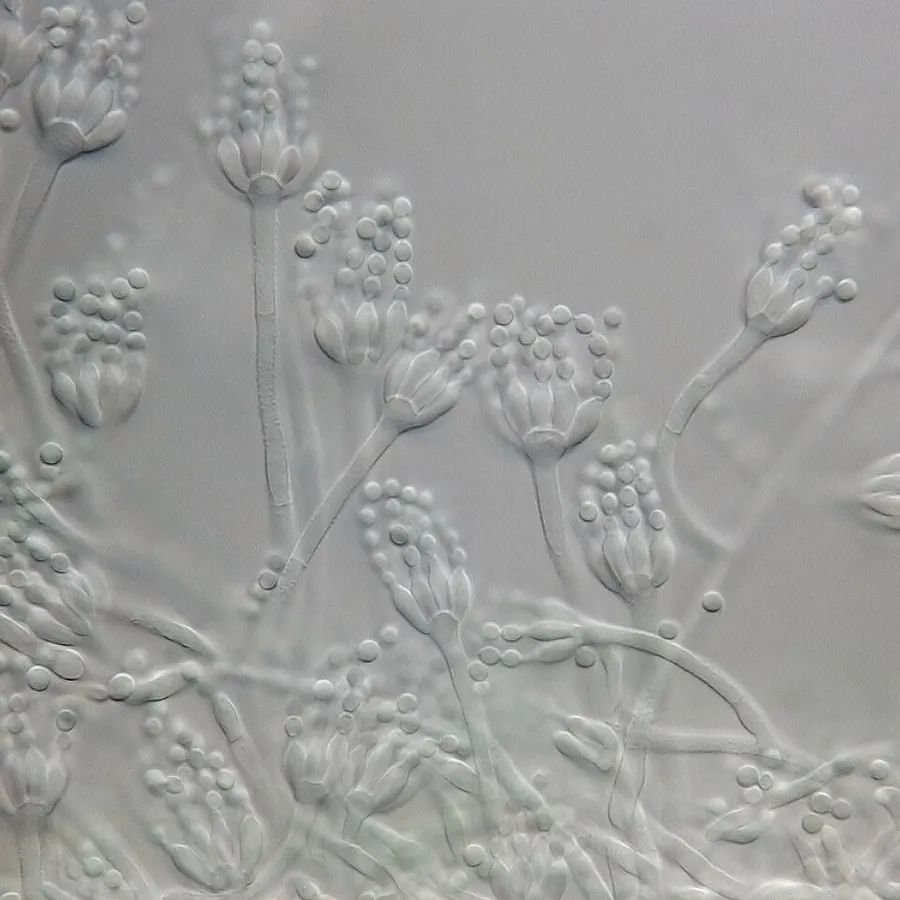
Penicillium spinulosum has round, spiny or irregularly rough-walled conidia produced in loose columns. The diameter of a conidium ranges from 3.0 to 3.5 μm. Penicillium spinulosum has thin-walled conidia with smooth or finely roughened texture terminating in a vesicle, the stipes of conidiospores generally range from 100 to 300 μm long, occasionally the length can be shorter than that. The conidiophores of P. spinulosum can arise from submerged or aerial hyphae. For conidiophores arising from aerial hyphae, the size of the stipes is shorter, e.g., 25–30 μm in length. The apex of conidiophores is inflated with simple (or monoverticilate) branching pattern. The conidiophores of P. spinulosum are terminated in 6 to 9 flask or bottom- shaped structure called phialides, these are not very abundant, and the length of individual phialide ranges from 2.5 to 3 μm. Subdivision of the genus Penicillium into subgenera and sections has traditionally been based on the branching pattern of the conidiophore. The conidiophores of P. spinulosum do not branch and is described as monoverticillate. However, modern phylogenetic studies of the genus Penicillium have revealed that these morphological patterns can arise independently, and thus do not reliably predict evolutionary relationships. Growing colonies of P. spinulosum have broad white edges consist of white mycelium. Young colonies appears blue-green or grey-green and white to cream or faintly pink on the reverse. As the colonies mature, the colour becomes grey. The growth of P. spinulosum on czapek dox agar (CZ), malt extract agar (MEA) and Yeast Extract with Supplements (YES) occur rapidly.

Sebagian uraian ditampilkan dalam bahasa sumber; terjemahannya belum tersedia atau belum lolos pemeriksaan.

Rujukan: [1]

Pengukuran mengikuti objek, spesimen atau kultur, dan metode yang disebutkan sumber. Baca uraian asli untuk konteks lengkap.

02 / Kehidupan

Habitat dan peran ekologis

Penicillium spinulosum is found world-wide, and is most commonly isolated from soil. P. spinulosum has also been isolated from dextrin paste, distilled water containers, cotton yarn, walnut kernels, chrome tanned leather, vinyl wall covering, paracetamol tablet, diesel fuel and emulsion paint treated with chromate. P. spinulosumis highly resistant to heavy metals, tannins and acids, and can be isolated from substrata contaminated by those materials.

Sebagian uraian ditampilkan dalam bahasa sumber; terjemahannya belum tersedia atau belum lolos pemeriksaan.

Rujukan: [1]

Habitat atau konteks temuan
Informasi belum tersedia pada sumber rilis ini.
Substrat
Informasi belum tersedia pada sumber rilis ini.
Peran atau konteks
Belum dikategorikan pada rilis ini.
Temukan hubungan serupa
03 / Siklus hidup

Reproduksi

Penicillium spinulosum has round, spiny or irregularly rough-walled conidia produced in loose columns. The diameter of a conidium ranges from 3.0 to 3.5 μm. Penicillium spinulosum has thin-walled conidia with smooth or finely roughened texture terminating in a vesicle, the stipes of conidiospores generally range from 100 to 300 μm long, occasionally the length can be shorter than that. The conidiophores of P. spinulosum can arise from submerged or aerial hyphae. For conidiophores arising from aerial hyphae, the size of the stipes is shorter, e.g., 25–30 μm in length. The apex of conidiophores is inflated with simple (or monoverticilate) branching pattern. The conidiophores of P. spinulosum are terminated in 6 to 9 flask or bottom- shaped structure called phialides, these are not very abundant, and the length of individual phialide ranges from 2.5 to 3 μm.

Sebagian uraian ditampilkan dalam bahasa sumber; terjemahannya belum tersedia atau belum lolos pemeriksaan.

Rujukan: [1]

Sinonim menurut acuan taksonomi rilis: Penicillium abeanum; Penicillium spinuloramigenum; Penicillium spinulosum var. ramigenum
04 / Batas informasi

Catatan identitas dan cakupan

  • Nama diterima mengikuti Catalogue of Life Base2026-09-11; uraian mempertahankan konsep dan nama sumber aslinya.
  • Original geographic, specimen and life-cycle scope retained; source import awaits individual editorial review.
  • Impor dan terjemahan otomatis belum diperiksa editorial per profil. Struktur reproduktif yang disebutkan tidak membuktikan seluruh siklus hidup diketahui.
  • Pengukuran pada uraian mengikuti spesimen, kultur, dan metode sumber; angka tidak diperluas ke semua populasi.

Catatan distribusi dalam narasi mengikuti sumbernya. Dokumentasi spesimen atau foto mengikuti catatan sumber. Bukti wilayah Indonesia dan penilaian konservasi tidak disimpulkan dari gambar.

05 / Dokumentasi

Melihat dengan konteks

Dokumentasi Penicillium spinulosum dari Wikimedia Commons. OLYMPUS DIGITAL CAMERA Identifikasi mengikuti record berkas sumber.

Jenis
Fotografi
Kredit
Medmyco
Sumber media
Buka entri sumber

Gambar menunjukkan objek menurut identifikasi sumber, bukan verifikasi independen spesimen oleh Fungi. Tidak ada skala baru yang ditambahkan.

06 / Rujukan

Sumber profil

  1. [1] Penicillium spinulosum — Wikipedia (en)Bagian sumber: Frozen revision 1376239740
    Tanggal penghimpunan sumber: 2026-10-12
    Teks sumber: CC BY-SA4.0 · Wikipedia contributors
  2. [2] Catalogue of Life Base2026-09-11 — Penicillium spinulosumBagian sumber: ColDP NameUsage.tsv ID 76J56; accepted species; source 2073
    Tanggal penghimpunan sumber: 2026-10-12
  3. [3] Dokumentasi visual — Penicillium spinulosumBagian sumber: Individual media record; identification follows the source, not independent determination
    Tanggal penghimpunan sumber: 2026-10-12
    Media sumber: CC BY-SA 4.0 · Medmyco

Adaptasi teks: CC BY-SA 4.0. Wikipedia contributors — Penicillium spinulosum — Wikipedia (en)

Uraian asli dan riwayat sumber

Riwayat atau halaman sumber

Ringkasan sumber

Penicillium spinulosum (spinulosus means with small spines in Latin) is a non-branched, fast-growing fungus with a swelling at the terminal of the stipe (vesiculate) in the genus Penicillium. P. spinulosum is able to grow and reproduce in environment with low temperature and low water availability, and is known to be acidotolerant. P. spinulosum is ubiquitously distributed, and can often be isolated from soil. Each individual strain of P. spinulosum differs from others in their colony morphology, including colony texture, amount of sporulation and roughness of conidia and conidiophores.

Revisi sumber

Morfologi sumber

Penicillium spinulosum has round, spiny or irregularly rough-walled conidia produced in loose columns. The diameter of a conidium ranges from 3.0 to 3.5 μm. Penicillium spinulosum has thin-walled conidia with smooth or finely roughened texture terminating in a vesicle, the stipes of conidiospores generally range from 100 to 300 μm long, occasionally the length can be shorter than that. The conidiophores of P. spinulosum can arise from submerged or aerial hyphae. For conidiophores arising from aerial hyphae, the size of the stipes is shorter, e.g., 25–30 μm in length. The apex of conidiophores is inflated with simple (or monoverticilate) branching pattern. The conidiophores of P. spinulosum are terminated in 6 to 9 flask or bottom- shaped structure called phialides, these are not very abundant, and the length of individual phialide ranges from 2.5 to 3 μm. Subdivision of the genus Penicillium into subgenera and sections has traditionally been based on the branching pattern of the conidiophore. The conidiophores of P. spinulosum do not branch and is described as monoverticillate. However, modern phylogenetic studies of the genus Penicillium have revealed that these morphological patterns can arise independently, and thus do not reliably predict evolutionary relationships. Growing colonies of P. spinulosum have broad white edges consist of white mycelium. Young colonies appears blue-green or grey-green and white to cream or faintly pink on the reverse. As the colonies mature, the colour becomes grey. The growth of P. spinulosum on czapek dox agar (CZ), malt extract agar (MEA) and Yeast Extract with Supplements (YES) occur rapidly.

Revisi sumber

Ekologi sumber

Penicillium spinulosum is found world-wide, and is most commonly isolated from soil. P. spinulosum has also been isolated from dextrin paste, distilled water containers, cotton yarn, walnut kernels, chrome tanned leather, vinyl wall covering, paracetamol tablet, diesel fuel and emulsion paint treated with chromate. P. spinulosumis highly resistant to heavy metals, tannins and acids, and can be isolated from substrata contaminated by those materials.

Revisi sumber

Struktur reproduksi sumber

Penicillium spinulosum has round, spiny or irregularly rough-walled conidia produced in loose columns. The diameter of a conidium ranges from 3.0 to 3.5 μm. Penicillium spinulosum has thin-walled conidia with smooth or finely roughened texture terminating in a vesicle, the stipes of conidiospores generally range from 100 to 300 μm long, occasionally the length can be shorter than that. The conidiophores of P. spinulosum can arise from submerged or aerial hyphae. For conidiophores arising from aerial hyphae, the size of the stipes is shorter, e.g., 25–30 μm in length. The apex of conidiophores is inflated with simple (or monoverticilate) branching pattern. The conidiophores of P. spinulosum are terminated in 6 to 9 flask or bottom- shaped structure called phialides, these are not very abundant, and the length of individual phialide ranges from 2.5 to 3 μm.

Revisi sumber

Rujukan halaman ini

Fungi. Penicillium spinulosum. Rilis data fungi-2026-10-12-expansion-2. https://fungi-atlas.mgadib.chatgpt.site/jamur/penicillium-spinulosum/.

Status: impor sumber; pemeriksaan editorial per profil belum selesai. Untuk klaim biologis, gunakan rujukan pada bagian terkait dan periksa konteks sumber aslinya.