01 / Morfologi

Ciri dan struktur

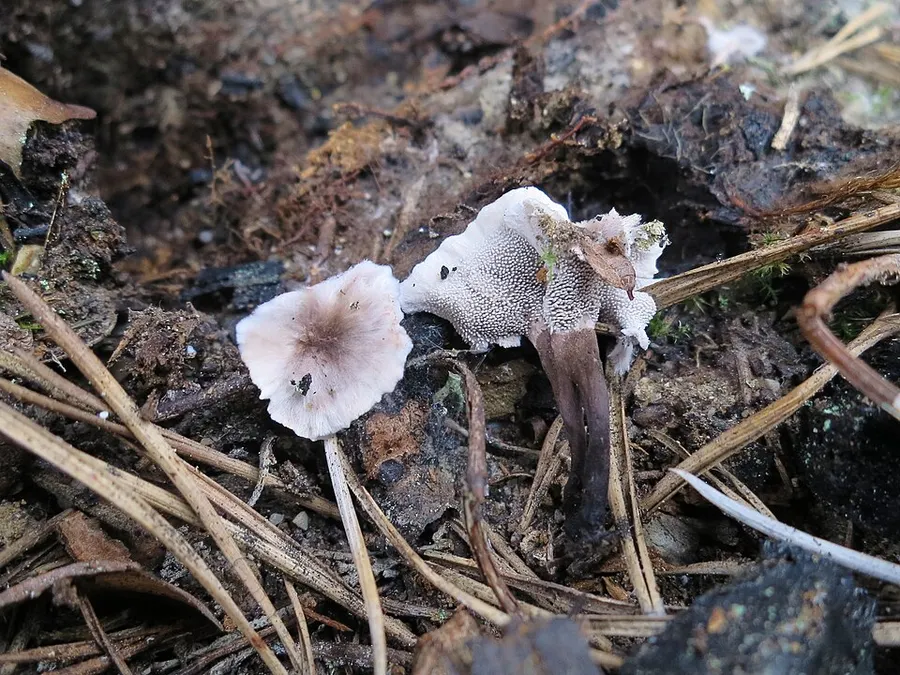
Phellodon secretus has a distinctive growth habit, typically emerging in sheltered spaces beneath fallen pine trunks or rootstocks, with only a few centimetres of gap between the soil and decayed wood. The basidiocarps (fruiting bodies) initially emerge from the humus as thin, needle-like black mycology about 1 mm in diameter. The cap (pileus) only begins to develop after the stipe makes contact with the overhanging wood surface above. The mature fruiting body is small, slender and fragile. The pileus is plane or funnel-shaped, sometimes irregularly roundish and lobed, measuring 0.9–3 cm (occasionally up to 5.5 cm) in diameter. It is thin (0.3–1.5 mm, rarely up to 3.5 mm) and cottony soft throughout. Young specimens are white with an ash-grey tint, while older specimens become darker grey or develop a sepia hue. The pileus is evenly coloured in young specimens, becoming paler towards the margin in older ones, but lacks the zonation pattern seen in some related species. The lower surface of the pileus bears slender, sharp hymenial spines that are initially white but later become light greyish-white. These spines are regular, dense, 0.3–0.9 mm long (occasionally up to 1.5 mm) and 0.06–0.12 mm in diameter at the base. The stipe is black, glabrous (smooth), very thin (0.3–1.8 mm, rarely up to 2.3 mm) and of even thickness, reaching 10–18 mm in length. It becomes brittle when dried. Fresh specimens are odourless, while dried specimens emit a very faint spicy scent. The flesh turns olivaceous (pale brownish green) when treated with potassium hydroxide (KOH) solution. Microscopically, P. secretus has a monomitic hyphal system with simple-septate hyphae (lacking clamp connections).

Sebagian uraian ditampilkan dalam bahasa sumber; terjemahannya belum tersedia atau belum lolos pemeriksaan.

Rujukan: [1]

Pengukuran mengikuti objek, spesimen atau kultur, dan metode yang disebutkan sumber. Baca uraian asli untuk konteks lengkap.

02 / Kehidupan

Habitat dan peran ekologis

In its original description, P. secretus was noted as strictly associated with old‑growth Pinus sylvestris woodlands, growing in the narrow gap between humus and fallen pine trunks or kelo rootstocks. British records come from Castanea sativa–pine mixed stands at two Fagaceae‑associated hydnoid hotspots (Buttersteep and Rapley 2–4) in Swinley Forest, Berkshire. Fruiting bodies were found beneath chestnut plant litter on low mossy mounds, often close (≤ 10 m) to Scots pine; lifting overlying wood sometimes broke the stipe, leaving the pileus attached to the wood above. Below‑ground, soil eDNA sampling detected P. secretus in three quadrats at each of the two sites, plus a further quadrat 750 m away on Mill pond embankment, indicating a wider mycelial presence than fruiting bodies alone reveal. Although no further records have yet appeared outside Finland and England, identical or near‑identical barcodes have since been reported from Estonia, Portugal and Russia, and a mycorrhizal root tip from California (Pinus muricata) indicates a Holarctic distribution.

Sebagian uraian ditampilkan dalam bahasa sumber; terjemahannya belum tersedia atau belum lolos pemeriksaan.

Rujukan: [1]

Habitat atau konteks temuan
hutan
Substrat
Informasi belum tersedia pada sumber rilis ini.
Peran atau konteks
Belum dikategorikan pada rilis ini.
Temukan hubungan serupa
03 / Siklus hidup

Reproduksi

Phellodon secretus has a distinctive growth habit, typically emerging in sheltered spaces beneath fallen pine trunks or rootstocks, with only a few centimetres of gap between the soil and decayed wood. The basidiocarps (fruiting bodies) initially emerge from the humus as thin, needle-like black mycology about 1 mm in diameter. The cap (pileus) only begins to develop after the stipe makes contact with the overhanging wood surface above. The lower surface of the pileus bears slender, sharp hymenial spines that are initially white but later become light greyish-white. These spines are regular, dense, 0.3–0.9 mm long (occasionally up to 1.5 mm) and 0.06–0.12 mm in diameter at the base. The stipe is black, glabrous (smooth), very thin (0.3–1.8 mm, rarely up to 2.3 mm) and of even thickness, reaching 10–18 mm in length.

Sebagian uraian ditampilkan dalam bahasa sumber; terjemahannya belum tersedia atau belum lolos pemeriksaan.

Rujukan: [1]

04 / Batas informasi

Catatan identitas dan cakupan

  • Nama diterima mengikuti Catalogue of Life Base2026-09-11; uraian mempertahankan konsep dan nama sumber aslinya.
  • Original geographic, specimen and life-cycle scope retained; source import awaits individual editorial review.
  • Impor dan terjemahan otomatis belum diperiksa editorial per profil. Struktur reproduktif yang disebutkan tidak membuktikan seluruh siklus hidup diketahui.
  • Pengukuran pada uraian mengikuti spesimen, kultur, dan metode sumber; angka tidak diperluas ke semua populasi.

Catatan distribusi dalam narasi mengikuti sumbernya. Dokumentasi spesimen atau foto mengikuti catatan sumber. Bukti wilayah Indonesia dan penilaian konservasi tidak disimpulkan dari gambar.

05 / Dokumentasi

Melihat dengan konteks

Dokumentasi Phellodon secretus dari Wikimedia Commons. Fruit bodies of the tooth fungus Phellodon secretus . Identifikasi mengikuti record berkas sumber.

Jenis
Fotografi
Kredit
caspar s
Lisensi
CC BY 2.0
Sumber media
Buka entri sumber

Gambar menunjukkan objek menurut identifikasi sumber, bukan verifikasi independen spesimen oleh Fungi. Tidak ada skala baru yang ditambahkan.

06 / Rujukan

Sumber profil

  1. [1] Phellodon secretus — Wikipedia (en)Bagian sumber: Frozen revision 1344906812
    Tanggal penghimpunan sumber: 2026-10-12
    Teks sumber: CC BY-SA4.0 · Wikipedia contributors
  2. [2] Catalogue of Life Base2026-09-11 — Phellodon secretusBagian sumber: ColDP NameUsage.tsv ID 4FZMV; accepted species; source 2073
    Tanggal penghimpunan sumber: 2026-10-12
  3. [3] Dokumentasi visual — Phellodon secretusBagian sumber: Individual media record; identification follows the source, not independent determination
    Tanggal penghimpunan sumber: 2026-10-12
    Media sumber: CC BY 2.0 · caspar s

Adaptasi teks: CC BY-SA 4.0. Wikipedia contributors — Phellodon secretus — Wikipedia (en)

Uraian asli dan riwayat sumber

Riwayat atau halaman sumber

Ringkasan sumber

Phellodon secretus is a rare species of tooth fungus in the family Bankeraceae, described in 2003. The fungus has a distinctive growth habit, typically emerging in sheltered spaces beneath fallen pine trunks or rootstocks with only a few centimetres of gap between the soil and decayed wood. Its small, slender fruit bodies feature thin, cottony soft caps that are initially white with an ash-grey tint, becoming darker with age, and bear slender white to greyish spines on their underside. Originally found in old-growth pine woodlands in Finland, the species has since been recorded in England and detected through environmental DNA in several other countries, suggesting a wider Holarctic distribution.

Revisi sumber

Morfologi sumber

Phellodon secretus has a distinctive growth habit, typically emerging in sheltered spaces beneath fallen pine trunks or rootstocks, with only a few centimetres of gap between the soil and decayed wood. The basidiocarps (fruiting bodies) initially emerge from the humus as thin, needle-like black mycology about 1 mm in diameter. The cap (pileus) only begins to develop after the stipe makes contact with the overhanging wood surface above. The mature fruiting body is small, slender and fragile. The pileus is plane or funnel-shaped, sometimes irregularly roundish and lobed, measuring 0.9–3 cm (occasionally up to 5.5 cm) in diameter. It is thin (0.3–1.5 mm, rarely up to 3.5 mm) and cottony soft throughout. Young specimens are white with an ash-grey tint, while older specimens become darker grey or develop a sepia hue. The pileus is evenly coloured in young specimens, becoming paler towards the margin in older ones, but lacks the zonation pattern seen in some related species. The lower surface of the pileus bears slender, sharp hymenial spines that are initially white but later become light greyish-white. These spines are regular, dense, 0.3–0.9 mm long (occasionally up to 1.5 mm) and 0.06–0.12 mm in diameter at the base. The stipe is black, glabrous (smooth), very thin (0.3–1.8 mm, rarely up to 2.3 mm) and of even thickness, reaching 10–18 mm in length. It becomes brittle when dried. Fresh specimens are odourless, while dried specimens emit a very faint spicy scent. The flesh turns olivaceous (pale brownish green) when treated with potassium hydroxide (KOH) solution. Microscopically, P. secretus has a monomitic hyphal system with simple-septate hyphae (lacking clamp connections).

Revisi sumber

Ekologi sumber

In its original description, P. secretus was noted as strictly associated with old‑growth Pinus sylvestris woodlands, growing in the narrow gap between humus and fallen pine trunks or kelo rootstocks. British records come from Castanea sativa–pine mixed stands at two Fagaceae‑associated hydnoid hotspots (Buttersteep and Rapley 2–4) in Swinley Forest, Berkshire. Fruiting bodies were found beneath chestnut plant litter on low mossy mounds, often close (≤ 10 m) to Scots pine; lifting overlying wood sometimes broke the stipe, leaving the pileus attached to the wood above. Below‑ground, soil eDNA sampling detected P. secretus in three quadrats at each of the two sites, plus a further quadrat 750 m away on Mill pond embankment, indicating a wider mycelial presence than fruiting bodies alone reveal. Although no further records have yet appeared outside Finland and England, identical or near‑identical barcodes have since been reported from Estonia, Portugal and Russia, and a mycorrhizal root tip from California (Pinus muricata) indicates a Holarctic distribution.

Revisi sumber

Struktur reproduksi sumber

Phellodon secretus has a distinctive growth habit, typically emerging in sheltered spaces beneath fallen pine trunks or rootstocks, with only a few centimetres of gap between the soil and decayed wood. The basidiocarps (fruiting bodies) initially emerge from the humus as thin, needle-like black mycology about 1 mm in diameter. The cap (pileus) only begins to develop after the stipe makes contact with the overhanging wood surface above. The lower surface of the pileus bears slender, sharp hymenial spines that are initially white but later become light greyish-white. These spines are regular, dense, 0.3–0.9 mm long (occasionally up to 1.5 mm) and 0.06–0.12 mm in diameter at the base. The stipe is black, glabrous (smooth), very thin (0.3–1.8 mm, rarely up to 2.3 mm) and of even thickness, reaching 10–18 mm in length.

Revisi sumber

Rujukan halaman ini

Fungi. Phellodon secretus. Rilis data fungi-2026-10-12-expansion-2. https://fungi-atlas.mgadib.chatgpt.site/jamur/phellodon-secretus/.

Status: impor sumber; pemeriksaan editorial per profil belum selesai. Untuk klaim biologis, gunakan rujukan pada bagian terkait dan periksa konteks sumber aslinya.