01 / Morfologi

Ciri dan struktur

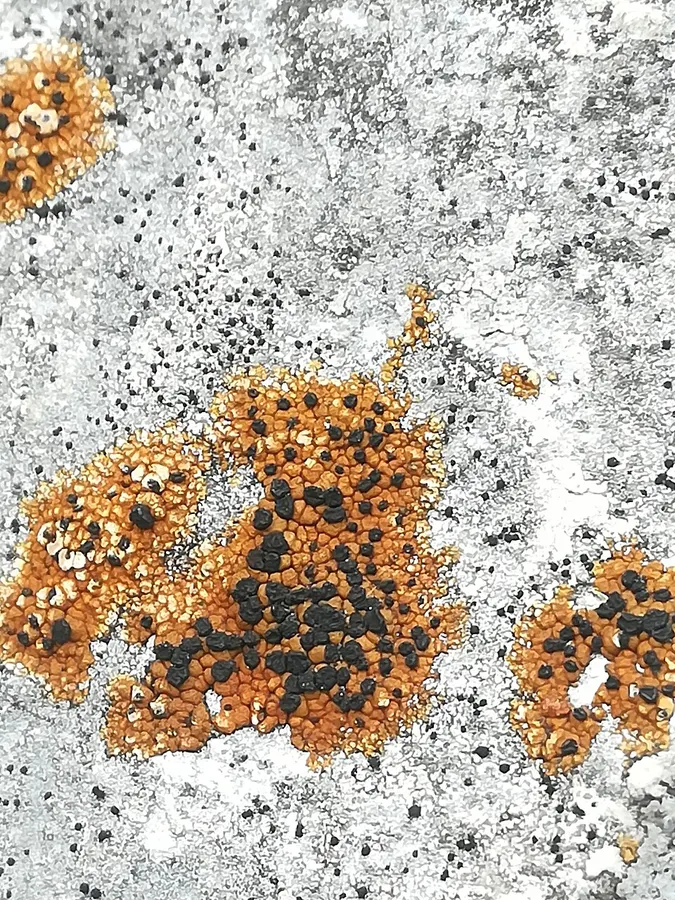
The thallus of Phoebus hydrophobius forms an orange-brown crust made up of small, slightly swollen polygonal blocks () that coalesce into rough patches up to about a millimetre thick. When a drop of potassium hydroxide solution (the standard "K" spot test) is placed on the surface, those blocks turn a deep violet-black, betraying the presence of anthraquinone-like pigments. In section the outer skin () is a firm, layer of tightly interwoven, gelatinised fungal threads; above it sits a thin, jelly-like tinged the same orange as the surface. Unusually, the white medulla—the cottony interior of the lichen—occurs both above and below the green algal band, giving the thallus a double-decker construction. The algal partner is Trentepohlia, a group of orange-pigmented, sausage-shaped cells that typically favour humid, sheltered rock faces. Black, slit-to-irregularly rounded fruiting bodies ( apothecia) erupt on or between the areoles. They start flush with the surface but soon become slightly elevated, with a coarse black rim and, at times, a dusting of orange powder. Inside, a dark brown underlies a 100-μm-tall spore-bearing layer (hymenium). The asci each contain eight ascospores arranged in two rows; the spores are colourless at first, surrounded by a gelatinous , divided by three cross-walls, and measure roughly 16–20 × 5–6.5 μm before maturing to a pale brown and developing a roughened coat. No asexual propagules (pycnidia) have been observed. This combination of an intensely K-positive orange crust, Trentepohlia photobiont, and opegraphoid apothecia separates Phoebus from superficially similar orange rock-dwelling lichens such as Caloplaca.

Sebagian uraian ditampilkan dalam bahasa sumber; terjemahannya belum tersedia atau belum lolos pemeriksaan.

Rujukan: [1]

Pengukuran mengikuti objek, spesimen atau kultur, dan metode yang disebutkan sumber. Baca uraian asli untuk konteks lengkap.

02 / Kehidupan

Habitat dan peran ekologis

Phoebus hydrophobius awalnya hanya dikenal dari dolomit dan bluff karbonat lainnya di Missouri ⁇ Arkansas Ozark Highlands, di mana jenis ini dikumpulkan di 2007. Targeted surveys dan penelitian molekul kemudian mengungkapkan spesies ini di enam penarikan batu kapur tambahan di Sierra Madre Oriental of timur laut Meksiko (satu situs di Coahuila, lima di Nuevo León), menunjukkan bahwa rentangnya menjembatani selatan United States and utara Mexico rather daripada dibatasi oleh Ozark. Across this luas luas lichen menempati sinar matahari, permukaan xeric dari batu kapur keras ⁇ baik dinding canyon vertikal dan trotoar miring ⁇ dalam xerophytic dan pedmont scrub vegetasi pada sekitar 900 – 1520 m ketinggian. Ini sering tumbuh dicampur dengan kerak kalsicolus lainnya seperti Alyxoria sierramadrensis dan berbagai Caloplaca, Buellia and Squamulea species, dan muncul secara lokal umum di beberapa Mexican sites. Sebagian besar populasi Nuevo León terletak di pegunungan yang banyak dikunjungi di sekitar Monterrey, di mana ekspansi perkotaan, penambangan batu kapur, dan polusi udara industri kronis menimbulkan ancaman potensial terhadap habitat spesies yang terbatas.

Rujukan: [1]

Habitat atau konteks temuan
Informasi belum tersedia pada sumber rilis ini.
Substrat
Informasi belum tersedia pada sumber rilis ini.
Peran atau konteks
Pembentuk liken
Temukan hubungan serupa
03 / Siklus hidup

Reproduksi

Black, slit-to-irregularly rounded fruiting bodies ( apothecia) erupt on or between the areoles. They start flush with the surface but soon become slightly elevated, with a coarse black rim and, at times, a dusting of orange powder. Inside, a dark brown underlies a 100-μm-tall spore-bearing layer (hymenium). The asci each contain eight ascospores arranged in two rows; the spores are colourless at first, surrounded by a gelatinous , divided by three cross-walls, and measure roughly 16–20 × 5–6.5 μm before maturing to a pale brown and developing a roughened coat. No asexual propagules (pycnidia) have been observed. This combination of an intensely K-positive orange crust, Trentepohlia photobiont, and opegraphoid apothecia separates Phoebus from superficially similar orange rock-dwelling lichens such as Caloplaca.

Sebagian uraian ditampilkan dalam bahasa sumber; terjemahannya belum tersedia atau belum lolos pemeriksaan.

Rujukan: [1]

04 / Batas informasi

Catatan identitas dan cakupan

  • Nama diterima mengikuti Catalogue of Life Base2026-09-11; uraian mempertahankan konsep dan nama sumber aslinya.
  • Original geographic, specimen and life-cycle scope retained; source import awaits individual editorial review.
  • Impor dan terjemahan otomatis belum diperiksa editorial per profil. Struktur reproduktif yang disebutkan tidak membuktikan seluruh siklus hidup diketahui.
  • Pengukuran pada uraian mengikuti spesimen, kultur, dan metode sumber; angka tidak diperluas ke semua populasi.

Catatan distribusi dalam narasi mengikuti sumbernya. Dokumentasi spesimen atau foto mengikuti catatan sumber. Bukti wilayah Indonesia dan penilaian konservasi tidak disimpulkan dari gambar.

05 / Dokumentasi

Melihat dengan konteks

Dokumentasi Phoebus hydrophobius dari Wikimedia Commons. Phoebus hydrophobius photographed in Fagáceas del Noreste de México, Monterrey, Nuevo León, México Identifikasi mengikuti record berkas sumber.

Jenis
Fotografi
Kredit
Francisco Martínez González
Sumber media
Buka entri sumber

Gambar menunjukkan objek menurut identifikasi sumber, bukan verifikasi independen spesimen oleh Fungi. Tidak ada skala baru yang ditambahkan.

06 / Rujukan

Sumber profil

  1. [1] Phoebus hydrophobius — Wikipedia (en)Bagian sumber: Frozen revision 1354851900
    Tanggal penghimpunan sumber: 2026-10-12
    Teks sumber: CC BY-SA4.0 · Wikipedia contributors
  2. [2] Catalogue of Life Base2026-09-11 — Phoebus hydrophobiusBagian sumber: ColDP NameUsage.tsv ID 4GKJG; accepted species; source 2073
    Tanggal penghimpunan sumber: 2026-10-12
  3. [3] Dokumentasi visual — Phoebus hydrophobiusBagian sumber: Individual media record; identification follows the source, not independent determination
    Tanggal penghimpunan sumber: 2026-10-12
    Media sumber: CC BY-SA 4.0 · Francisco Martínez González

Adaptasi teks: CC BY-SA 4.0. Wikipedia contributors — Phoebus hydrophobius — Wikipedia (en)

Uraian asli dan riwayat sumber

Riwayat atau halaman sumber

Ringkasan sumber

Phoebus hydrophobius is the single lichen species in the fungal genus Phoebus, which is placed in the family Lecanographaceae (order Arthoniales). This distinctive lichen was discovered in 2007 in the Ozark region of the central United States and later found in limestone areas of northeastern Mexico. It forms orange-brown crusty patches on sun-exposed rock faces and can be identified by its intense violet-black color reaction when treated with potassium hydroxide solution, a standard chemical spot test.

Revisi sumber

Morfologi sumber

The thallus of Phoebus hydrophobius forms an orange-brown crust made up of small, slightly swollen polygonal blocks () that coalesce into rough patches up to about a millimetre thick. When a drop of potassium hydroxide solution (the standard "K" spot test) is placed on the surface, those blocks turn a deep violet-black, betraying the presence of anthraquinone-like pigments. In section the outer skin () is a firm, layer of tightly interwoven, gelatinised fungal threads; above it sits a thin, jelly-like tinged the same orange as the surface. Unusually, the white medulla—the cottony interior of the lichen—occurs both above and below the green algal band, giving the thallus a double-decker construction. The algal partner is Trentepohlia, a group of orange-pigmented, sausage-shaped cells that typically favour humid, sheltered rock faces. Black, slit-to-irregularly rounded fruiting bodies ( apothecia) erupt on or between the areoles. They start flush with the surface but soon become slightly elevated, with a coarse black rim and, at times, a dusting of orange powder. Inside, a dark brown underlies a 100-μm-tall spore-bearing layer (hymenium). The asci each contain eight ascospores arranged in two rows; the spores are colourless at first, surrounded by a gelatinous , divided by three cross-walls, and measure roughly 16–20 × 5–6.5 μm before maturing to a pale brown and developing a roughened coat. No asexual propagules (pycnidia) have been observed. This combination of an intensely K-positive orange crust, Trentepohlia photobiont, and opegraphoid apothecia separates Phoebus from superficially similar orange rock-dwelling lichens such as Caloplaca.

Revisi sumber

Ekologi sumber

Phoebus hydrophobius was originally known only from dolomitic and other carbonate bluffs in the Missouri–Arkansas Ozark Highlands, where the type was collected in 2007. Targeted surveys and molecular work later revealed the species on six additional limestone outcrops in the Sierra Madre Oriental of north-eastern Mexico (one site in Coahuila, five in Nuevo León), showing that its range bridges the southern United States and northern Mexico rather than being Ozark-restricted. Across this expanded range the lichen occupies sun-exposed, xeric faces of hard limestone—both vertical canyon walls and sloping pavements—within xerophytic and piedmont scrub vegetation at roughly 900 – 1520 m elevation. It often grows intermixed with other calcicolous crusts such as Alyxoria sierramadrensis and various Caloplaca, Buellia and Squamulea species, and appears locally common at several Mexican sites. Most Nuevo León populations lie on heavily visited mountains around Monterrey, where urban expansion, quarrying of limestone, and chronic industrial air pollution pose potential threats to the species' limited habitat.

Revisi sumber

Struktur reproduksi sumber

Black, slit-to-irregularly rounded fruiting bodies ( apothecia) erupt on or between the areoles. They start flush with the surface but soon become slightly elevated, with a coarse black rim and, at times, a dusting of orange powder. Inside, a dark brown underlies a 100-μm-tall spore-bearing layer (hymenium). The asci each contain eight ascospores arranged in two rows; the spores are colourless at first, surrounded by a gelatinous , divided by three cross-walls, and measure roughly 16–20 × 5–6.5 μm before maturing to a pale brown and developing a roughened coat. No asexual propagules (pycnidia) have been observed. This combination of an intensely K-positive orange crust, Trentepohlia photobiont, and opegraphoid apothecia separates Phoebus from superficially similar orange rock-dwelling lichens such as Caloplaca.

Revisi sumber

Rujukan halaman ini

Fungi. Phoebus hydrophobius. Rilis data fungi-2026-10-12-expansion-2. https://fungi-atlas.mgadib.chatgpt.site/jamur/phoebus-hydrophobius/.

Status: impor sumber; pemeriksaan editorial per profil belum selesai. Untuk klaim biologis, gunakan rujukan pada bagian terkait dan periksa konteks sumber aslinya.