Ciri dan struktur
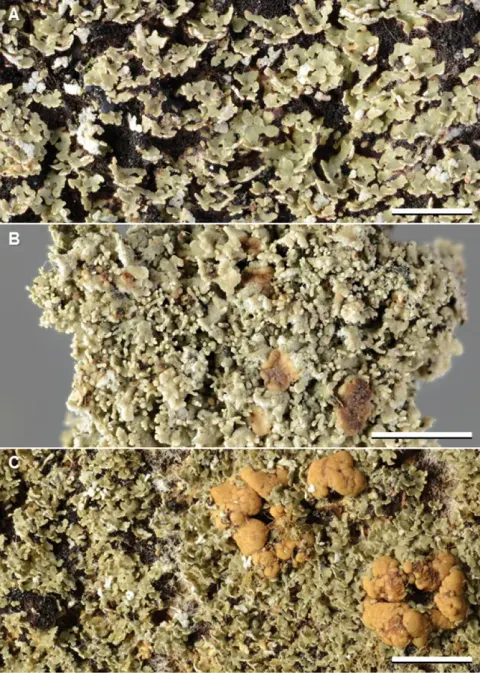
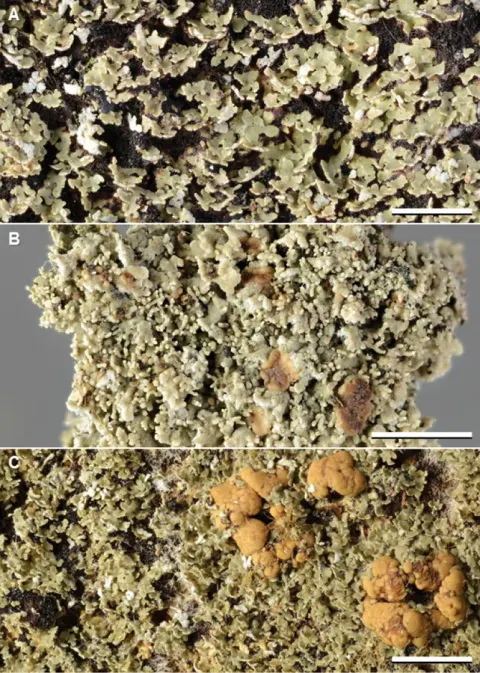
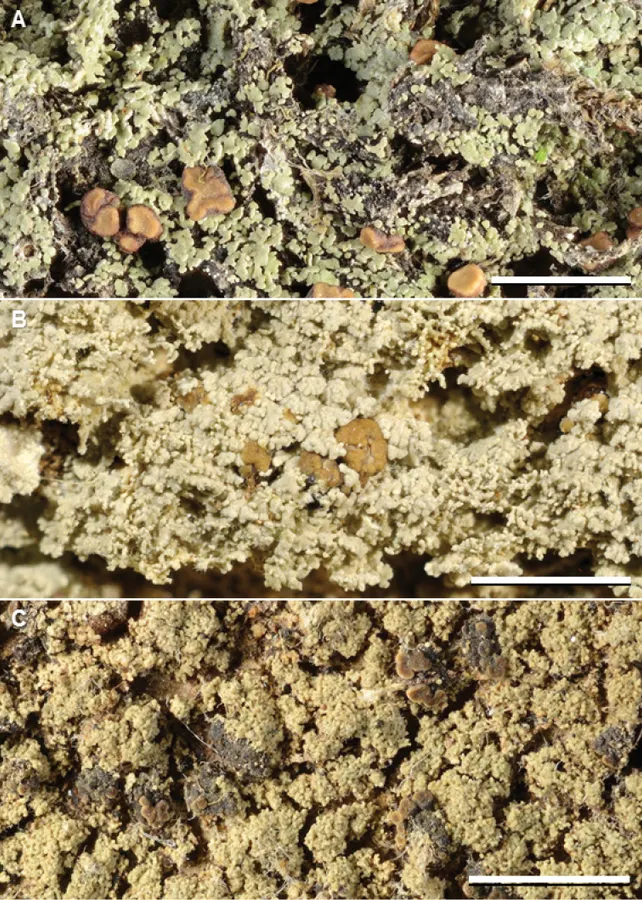
Phyllopsora dolichospora has a thallus (main body) that forms a spreading crust developing from a (initial fungal growth stage). The crust consists of small (island-like segments) that often merge to form a continuous surface. The thallus ranges from indistinct to well-developed, with a colour that varies from white to reddish-brown. The are attached to the along their entire lower surface (), are roughly circular and of equal diameter (), and are flat to slightly convex. They appear medium to dark green and may be smooth () or slightly fuzzy () along the edges. Isidia, the small vegetative reproductive structures, are abundant, moderately thick, often elongated, and range from medium to dark green. They can be smooth or occasionally coral-like in appearance, often curved, and attached at their base while rising upward. The upper is about 5–15 μm thick, classified as type 2, and lacks crystals, while the medulla contains crystals that dissolve in potassium hydroxide solution (KOH). Apothecia (fruiting bodies) are common in P. dolichospora, measuring up to 2 mm in diameter. They have an irregular shape, typically forming clusters, and range from flat to slightly convex and from medium to dark brown in colour, with a somewhat indistinct, often slightly paler margin that may be smooth or slightly fuzzy, especially in younger specimens. The , the outer protective layer of the apothecium, is pale brown with scattered darker brown patches, containing colourless crystals that dissolve in KOH. The , the tissue beneath the spore-producing layer, is pale brown in its lower portion and more reddish-brown in its upper part, containing scattered colourless crystals that dissolve in KOH.
Habitat dan peran ekologis
Phyllopsora dolichospora grows in montane rainforests and humid woodland habitats. It has been documented across a significant elevation range in East Africa from sea level up to 1,800 metres altitude, in Tanzania at elevations between 1,450–1,600 metres, particularly in the Southern Highlands Province and Tanga Province, in Mauritius at approximately 600 metres altitude, and in the Seychelles from sea level up to 460 metres altitude. Specific collection sites include the Shewa Province in Ethiopia, Rufiji District and Iringa District in Tanzania, the west Usambara Mountains, and Mahé Island in the Seychelles. The species tends to inhabit forest edges, escarpments, and areas along paths and roads in tropical regions. In 2014, it was reported from Sri Lanka.
- Habitat atau konteks temuan
- hutan
- Substrat
- Informasi belum tersedia pada sumber rilis ini.
- Peran atau konteks
- Pembentuk liken
Reproduksi
Isidia, the small vegetative reproductive structures, are abundant, moderately thick, often elongated, and range from medium to dark green. They can be smooth or occasionally coral-like in appearance, often curved, and attached at their base while rising upward. The upper is about 5–15 μm thick, classified as type 2, and lacks crystals, while the medulla contains crystals that dissolve in potassium hydroxide solution (KOH). The , the outer protective layer of the apothecium, is pale brown with scattered darker brown patches, containing colourless crystals that dissolve in KOH. The , the tissue beneath the spore-producing layer, is pale brown in its lower portion and more reddish-brown in its upper part, containing scattered colourless crystals that dissolve in KOH.
Catatan identitas dan cakupan
- Nama diterima mengikuti Catalogue of Life Base2026-09-11; uraian mempertahankan konsep dan nama sumber aslinya.
- Original geographic, specimen and life-cycle scope retained; source import awaits individual editorial review.
- Impor dan terjemahan otomatis belum diperiksa editorial per profil. Struktur reproduktif yang disebutkan tidak membuktikan seluruh siklus hidup diketahui.
- Pengukuran pada uraian mengikuti spesimen, kultur, dan metode sumber; angka tidak diperluas ke semua populasi.
Catatan distribusi dalam narasi mengikuti sumbernya. Dokumentasi spesimen atau foto mengikuti catatan sumber. Bukti wilayah Indonesia dan penilaian konservasi tidak disimpulkan dari gambar.
Melihat dengan konteks
Species of Phyllopsora occurring in Asia and Melanesia. A Phyllopsora confusa (Kistenich & Weerakoon SK1-532) B P. cuyabensis (Aguirre, James & Wolseley 2467a) C P. dolichospora (Weerakoon Si113B). Scale bars: 2 mm.
- Jenis
- Pelat ilmiah
- Kredit
- Sonja Kistenich, Mika Bendiksby, Charles S. Vairappan, Gothamie Weerakoon, Siril Wijesundara, Patricia A. Wolseley, Einar Timdal
- Lisensi
- CC BY 4.0
- Sumber media
- Buka entri sumber
Sumber profil
- [1] Phyllopsora dolichospora — Wikipedia (en)
- [2] Catalogue of Life Base2026-09-11 — Phyllopsora dolichospora
- [3] Dokumentasi visual — Phyllopsora dolichospora
Rujukan halaman ini
Fungi. Phyllopsora dolichospora. Rilis data fungi-2026-10-12-expansion-2. https://fungi-atlas.mgadib.chatgpt.site/jamur/phyllopsora-dolichospora/.
Status: impor sumber; pemeriksaan editorial per profil belum selesai. Untuk klaim biologis, gunakan rujukan pada bagian terkait dan periksa konteks sumber aslinya.