01 / Morfologi

Ciri dan struktur

Differs from P. corallina in having a more rosulate thallus and in substitutions in the mtSSU and ITS sequences. Thallus effuse or forming irregular rosettes up to 1 cm diam., squamulose; squamules medium sized, up to 1 mm wide, adnate to ascending, elongate, contiguous or partly imbricate, crenulate to incised, plane to weakly convex, medium green, glabrous on the upper side, faintly pubescent along the margin; isidia common, attached marginally to the squamules, cylindrical, simple or slightly branched, up to 0.1 mm wide and 0.6 mm long; upper cortex formed by thick-walled hyphae with rounded lumina (type 2), 20–30 µm thick; cortex and medulla not containing crystals (PD–, K–); prothallus indistinct to partly well developed, white. Apothecia common, up to 1.5 mm diam., rounded when young, later often becoming irregular, simple or sometimes somewhat conglomerate, plane to moderately convex, yellowish to medium brown, with an indistinct, usually slightly paler, glabrous to finely pubescent margin; excipulum pale brown to colourless, K–; hypothecium pale brown to colourless, K–; epithecium colourless; no crystals in apothecium; ascospores narrowly ellipsoid to shortly bacilliform, simple, 6–10 × 2.5–3 µm (n=30). Conidiomata not seen.

Sebagian uraian ditampilkan dalam bahasa sumber; terjemahannya belum tersedia atau belum lolos pemeriksaan.

Rujukan: [1]

Pengukuran mengikuti objek, spesimen atau kultur, dan metode yang disebutkan sumber. Baca uraian asli untuk konteks lengkap.

02 / Kehidupan

Habitat dan peran ekologis

The species is morphologically, anatomically, and chemically very similar to P. corallina. There is, however, a tendency of P. pseudocorallina being more rosulate, i.e., composed of more radiating and elongated marginal lobes. The phylogenetic tree (Fig. 1), however, shows the two species not to be closely related: P. corallina is resolved in a clade with P. glaucella and P. rappiana as sister to P. martinii, while P. pseudocorallina appears in a clade with P. castaneocincta and P. neofoliata among others (Fig. 1). The new species is widely distributed in Asia and also found on The Seychelles. It is unclear whether P. corallina occurs in Asia at all or if previously reported specimens of P. corallina rather represent specimens of P. pseudocorallina. MALAYSIA, Sabah: Malaysian Borneo, Maliau, “Knowledge Trail”, pristine lowland dipterocarp forest; on stem (ca. 20 m high) of fallen tree on crushed bridge, 2012, H. Thüs, P. Wolseley & C. Vairappan M001a (BORH) [DNA: MK412437 (mtSSU)]; same locality data, H. Thüs, P. Wolseley & C. Vairappan M001b (BORH); same locality data, H. Thüs, P. Wolseley & C. Vairappan M005 (BORH) [DNA: MK412438 (mtSSU)]. PAPUA NEW GUINEA, Madang: Manam island, near Bogia, in gardens near Budua, 4°07'S, 145°00'E, 50 m alt., epiphytic, 1992-07-22, P.

Sebagian uraian ditampilkan dalam bahasa sumber; terjemahannya belum tersedia atau belum lolos pemeriksaan.

Rujukan: [1]

Habitat atau konteks temuan
hutan
Substrat
Informasi belum tersedia pada sumber rilis ini.
Peran atau konteks
Pembentuk liken
Temukan hubungan serupa
03 / Siklus hidup

Reproduksi

Thallus effuse or forming irregular rosettes up to 1 cm diam., squamulose; squamules medium sized, up to 1 mm wide, adnate to ascending, elongate, contiguous or partly imbricate, crenulate to incised, plane to weakly convex, medium green, glabrous on the upper side, faintly pubescent along the margin; isidia common, attached marginally to the squamules, cylindrical, simple or slightly branched, up to 0.1 mm wide and 0.6 mm long; upper cortex formed by thick-walled hyphae with rounded lumina (type 2), 20–30 µm thick; cortex and medulla not containing crystals (PD–, K–); prothallus indistinct to partly well developed, white. Apothecia common, up to 1.5 mm diam., rounded when young, later often becoming irregular, simple or sometimes somewhat conglomerate, plane to moderately convex, yellowish to medium brown, with an indistinct, usually slightly paler, glabrous to finely pubescent margin; excipulum pale brown to colourless, K–; hypothecium pale brown to colourless, K–; epithecium colourless; no crystals in apothecium; ascospores narrowly ellipsoid to shortly bacilliform, simple, 6–10 × 2.5–3 µm (n=30).

Sebagian uraian ditampilkan dalam bahasa sumber; terjemahannya belum tersedia atau belum lolos pemeriksaan.

Rujukan: [1]

04 / Batas informasi

Catatan identitas dan cakupan

  • Nama diterima mengikuti Catalogue of Life Base2026-09-11; uraian mempertahankan konsep dan nama sumber aslinya.
  • Preserve original treatment localities, hosts and substrate scope. Materials examined describe documented specimens, not the full global range.
  • Impor dan terjemahan otomatis belum diperiksa editorial per profil. Struktur reproduktif yang disebutkan tidak membuktikan seluruh siklus hidup diketahui.
  • Pengukuran pada uraian mengikuti spesimen, kultur, dan metode sumber; angka tidak diperluas ke semua populasi.

Catatan distribusi dalam narasi mengikuti sumbernya. Dokumentasi spesimen atau foto mengikuti catatan sumber. Bukti wilayah Indonesia dan penilaian konservasi tidak disimpulkan dari gambar.

05 / Dokumentasi

Melihat dengan konteks

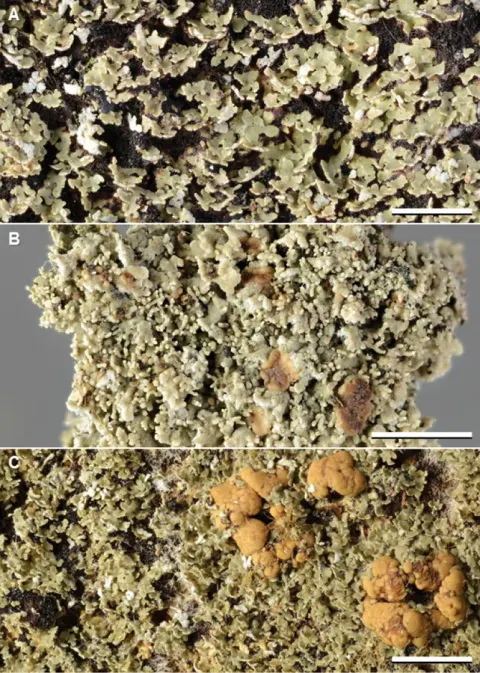
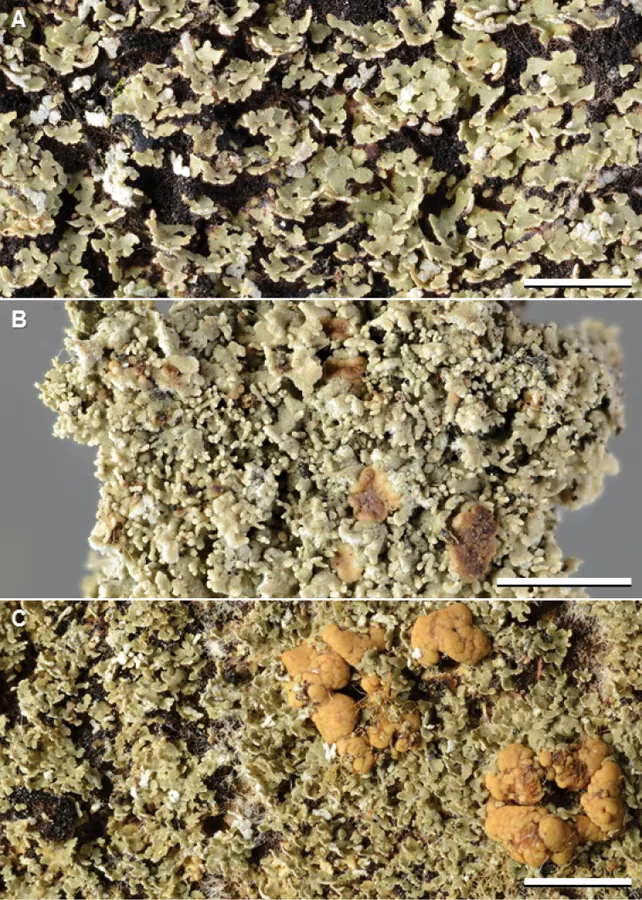
Species of Phyllopsora occurring in Asia and Melanesia. A Phyllopsora porphyromelaena (Kistenich & Weerakoon SK1-572) B P. pseudocorallina sp. nov. (holotype, Kashiwadani 47806) C P. sabahana sp. nov. (holotype, Wolseley, Thüs & Vairappan S.B.oQ.3). Scale bars: 2 mm.

Jenis
Pelat ilmiah
Kredit
Sonja Kistenich, Mika Bendiksby, Charles S. Vairappan, Gothamie Weerakoon, Siril Wijesundara, Patricia A. Wolseley, Einar Timdal
Lisensi
CC BY 4.0
Sumber media
Buka entri sumber

Gambar menunjukkan objek menurut identifikasi sumber, bukan verifikasi independen spesimen oleh Fungi. Tidak ada skala baru yang ditambahkan.

06 / Rujukan

Sumber profil

  1. [1] A regional study of the genus Phyllopsora (Ramalinaceae) in Asia and Melanesia — Phyllopsora pseudocorallinaBagian sumber: PMC6551344_section_104
    Tanggal penghimpunan sumber: 2026-10-12
    Teks sumber: CC BY 4.0 · Kistenich S, Bendiksby M, Vairappan CS, Weerakoon G, Wijesundara S, Wolseley PA, Timdal E.
  2. [2] Catalogue of Life Base2026-09-11 — Phyllopsora pseudocorallinaBagian sumber: ColDP NameUsage.tsv ID 6VG9K; accepted species; source 2073
    Tanggal penghimpunan sumber: 2026-10-12
  3. [3] Dokumentasi visual — Phyllopsora pseudocorallinaBagian sumber: Individual media record; identification follows the source, not independent determination
    Tanggal penghimpunan sumber: 2026-10-12
    Media sumber: CC BY 4.0 · Sonja Kistenich, Mika Bendiksby, Charles S. Vairappan, Gothamie Weerakoon, Siril Wijesundara, Patricia A. Wolseley, Einar Timdal

Adaptasi teks: CC BY 4.0. Kistenich S, Bendiksby M, Vairappan CS, Weerakoon G, Wijesundara S, Wolseley PA, Timdal E. — A regional study of the genus Phyllopsora (Ramalinaceae) in Asia and Melanesia — Phyllopsora pseudocorallina

Uraian asli dan riwayat sumber

Riwayat atau halaman sumber

Ringkasan sumber

Differs from P. corallina in having a more rosulate thallus and in substitutions in the mtSSU and ITS sequences. Thallus effuse or forming irregular rosettes up to 1 cm diam., squamulose; squamules medium sized, up to 1 mm wide, adnate to ascending, elongate, contiguous or partly imbricate, crenulate to incised, plane to weakly convex, medium green, glabrous on the upper side, faintly pubescent along the margin; isidia common, attached marginally to the squamules, cylindrical, simple or slightly branched, up to 0.1 mm wide and 0.6 mm long; upper cortex formed by thick-walled hyphae with rounded lumina (type 2), 20–30 µm thick; cortex and medulla not containing crystals (PD–, K–); prothallus indistinct to partly well developed, white.

Revisi sumber

Morfologi sumber

Differs from P. corallina in having a more rosulate thallus and in substitutions in the mtSSU and ITS sequences. Thallus effuse or forming irregular rosettes up to 1 cm diam., squamulose; squamules medium sized, up to 1 mm wide, adnate to ascending, elongate, contiguous or partly imbricate, crenulate to incised, plane to weakly convex, medium green, glabrous on the upper side, faintly pubescent along the margin; isidia common, attached marginally to the squamules, cylindrical, simple or slightly branched, up to 0.1 mm wide and 0.6 mm long; upper cortex formed by thick-walled hyphae with rounded lumina (type 2), 20–30 µm thick; cortex and medulla not containing crystals (PD–, K–); prothallus indistinct to partly well developed, white. Apothecia common, up to 1.5 mm diam., rounded when young, later often becoming irregular, simple or sometimes somewhat conglomerate, plane to moderately convex, yellowish to medium brown, with an indistinct, usually slightly paler, glabrous to finely pubescent margin; excipulum pale brown to colourless, K–; hypothecium pale brown to colourless, K–; epithecium colourless; no crystals in apothecium; ascospores narrowly ellipsoid to shortly bacilliform, simple, 6–10 × 2.5–3 µm (n=30). Conidiomata not seen.

Revisi sumber

Ekologi sumber

The species is morphologically, anatomically, and chemically very similar to P. corallina. There is, however, a tendency of P. pseudocorallina being more rosulate, i.e., composed of more radiating and elongated marginal lobes. The phylogenetic tree (Fig. 1), however, shows the two species not to be closely related: P. corallina is resolved in a clade with P. glaucella and P. rappiana as sister to P. martinii, while P. pseudocorallina appears in a clade with P. castaneocincta and P. neofoliata among others (Fig. 1). The new species is widely distributed in Asia and also found on The Seychelles. It is unclear whether P. corallina occurs in Asia at all or if previously reported specimens of P. corallina rather represent specimens of P. pseudocorallina. MALAYSIA, Sabah: Malaysian Borneo, Maliau, “Knowledge Trail”, pristine lowland dipterocarp forest; on stem (ca. 20 m high) of fallen tree on crushed bridge, 2012, H. Thüs, P. Wolseley & C. Vairappan M001a (BORH) [DNA: MK412437 (mtSSU)]; same locality data, H. Thüs, P. Wolseley & C. Vairappan M001b (BORH); same locality data, H. Thüs, P. Wolseley & C. Vairappan M005 (BORH) [DNA: MK412438 (mtSSU)]. PAPUA NEW GUINEA, Madang: Manam island, near Bogia, in gardens near Budua, 4°07'S, 145°00'E, 50 m alt., epiphytic, 1992-07-22, P.

Revisi sumber

Struktur reproduksi sumber

Thallus effuse or forming irregular rosettes up to 1 cm diam., squamulose; squamules medium sized, up to 1 mm wide, adnate to ascending, elongate, contiguous or partly imbricate, crenulate to incised, plane to weakly convex, medium green, glabrous on the upper side, faintly pubescent along the margin; isidia common, attached marginally to the squamules, cylindrical, simple or slightly branched, up to 0.1 mm wide and 0.6 mm long; upper cortex formed by thick-walled hyphae with rounded lumina (type 2), 20–30 µm thick; cortex and medulla not containing crystals (PD–, K–); prothallus indistinct to partly well developed, white. Apothecia common, up to 1.5 mm diam., rounded when young, later often becoming irregular, simple or sometimes somewhat conglomerate, plane to moderately convex, yellowish to medium brown, with an indistinct, usually slightly paler, glabrous to finely pubescent margin; excipulum pale brown to colourless, K–; hypothecium pale brown to colourless, K–; epithecium colourless; no crystals in apothecium; ascospores narrowly ellipsoid to shortly bacilliform, simple, 6–10 × 2.5–3 µm (n=30).

Revisi sumber

Rujukan halaman ini

Fungi. Phyllopsora pseudocorallina. Rilis data fungi-2026-10-12-expansion-2. https://fungi-atlas.mgadib.chatgpt.site/jamur/phyllopsora-pseudocorallina/.

Status: impor sumber; pemeriksaan editorial per profil belum selesai. Untuk klaim biologis, gunakan rujukan pada bagian terkait dan periksa konteks sumber aslinya.