Ciri dan struktur
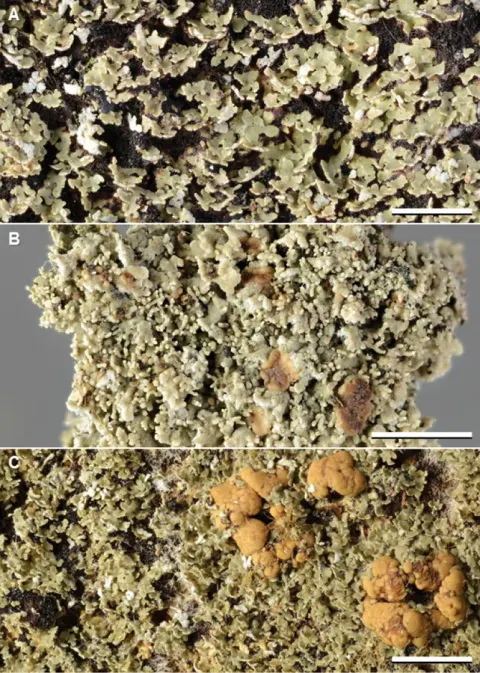
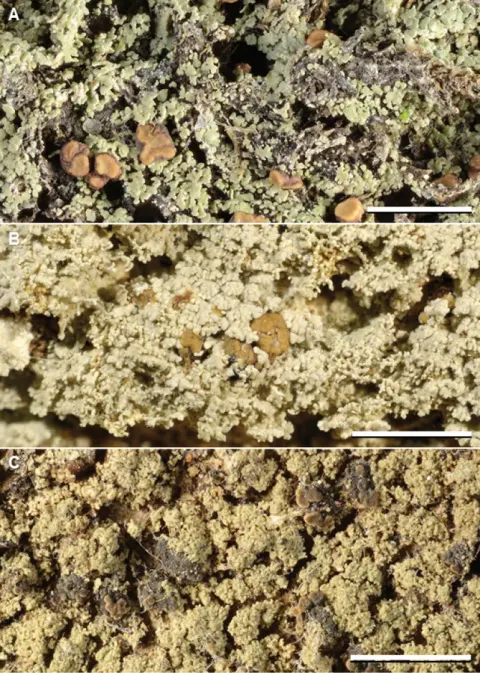
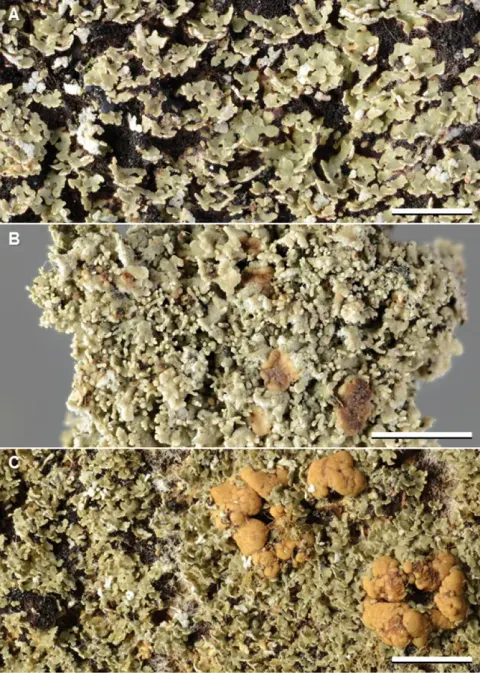
In the original description, Nylander characterized the lichen body (thallus) as whitish to blue-grey, closely pressed to its substrate, and arranged in somewhat overlapping, shallowly scalloped that give the whole patch a vaguely rosette-like () outline. He noted that the underside is black, with even the upper edges of the lobes faintly darkened. The fruiting bodies (apothecia) were described as dark brown to black, convex, and lacking a rim of thalline tissue (), measuring about 0.5–0.8 mm across. Each spore-bearing sac (ascus) contains eight ascospores, which are undivided (), ellipsoid to oblong, and about 4–6 by 2 micrometres. The surface layer of the fruiting disc () was colourless, the tissue beneath it () brown, and the spore-producing layer (hymenium) turned blue and then quickly tawny-red in iodine. Nylander also described the species as bark-dwelling and distinguished it by its relatively thick thallus—up to about 0.5 mm—that gives no reaction to potassium hydroxide (K−) and has a black underside.
Habitat dan peran ekologis
Phyllopsora pyxinoides is widely distributed in Brazil, where it has been documented from numerous states. It has also been found in Colombia, in mainland Ecuador, Mexico, and Florida. Outside of the Americas, the lichen has been reported from South and Southeast Asia, including India, Sri Lanka, and Thailand.
- Habitat atau konteks temuan
- Informasi belum tersedia pada sumber rilis ini.
- Substrat
- Informasi belum tersedia pada sumber rilis ini.
- Peran atau konteks
- Pembentuk liken
Reproduksi
In the original description, Nylander characterized the lichen body (thallus) as whitish to blue-grey, closely pressed to its substrate, and arranged in somewhat overlapping, shallowly scalloped that give the whole patch a vaguely rosette-like () outline. He noted that the underside is black, with even the upper edges of the lobes faintly darkened. The fruiting bodies (apothecia) were described as dark brown to black, convex, and lacking a rim of thalline tissue (), measuring about 0.5–0.8 mm across. Each spore-bearing sac (ascus) contains eight ascospores, which are undivided (), ellipsoid to oblong, and about 4–6 by 2 micrometres. The surface layer of the fruiting disc () was colourless, the tissue beneath it () brown, and the spore-producing layer (hymenium) turned blue and then quickly tawny-red in iodine.
Catatan identitas dan cakupan
- Nama diterima mengikuti Catalogue of Life Base2026-09-11; uraian mempertahankan konsep dan nama sumber aslinya.
- Original geographic, specimen and life-cycle scope retained; source import awaits individual editorial review.
- Impor dan terjemahan otomatis belum diperiksa editorial per profil. Struktur reproduktif yang disebutkan tidak membuktikan seluruh siklus hidup diketahui.
- Pengukuran pada uraian mengikuti spesimen, kultur, dan metode sumber; angka tidak diperluas ke semua populasi.
Catatan distribusi dalam narasi mengikuti sumbernya. Dokumentasi spesimen atau foto mengikuti catatan sumber. Bukti wilayah Indonesia dan penilaian konservasi tidak disimpulkan dari gambar.
Melihat dengan konteks
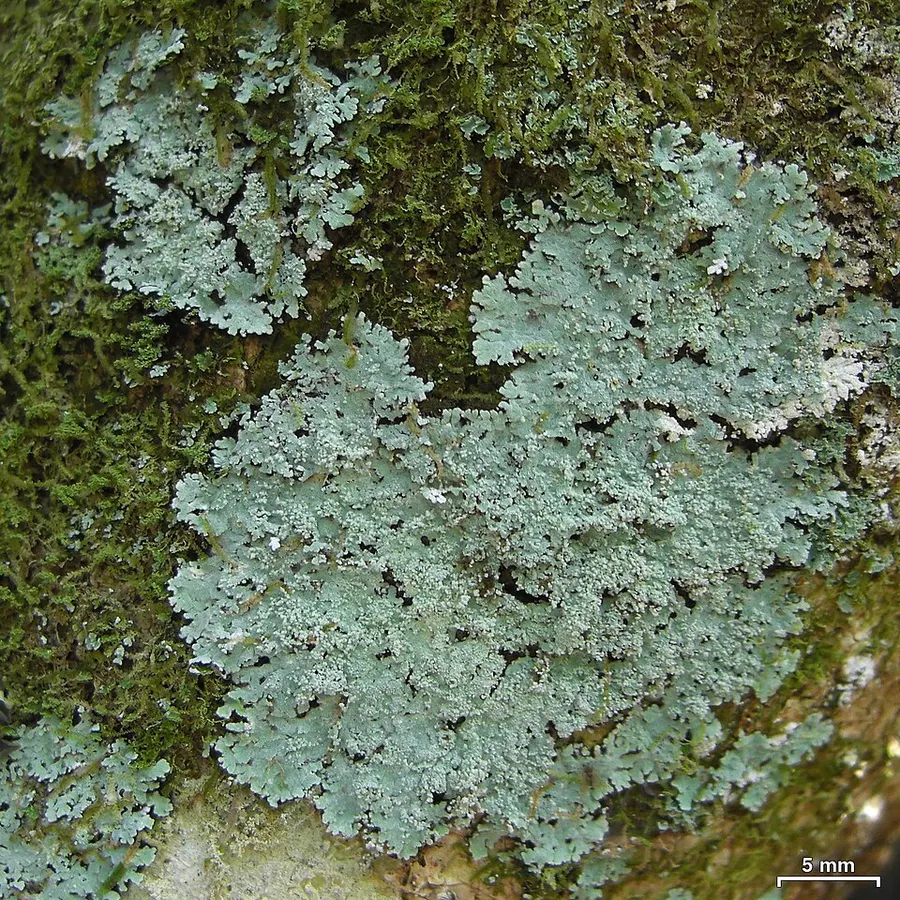
Dokumentasi Phyllopsora pyxinoides dari Wikimedia Commons. Fakahatchee Strand, Florida, 20131217 Identifikasi mengikuti record berkas sumber.
- Jenis
- Fotografi
- Kredit
- Jason Hollinger
- Lisensi
- CC BY 2.0
- Sumber media
- Buka entri sumber
Sumber profil
- [1] Phyllopsora pyxinoides — Wikipedia (en)
- [2] Catalogue of Life Base2026-09-11 — Phyllopsora pyxinoides
- [3] Dokumentasi visual — Phyllopsora pyxinoides
Rujukan halaman ini
Fungi. Phyllopsora pyxinoides. Rilis data fungi-2026-10-12-expansion-2. https://fungi-atlas.mgadib.chatgpt.site/jamur/phyllopsora-pyxinoides/.
Status: impor sumber; pemeriksaan editorial per profil belum selesai. Untuk klaim biologis, gunakan rujukan pada bagian terkait dan periksa konteks sumber aslinya.