01 / Morfologi

Ciri dan struktur

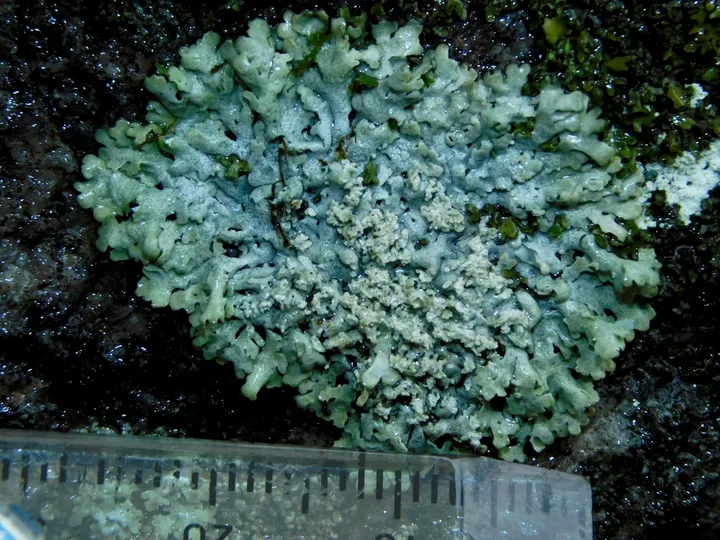
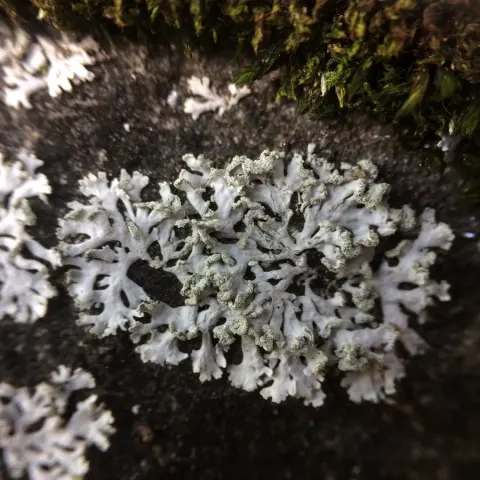
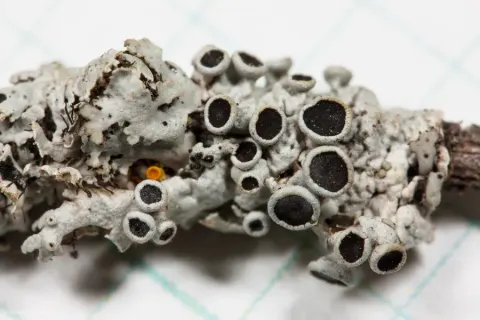
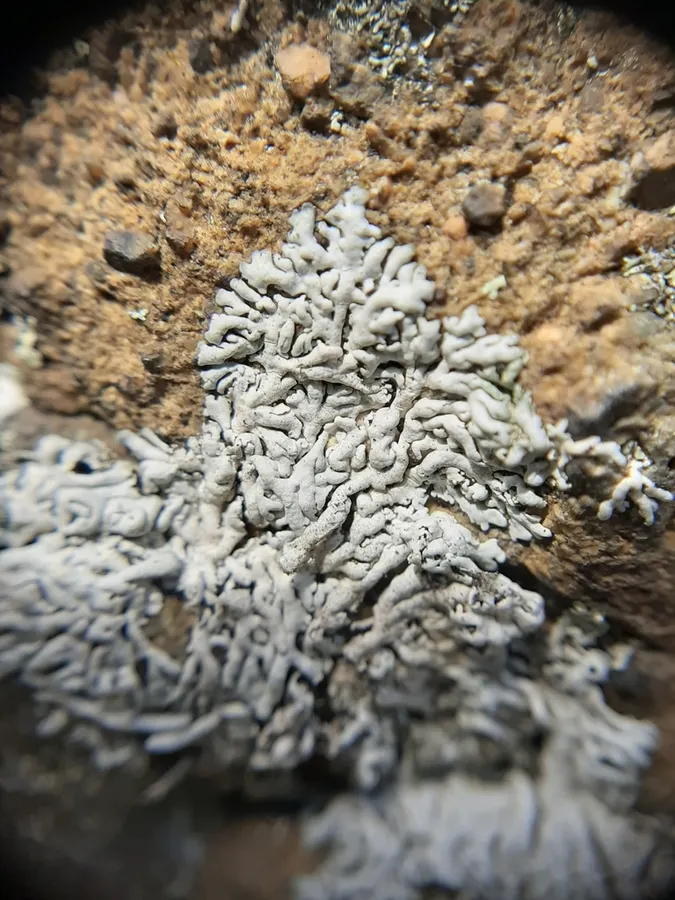
Physcia caesia is a foliose lichen that forms small rosettes, typically measuring 2 – 3 cm across at maturity, though it can reach diameters of up to 7 cm. The thallus is pale gray shading to darker gray in the center, and adheres closely to the substrate on which it grows. Its convex lobes are linear, typically measuring 0.5 – 1.0 mm in width, though occasionally as wide as 2 mm. Forms in some areas, including Greenland, can be considerably darker, with a thallus ranging from gray to dark gray; they can also have broader or narrower lobes. The lichen's surface is white-spotted, though this is not always obvious. It has blue-gray soredia, which are piled in round mounds (such aggregations are known as soralia) across the thallus's upper surface. The lower surface is white to brown with short, dark rhizines. Physcia caesia only rarely has apothecia. Where present, these are black discs measuring up to 2 mm across, with prominent thalline margins (which means the thallus extends up around the edges of the apothecia) and a grayish pruinescence. Each ascus contains 8 spores, which are thick-walled and brown, measuring 18 – 25 μm x 6 – 10 μm. Its photobiont is the green alga Trebouxia impressa, a species associated with many Physcia lichens. The lichen's cortex and medulla react positively with potassium hydroxide (K), turning yellow. Cortex and medulla react positively with para-phenylenediamene (Pd) as well, also turning yellow. They produce no reaction with calcium or sodium hypochlorite (bleach – C), nor with KC (potassium hydroxide quickly followed by bleach). Among the substances produced by the lichen are atranorin and zeorin.

Sebagian uraian ditampilkan dalam bahasa sumber; terjemahannya belum tersedia atau belum lolos pemeriksaan.

Rujukan: [1]

Pengukuran mengikuti objek, spesimen atau kultur, dan metode yang disebutkan sumber. Baca uraian asli untuk konteks lengkap.

02 / Kehidupan

Habitat dan peran ekologis

Physcia caesia is widespread across much of the world, found in Arctic, boreal and temperate vegetation zones. Widely distributed across Europe, it is one of the most common species of Physcia in Greenland, and is abundant throughout Britain. Though found across much of North America, it is absent from central and southeastern United States, parts of the Great Basin, and northern Alaska. In South America, it is found in Argentina, Chile, and Peru; common and widespread in temperate areas, it occurs only rarely and only at elevations above 3700 m in tropical regions. It occurs patchily across Asia—in India, Bhutan, Nepal and Japan—as well as in East Africa. It is described as "cosmopolitan" in New Zealand, has been reported from a number of sites in southeastern Australia and Tasmania, and also occurs in Antarctica. It is common on calcareous substrates, growing on limestone (including tufa) and concrete. It also grows on basaltic and siliceous rock, as well as on bone. It is particularly common on rocks where birds perch and defecate. It is uncommon on bark; however, in the Colorado Rocky Mountains, it is one of the predominant lichens on juniper trees, growing primarily within 0.1 m of the ground on the northern and eastern side of trunks.

Sebagian uraian ditampilkan dalam bahasa sumber; terjemahannya belum tersedia atau belum lolos pemeriksaan.

Rujukan: [1]

Habitat atau konteks temuan
Informasi belum tersedia pada sumber rilis ini.
Substrat
kulit kayu
Peran atau konteks
Pembentuk liken
Temukan hubungan serupa
03 / Siklus hidup

Reproduksi

Physcia caesia is a foliose lichen that forms small rosettes, typically measuring 2 – 3 cm across at maturity, though it can reach diameters of up to 7 cm. The thallus is pale gray shading to darker gray in the center, and adheres closely to the substrate on which it grows. Its convex lobes are linear, typically measuring 0.5 – 1.0 mm in width, though occasionally as wide as 2 mm. Forms in some areas, including Greenland, can be considerably darker, with a thallus ranging from gray to dark gray; they can also have broader or narrower lobes. The lichen's surface is white-spotted, though this is not always obvious. It has blue-gray soredia, which are piled in round mounds (such aggregations are known as soralia) across the thallus's upper surface.

Sebagian uraian ditampilkan dalam bahasa sumber; terjemahannya belum tersedia atau belum lolos pemeriksaan.

Rujukan: [1]

Sinonim menurut acuan taksonomi rilis: Anaptychia caesia; Anaptychia stellaris var. caesia; Borrera caesia; Dimelaena caesia; Hagenia caesia; Imbricaria caesia; Lobaria caesia; Parmelia caesia; Parmelia pulchella var. caesia; Parmelia stellaris var. caesia; Physcia caesia f. subalbinea; Physcia stellaris f. caesia; Physcia stellaris f. subalbinea; Physcia stellaris var. caesia; Physcia subalbinea; Physcia wainioi; Placodium caesium; Psora caesia; Squamaria caesia; Xanthoria caesia
04 / Batas informasi

Catatan identitas dan cakupan

  • Nama diterima mengikuti Catalogue of Life Base2026-09-11; uraian mempertahankan konsep dan nama sumber aslinya.
  • Original geographic, specimen and life-cycle scope retained; source import awaits individual editorial review.
  • Impor dan terjemahan otomatis belum diperiksa editorial per profil. Struktur reproduktif yang disebutkan tidak membuktikan seluruh siklus hidup diketahui.
  • Pengukuran pada uraian mengikuti spesimen, kultur, dan metode sumber; angka tidak diperluas ke semua populasi.

Catatan distribusi dalam narasi mengikuti sumbernya. Dokumentasi spesimen atau foto mengikuti catatan sumber. Bukti wilayah Indonesia dan penilaian konservasi tidak disimpulkan dari gambar.

05 / Dokumentasi

Melihat dengan konteks

Dokumentasi Physcia caesia menurut asosiasi foto pada record takson iNaturalist. Kredit: Colin Meurk. Identitas mengikuti sumber; bukan penentuan spesimen independen.

Jenis
Fotografi
Kredit
(c) Colin Meurk, some rights reserved (CC BY-SA), uploaded by Colin Meurk
Sumber media
Buka entri sumber

Gambar menunjukkan objek menurut identifikasi sumber, bukan verifikasi independen spesimen oleh Fungi. Tidak ada skala baru yang ditambahkan.

Dokumentasi tambahan

06 / Rujukan

Sumber profil

  1. [1] Physcia caesia — Wikipedia (en)Bagian sumber: Frozen revision 1319377459
    Tanggal penghimpunan sumber: 2026-10-12
    Teks sumber: CC BY-SA4.0 · Wikipedia contributors
  2. [2] Catalogue of Life Base2026-09-11 — Physcia caesiaBagian sumber: ColDP NameUsage.tsv ID 77HY7; accepted species; source 2073
    Tanggal penghimpunan sumber: 2026-10-12
  3. [3] Dokumentasi visual — Physcia caesiaBagian sumber: Identitas mengikuti sumber dokumentasi; bukan penentuan spesimen independen.
    Tanggal penghimpunan sumber: 2026-10-17
    Media sumber: CC BY-SA 4.0 · (c) Colin Meurk, some rights reserved (CC BY-SA), uploaded by Colin Meurk
  4. [4] Dokumentasi visual — Physcia caesiaBagian sumber: Identitas mengikuti sumber dokumentasi; bukan penentuan spesimen independen.
    Tanggal penghimpunan sumber: 2026-10-17
    Teks sumber: CC BY 4.0 · (c) Michael J. Papay, some rights reserved (CC BY), uploaded by Michael J. Papay

Adaptasi teks: CC BY-SA 4.0. Wikipedia contributors — Physcia caesia — Wikipedia (en)

Uraian asli dan riwayat sumber

Riwayat atau halaman sumber

Ringkasan sumber

Physcia caesia, known colloquially as blue-gray rosette lichen and powder-back lichen, is a species of foliose lichenized fungus. First described by Georg Franz Hoffmann in 1784, it is common across much of Europe, North America and New Zealand, and more patchily distributed in South America, Asia, Australia and Antarctica. There are 2 subspecies: P. c. caesia and P. c. ventosa, as well as a number of distinct forms and varieties. Molecular studies suggest that the species as currently defined may be polyphyletic.

Revisi sumber

Morfologi sumber

Physcia caesia is a foliose lichen that forms small rosettes, typically measuring 2 – 3 cm across at maturity, though it can reach diameters of up to 7 cm. The thallus is pale gray shading to darker gray in the center, and adheres closely to the substrate on which it grows. Its convex lobes are linear, typically measuring 0.5 – 1.0 mm in width, though occasionally as wide as 2 mm. Forms in some areas, including Greenland, can be considerably darker, with a thallus ranging from gray to dark gray; they can also have broader or narrower lobes. The lichen's surface is white-spotted, though this is not always obvious. It has blue-gray soredia, which are piled in round mounds (such aggregations are known as soralia) across the thallus's upper surface. The lower surface is white to brown with short, dark rhizines. Physcia caesia only rarely has apothecia. Where present, these are black discs measuring up to 2 mm across, with prominent thalline margins (which means the thallus extends up around the edges of the apothecia) and a grayish pruinescence. Each ascus contains 8 spores, which are thick-walled and brown, measuring 18 – 25 μm x 6 – 10 μm. Its photobiont is the green alga Trebouxia impressa, a species associated with many Physcia lichens. The lichen's cortex and medulla react positively with potassium hydroxide (K), turning yellow. Cortex and medulla react positively with para-phenylenediamene (Pd) as well, also turning yellow. They produce no reaction with calcium or sodium hypochlorite (bleach – C), nor with KC (potassium hydroxide quickly followed by bleach). Among the substances produced by the lichen are atranorin and zeorin.

Revisi sumber

Ekologi sumber

Physcia caesia is widespread across much of the world, found in Arctic, boreal and temperate vegetation zones. Widely distributed across Europe, it is one of the most common species of Physcia in Greenland, and is abundant throughout Britain. Though found across much of North America, it is absent from central and southeastern United States, parts of the Great Basin, and northern Alaska. In South America, it is found in Argentina, Chile, and Peru; common and widespread in temperate areas, it occurs only rarely and only at elevations above 3700 m in tropical regions. It occurs patchily across Asia—in India, Bhutan, Nepal and Japan—as well as in East Africa. It is described as "cosmopolitan" in New Zealand, has been reported from a number of sites in southeastern Australia and Tasmania, and also occurs in Antarctica. It is common on calcareous substrates, growing on limestone (including tufa) and concrete. It also grows on basaltic and siliceous rock, as well as on bone. It is particularly common on rocks where birds perch and defecate. It is uncommon on bark; however, in the Colorado Rocky Mountains, it is one of the predominant lichens on juniper trees, growing primarily within 0.1 m of the ground on the northern and eastern side of trunks.

Revisi sumber

Struktur reproduksi sumber

Physcia caesia is a foliose lichen that forms small rosettes, typically measuring 2 – 3 cm across at maturity, though it can reach diameters of up to 7 cm. The thallus is pale gray shading to darker gray in the center, and adheres closely to the substrate on which it grows. Its convex lobes are linear, typically measuring 0.5 – 1.0 mm in width, though occasionally as wide as 2 mm. Forms in some areas, including Greenland, can be considerably darker, with a thallus ranging from gray to dark gray; they can also have broader or narrower lobes. The lichen's surface is white-spotted, though this is not always obvious. It has blue-gray soredia, which are piled in round mounds (such aggregations are known as soralia) across the thallus's upper surface.

Revisi sumber

Rujukan halaman ini

Fungi. Physcia caesia. Rilis data fungi-2026-10-12-expansion-2. https://fungi-atlas.mgadib.chatgpt.site/jamur/physcia-caesia/.

Status: impor sumber; pemeriksaan editorial per profil belum selesai. Untuk klaim biologis, gunakan rujukan pada bagian terkait dan periksa konteks sumber aslinya.