Ciri dan struktur
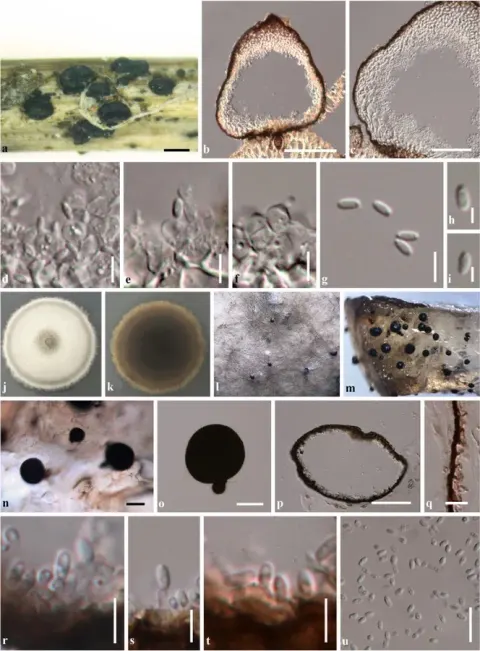
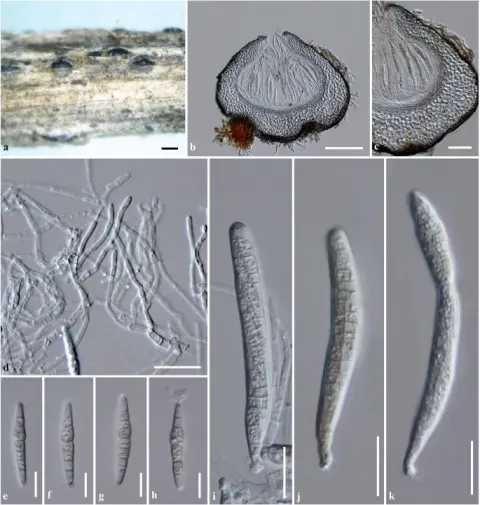
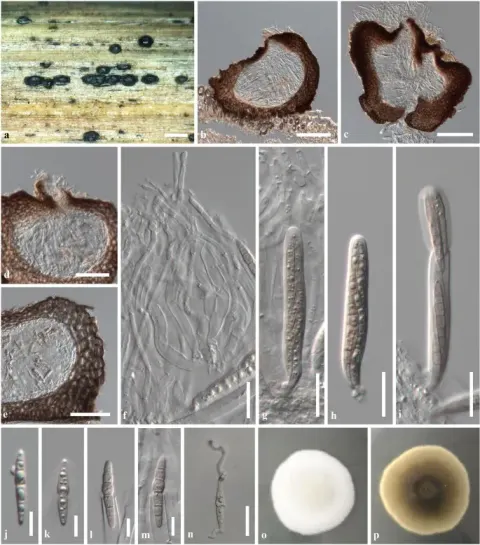
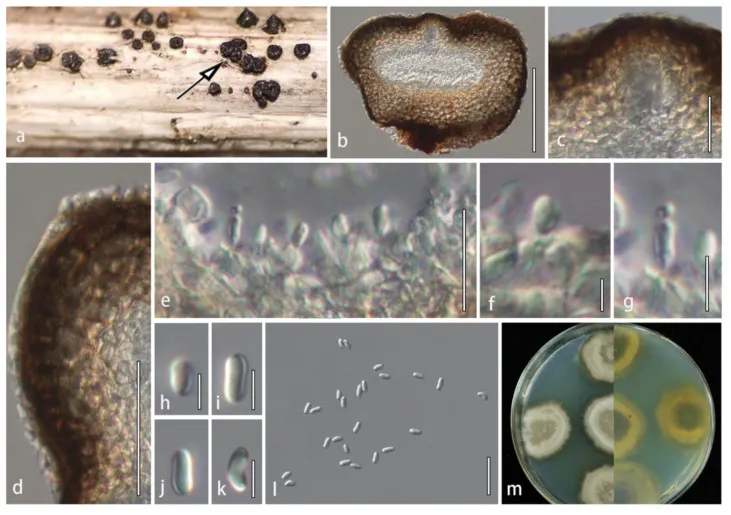
Description: Saprobic on dead stems of Poaceae. Sexual morph: Undetermined. Asexual morph: Conidiomata 163–192 × 193–245 μm (x = 175 × 207 μm, n = 5), pycnidial, solitary or in groups of 2–5, erumpent, aggregated, globose to subglobose, depression in the middle, thick-walled, subcoriaceous to coriaceous at the outer layers, dark brown to black, ostiolate. Ostioles 20–45 μm, central, papillate, ovoid, filled with short periphyses. Conidiomatal wall 24–48 μm wide, thick, multilayered, outer layer composed of 8–10 layers of dark brown to brown cells of textura angularis, lined with a thick hyaline layer bearing conidiogenous cells. Conidiophores reduced to conidiogenous cells. Conidiogenous cells 2.8–5.8 × 1.5–2.8 μm (x = 4.1 × 2 μm, n = 30), enteroblastic, phialidic, determinate, smooth-walled, hyaline. Conidia 5–7.6 × 2–3.4 μm (x = 6.2 × 2.7 μm, n = 50), oblong or oval, slightly curved toward the ends, rounded ends, aseptate, hyaline, smooth-walled. Culture characteristics: Colonies on PDA reaching 30 mm diam. after 3 weeks at 25 °C. Cultures from above, gray in the center, milky white radiating outward, dense, circular, creeping hyphae, grayish-green at the margins; reverse dark at the center, milky white radiating outward. Yellow pigmentation diffused into the media.
Habitat dan peran ekologis
Description: Saprobic on dead stems of Poaceae. Sexual morph: Undetermined. Asexual morph: Conidiomata 163–192 × 193–245 μm (x = 175 × 207 μm, n = 5), pycnidial, solitary or in groups of 2–5, erumpent, aggregated, globose to subglobose, depression in the middle, thick-walled, subcoriaceous to coriaceous at the outer layers, dark brown to black, ostiolate. Ostioles 20–45 μm, central, papillate, ovoid, filled with short periphyses. Conidiomatal wall 24–48 μm wide, thick, multilayered, outer layer composed of 8–10 layers of dark brown to brown cells of textura angularis, lined with a thick hyaline layer bearing conidiogenous cells. Conidiophores reduced to conidiogenous cells. Conidiogenous cells 2.8–5.8 × 1.5–2.8 μm (x = 4.1 × 2 μm, n = 30), enteroblastic, phialidic, determinate, smooth-walled, hyaline. Conidia 5–7.6 × 2–3.4 μm (x = 6.2 × 2.7 μm, n = 50), oblong or oval, slightly curved toward the ends, rounded ends, aseptate, hyaline, smooth-walled. Culture characteristics: Colonies on PDA reaching 30 mm diam. after 3 weeks at 25 °C. Cultures from above, gray in the center, milky white radiating outward, dense, circular, creeping hyphae, grayish-green at the margins; reverse dark at the center, milky white radiating outward.
- Habitat atau konteks temuan
- kultur yang didokumentasikan
- Substrat
- Informasi belum tersedia pada sumber rilis ini.
- Peran atau konteks
- Pengurai
Reproduksi
Description: Saprobic on dead stems of Poaceae. Sexual morph: Undetermined. Asexual morph: Conidiomata 163–192 × 193–245 μm (x = 175 × 207 μm, n = 5), pycnidial, solitary or in groups of 2–5, erumpent, aggregated, globose to subglobose, depression in the middle, thick-walled, subcoriaceous to coriaceous at the outer layers, dark brown to black, ostiolate. Ostioles 20–45 μm, central, papillate, ovoid, filled with short periphyses. Conidiomatal wall 24–48 μm wide, thick, multilayered, outer layer composed of 8–10 layers of dark brown to brown cells of textura angularis, lined with a thick hyaline layer bearing conidiogenous cells. Conidiophores reduced to conidiogenous cells. Conidiogenous cells 2.8–5.8 × 1.5–2.8 μm (x = 4.1 × 2 μm, n = 30), enteroblastic, phialidic, determinate, smooth-walled, hyaline.
Catatan identitas dan cakupan
- Nama diterima mengikuti Catalogue of Life Base2026-09-11; uraian mempertahankan konsep dan nama sumber aslinya.
- Preserve original treatment localities, hosts and substrate scope. Materials examined describe documented specimens, not the full global range.
- Impor dan terjemahan otomatis belum diperiksa editorial per profil. Struktur reproduktif yang disebutkan tidak membuktikan seluruh siklus hidup diketahui.
- Pengukuran pada uraian mengikuti spesimen, kultur, dan metode sumber; angka tidak diperluas ke semua populasi.
Catatan distribusi dalam narasi mengikuti sumbernya. Dokumentasi spesimen atau foto mengikuti catatan sumber. Bukti wilayah Indonesia dan penilaian konservasi tidak disimpulkan dari gambar.
Melihat dengan konteks
Plenodomus changchunensis (HMJAU 60186, holotype). (a) Appearance of conidiomata on host substrate; black arrow indicates the conidiomata of P. changchunensis on the host. (b) Vertical section of conidioma. (c) Ostiolar canal. (d) Section of conidioma wall. (e – g) Conidiogenous cells and conidia. (h – l) Conidia. (m) Culture characteristics on PDA after three weeks at 25 °C. Scale bars: (b) = 100 µm; (c, e, l) = 20 µm; (d) = 50 µm; and (f – k) = 5 µm.
- Jenis
- Pelat ilmiah
- Kredit
- © 2022 by the authors.
- Lisensi
- CC BY 4.0
- Sumber media
- Buka entri sumber
Sumber profil
- [1] Synopsis of Leptosphaeriaceae and Introduction of Three New Taxa and One New Record from China — Plenodomus changchunensis
- [2] Catalogue of Life Base2026-09-11 — Plenodomus changchunensis
- [3] Dokumentasi visual — Plenodomus changchunensis
Rujukan halaman ini
Fungi. Plenodomus changchunensis. Rilis data fungi-2026-10-12-expansion-2. https://fungi-atlas.mgadib.chatgpt.site/jamur/plenodomus-changchunensis/.
Status: impor sumber; pemeriksaan editorial per profil belum selesai. Untuk klaim biologis, gunakan rujukan pada bagian terkait dan periksa konteks sumber aslinya.