Ciri dan struktur
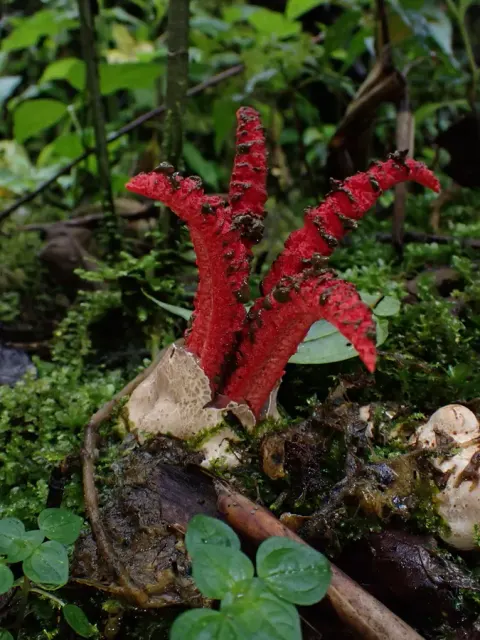
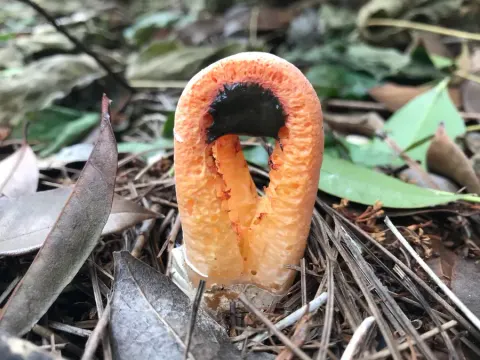
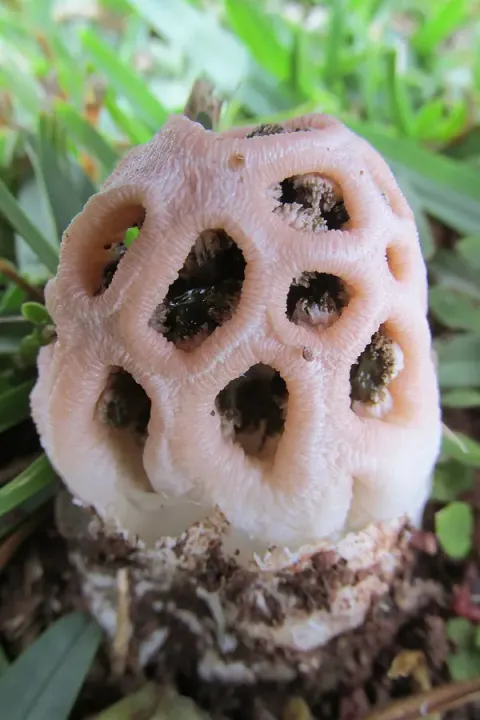
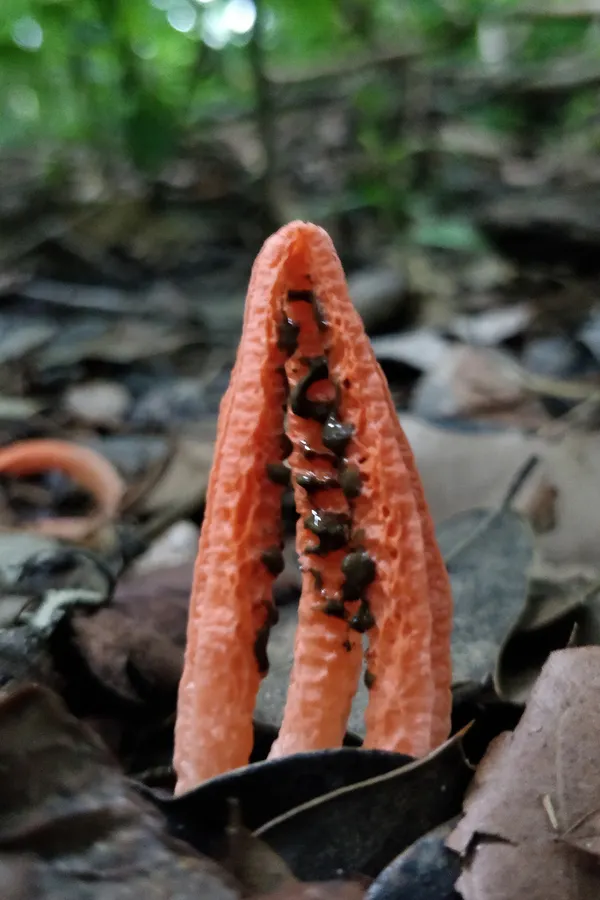
Immature fruiting bodies resemble egg- or pear-shaped puffballs, grayish-brown to pale gray in color, with dimensions of 0.5 to 2.5 cm diameter; the top surface is broken into small regions by cracks or crevices (areolate). As the fungus matures, the fruiting body cracks open and forms a stalk with tapering arms, a volva, and a spore mass known as a gleba. The mature fruiting body is typically 3 to 6 cm in height, with arms that are 2–5 times the length of the stipe. The stipe itself does not extend past the volva, and is hollow, thin-walled, chambered, wrinkled, and flares towards the upper end. The color of the stipe is white or grayish-white; it is 1 to 3.5 cm in height, and 0.5 to 2.5 cm thick at the widest diameter. The three or four arms extending from the stipe average 3.6 cm in length (ranging from 1 to 13 cm, and wrinkled on the side bearing the gleba. The arms, which are joined at the top, are shaped like a lance (lanceolate), pointed towards the apex; they are orange-colored. The internal structure of the arms is made of chambers; one large chamber towards the outside, and typically three smaller chambers on the inside of the arm. The gleba is commonly found on the upper two-thirds of the inside surface of the arms, and is dark green and slimy. The fetid odor of the gleba, described by one author as comparable to "fresh pig manure", attracts insects that help to disperse the spores. The spores are elliptical or ovoid, smooth, translucent (hyaline), with dimensions of 4.5–5.5 by 2–2.5 μm. The basidia, the spore-bearing cells, are attached to 6–8 sessile spores.
Habitat dan peran ekologis
This species grows scattered or in groups on disturbed soil in coniferous or mixed forests. It is also found growing on wood chips used as mulch in gardens or for landscaping; Blanton has also reported it growing in a garden "solitary and very large". Pseudocolus fusiformis has been collected from a variety of locations worldwide, including Europe, Australia, Japan, Java, the Philippines, Reunion Island, the United States, and Turkey. It is thought to have been introduced from southeast Asia to North America, where it can be found from May to September. In the continental United States, it was first collected in Pittsburgh in 1915; since then it has been found in Alabama, Connecticut, Georgia, Louisiana, Florida, Massachusetts, Mississippi, New Jersey, New York, North Carolina, Rhode Island, Tennessee, and Virginia; it has also been found in Hawaii.
- Habitat atau konteks temuan
- hutan
- Substrat
- kayu
- Peran atau konteks
- Belum dikategorikan pada rilis ini.
Reproduksi
Immature fruiting bodies resemble egg- or pear-shaped puffballs, grayish-brown to pale gray in color, with dimensions of 0.5 to 2.5 cm diameter; the top surface is broken into small regions by cracks or crevices (areolate). As the fungus matures, the fruiting body cracks open and forms a stalk with tapering arms, a volva, and a spore mass known as a gleba. The mature fruiting body is typically 3 to 6 cm in height, with arms that are 2–5 times the length of the stipe. The stipe itself does not extend past the volva, and is hollow, thin-walled, chambered, wrinkled, and flares towards the upper end. The color of the stipe is white or grayish-white; it is 1 to 3.5 cm in height, and 0.5 to 2.5 cm thick at the widest diameter.
Catatan identitas dan cakupan
- Nama diterima mengikuti Catalogue of Life Base2026-09-11; uraian mempertahankan konsep dan nama sumber aslinya.
- Original geographic, specimen and life-cycle scope retained; source import awaits individual editorial review.
- Impor dan terjemahan otomatis belum diperiksa editorial per profil. Struktur reproduktif yang disebutkan tidak membuktikan seluruh siklus hidup diketahui.
- Pengukuran pada uraian mengikuti spesimen, kultur, dan metode sumber; angka tidak diperluas ke semua populasi.
Catatan distribusi dalam narasi mengikuti sumbernya. Dokumentasi spesimen atau foto mengikuti catatan sumber. Bukti wilayah Indonesia dan penilaian konservasi tidak disimpulkan dari gambar.
Melihat dengan konteks
Dokumentasi Pseudocolus fusiformis menurut asosiasi foto pada record takson iNaturalist. Kredit: stephen. Identitas mengikuti sumber; bukan penentuan spesimen independen.
- Jenis
- Fotografi
- Kredit
- (c) stephen, some rights reserved (CC BY), uploaded by stephen
- Lisensi
- CC BY 4.0
- Sumber media
- Buka entri sumber
Dokumentasi tambahan
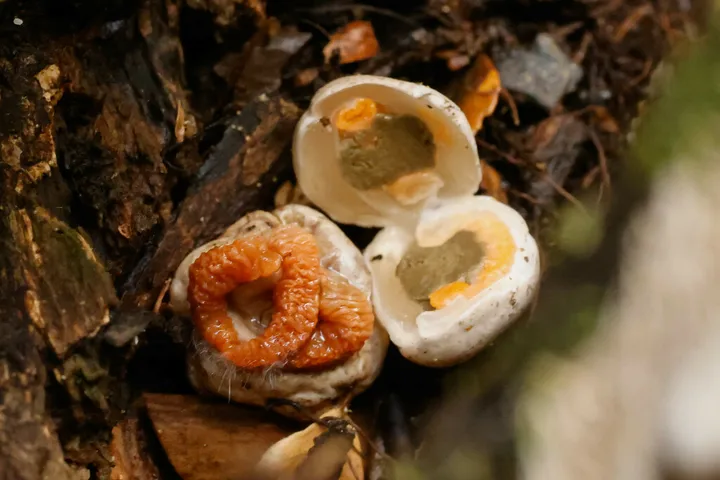
Foto yang diasosiasikan dengan Pseudocolus fusiformis pada iNaturalist. Identifikasi mengikuti sumber; bukan penentuan spesimen independen.
Kredit dan penggunaan
(c) Barry Langdon-Lassagne, some rights reserved (CC BY), uploaded by Barry Langdon-Lassagne
Ukuran dan format gambar disesuaikan tanpa pemotongan, retus, atau penambahan skala. Lisensi sumber dipertahankan.
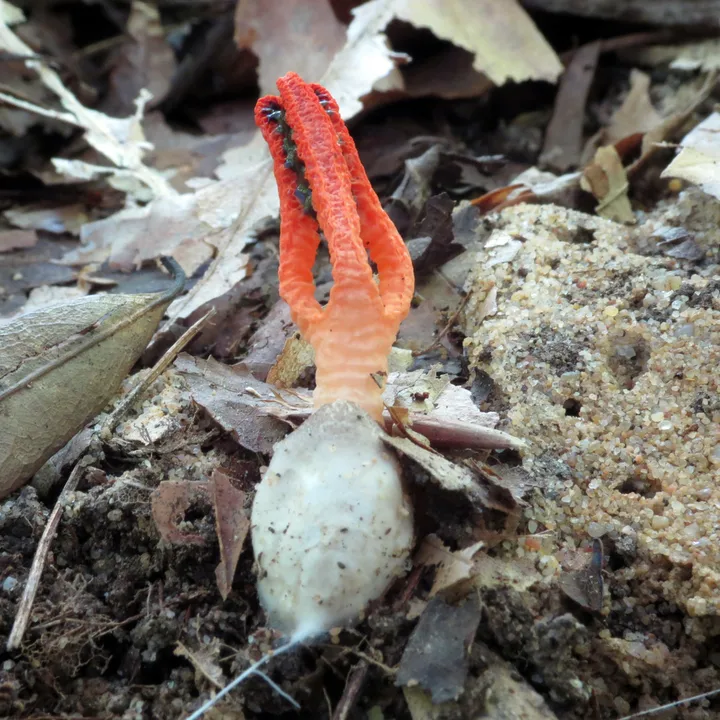
Foto yang diasosiasikan dengan Pseudocolus fusiformis pada iNaturalist. Identifikasi mengikuti sumber; bukan penentuan spesimen independen.
Kredit dan penggunaan
(c) Katja Schulz, some rights reserved (CC BY)
Ukuran dan format gambar disesuaikan tanpa pemotongan, retus, atau penambahan skala. Lisensi sumber dipertahankan.
Sumber profil
- [1] Pseudocolus fusiformis — Wikipedia (en)
- [2] Catalogue of Life Base2026-09-11 — Pseudocolus fusiformis
- [3] Dokumentasi visual — Pseudocolus fusiformis
- [4] Dokumentasi visual — Pseudocolus fusiformis
- [5] Dokumentasi visual — Pseudocolus fusiformis
Rujukan halaman ini
Fungi. Pseudocolus fusiformis. Rilis data fungi-2026-10-12-expansion-2. https://fungi-atlas.mgadib.chatgpt.site/jamur/pseudocolus-fusiformis/.
Status: impor sumber; pemeriksaan editorial per profil belum selesai. Untuk klaim biologis, gunakan rujukan pada bagian terkait dan periksa konteks sumber aslinya.