Ciri dan struktur
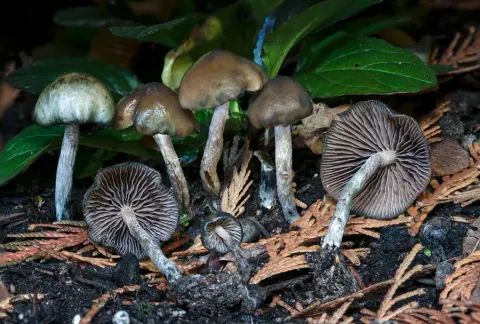
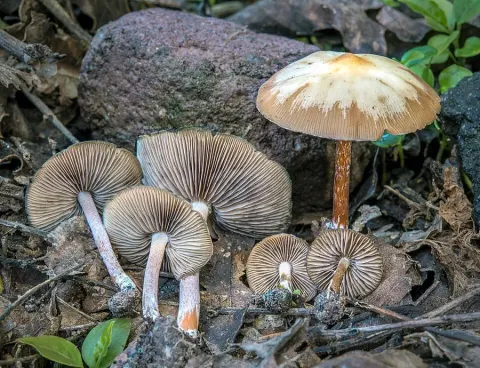
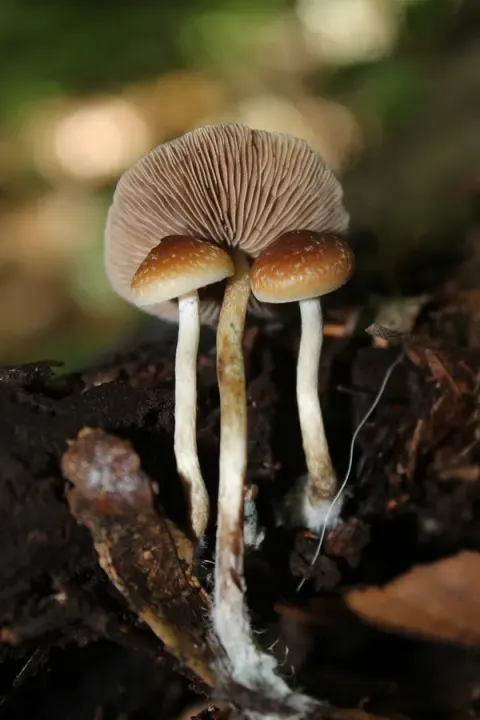
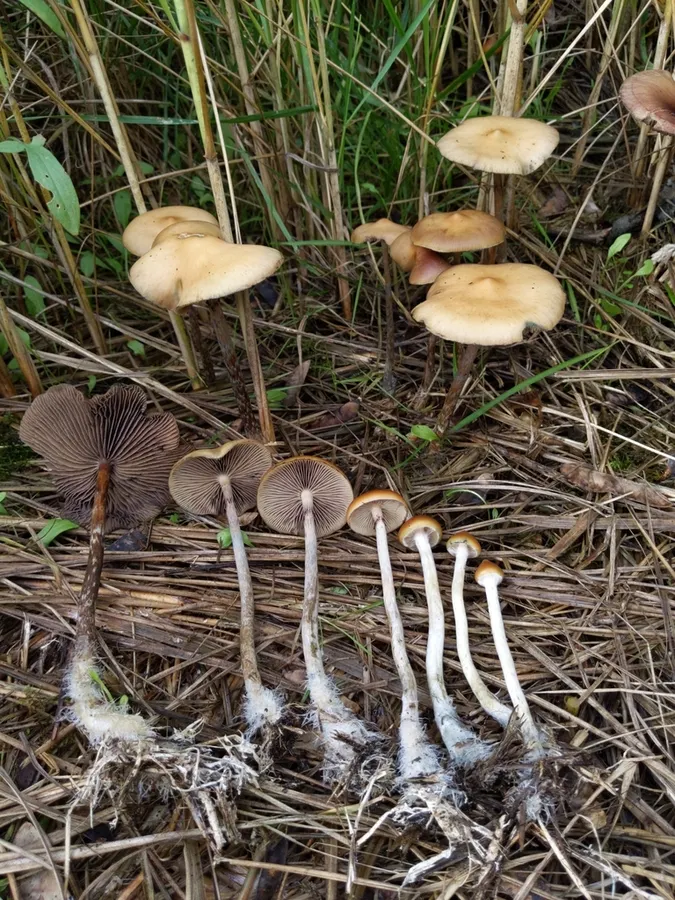
The cap (pileus) of Psilocybe azurescens is 3 - 10 cm in diameter. It has a conic to convex shape, expanding to broadly convex and eventually flattening with age with a pronounced, persistent broad umbo. Its surface is smooth and viscous when moist, covered by a separable gelatinous pellicle. It is chestnut to ochraceous brown to caramel in color, often becoming pitted with dark blue or bluish black zones. It is hygrophanous, fading to light straw color in drying and strongly bruising blue when damaged. Its margin is even, sometimes irregular and eroded at maturity. At first, it is slightly incurved, though it becomes decurved with time. The cap is translucent striate and often leaves a fibrillose annular zone in the upper regions of the stipe The lamellae are ascending, and have a sinuate to adnate attachment. They are brown and stain black when injured. They are close, and two-tiered, with whitish edges. The spore print is a dark purplish brown to purplish black. The stipe is 9 - 20 cm in length and 3 - 6 mm. It is thick, silky white to dingy brown with age. It is hollow at maturity, and composed of twisted, cartilaginous tissue. The base of the stipe thickens downwards, is often curved, and is characterized by coarse white aerial tufts of mycelium, often with azure tones. The mycelium surrounding the stipe base is densely rhizomorphic (i.e., root-like), silky white, tenaciously holding the wood-chips together. The taste of this mushroom is extremely bitter, while it is odorless to starchy smelling.
Habitat dan peran ekologis
P. azurescens terjadi secara alami di sepanjang daerah kecil di Amerika Serikat Barat Coast of, termasuk di bagian-bagian California Oregon and. Hal ini telah secara teratur ditemukan sejauh selatan Depoe Bay, Oregon, dan sejauh utara Graces Harbor County, Washington. Lokasinya utama dikelompokkan di sekitar Delta Sungai Columbia: koleksi tipe pertama dibuat di Hammond, Oregon, dekat Astoria. Hal ini juga cukup umum di utara Columbia River in Washington, dari Long Beach north ke Westport. Some feral spesimen juga dilaporkan di Stuttgart, Jerman. While infrequent, jamur ini kadang-kadang dapat ditemukan di sekitar kayu yang membusuk di Willamette Valley of Oregon, yang mendekriminalisasi psilocybin di 2020. Ilwaco, Washington also memiliki populasi yang besar, tetapi pemotongan adalah pelanggaran potensial yang diberlakukan oleh badan penegak hukum lokal. The species' preferred environment ranges from caespitose (growing in tight, separated clusters) to gregarious on deciduous wood-chips and/or in sandy soils rich in lignicolous (woody) debris. Jamur ini memiliki afinitas dengan rumput dun pantai. Dalam aspeknya menghasilkan karet micelia yang luas, padat, dan teguh (collyboid). P. azurescens menyebabkan pemutihan kayu.
- Habitat atau konteks temuan
- Informasi belum tersedia pada sumber rilis ini.
- Substrat
- Informasi belum tersedia pada sumber rilis ini.
- Peran atau konteks
- Belum dikategorikan pada rilis ini.
Reproduksi
The lamellae are ascending, and have a sinuate to adnate attachment. They are brown and stain black when injured. They are close, and two-tiered, with whitish edges. The spore print is a dark purplish brown to purplish black.
Catatan identitas dan cakupan
- Nama diterima mengikuti Catalogue of Life Base2026-09-11; uraian mempertahankan konsep dan nama sumber aslinya.
- Original geographic, specimen and life-cycle scope retained; source import awaits individual editorial review.
- Impor dan terjemahan otomatis belum diperiksa editorial per profil. Struktur reproduktif yang disebutkan tidak membuktikan seluruh siklus hidup diketahui.
- Pengukuran pada uraian mengikuti spesimen, kultur, dan metode sumber; angka tidak diperluas ke semua populasi.
Catatan distribusi dalam narasi mengikuti sumbernya. Dokumentasi spesimen atau foto mengikuti catatan sumber. Bukti wilayah Indonesia dan penilaian konservasi tidak disimpulkan dari gambar.
Melihat dengan konteks
Dokumentasi Psilocybe azurescens menurut asosiasi foto pada record takson iNaturalist. Kredit: Alan Rockefeller. Identitas mengikuti sumber; bukan penentuan spesimen independen.
- Jenis
- Fotografi
- Kredit
- (c) Alan Rockefeller, kai kurios teisės saugomos (CC BY), uploaded by Alan Rockefeller
- Lisensi
- CC BY 4.0
- Sumber media
- Buka entri sumber
Dokumentasi tambahan
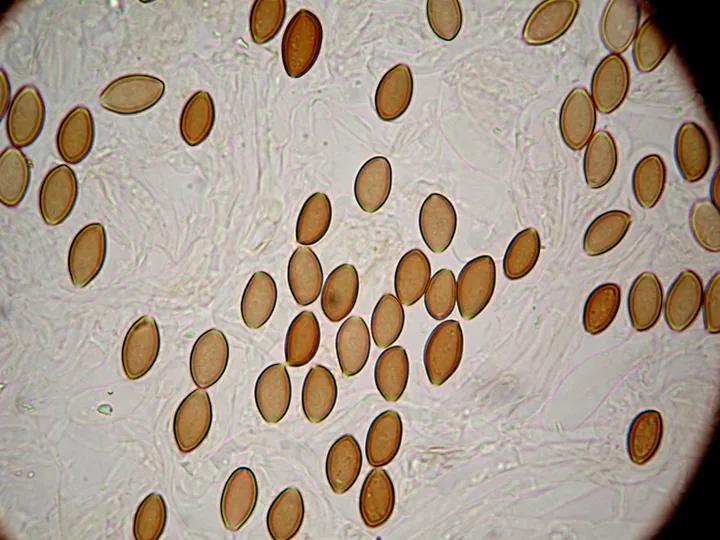
Foto yang diasosiasikan dengan Psilocybe azurescens pada iNaturalist. Identifikasi mengikuti sumber; bukan penentuan spesimen independen.
Kredit dan penggunaan
(c) Alan Rockefeller, some rights reserved (CC BY), uploaded by Alan Rockefeller
Ukuran dan format gambar disesuaikan tanpa pemotongan, retus, atau penambahan skala. Lisensi sumber dipertahankan.
Sumber profil
- [1] Psilocybe azurescens — Wikipedia (en)
- [2] Catalogue of Life Base2026-09-11 — Psilocybe azurescens
- [3] Dokumentasi visual — Psilocybe azurescens
- [4] Dokumentasi visual — Psilocybe azurescens
Rujukan halaman ini
Fungi. Psilocybe azurescens. Rilis data fungi-2026-10-12-expansion-2. https://fungi-atlas.mgadib.chatgpt.site/jamur/psilocybe-azurescens/.
Status: impor sumber; pemeriksaan editorial per profil belum selesai. Untuk klaim biologis, gunakan rujukan pada bagian terkait dan periksa konteks sumber aslinya.