Ciri dan struktur
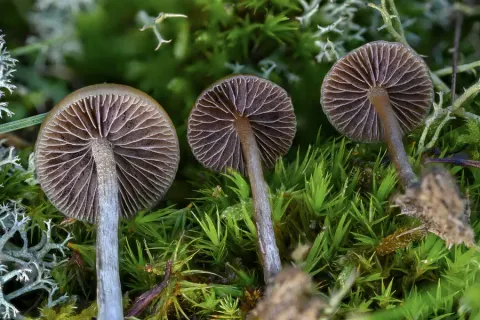
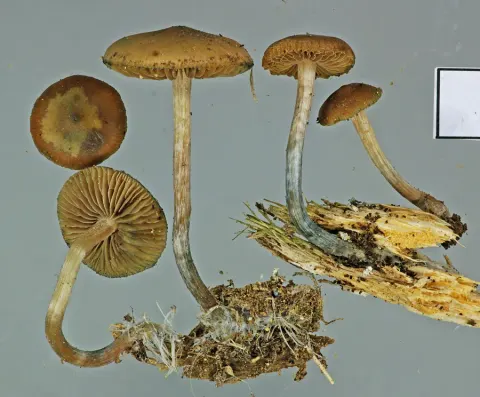
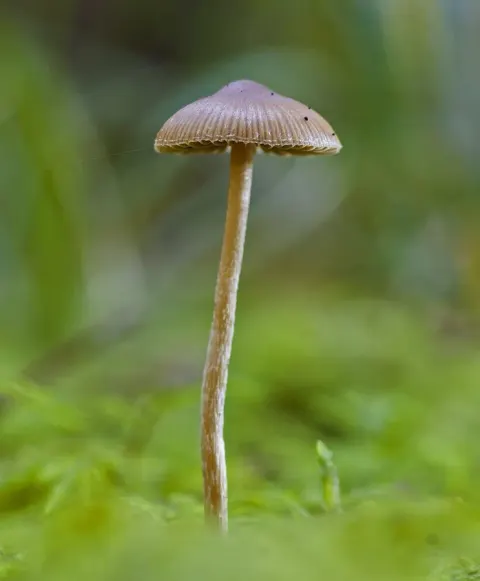
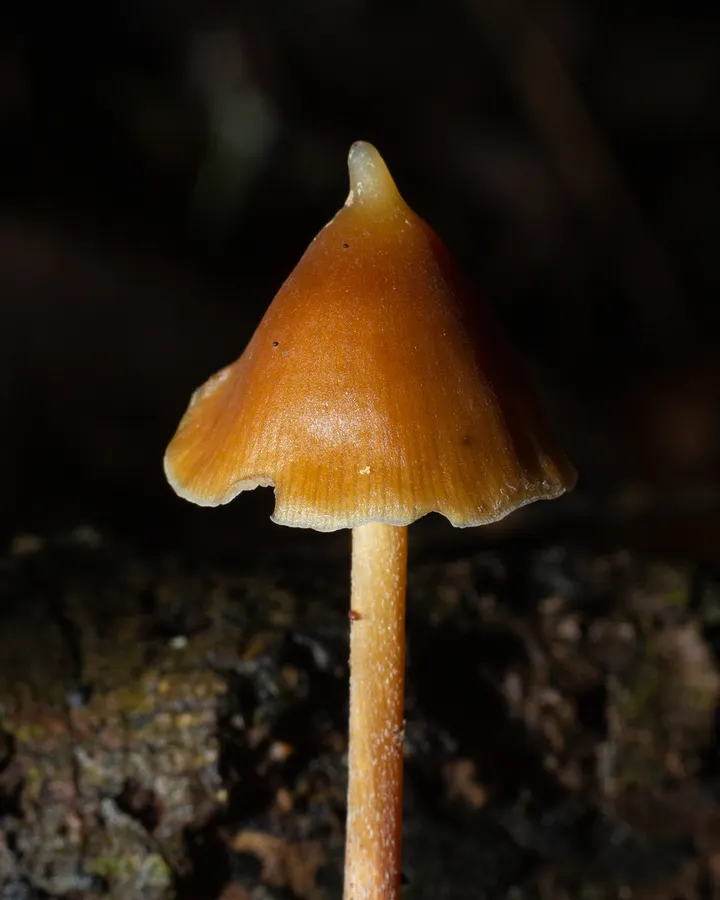
The cap ranges in shape from conical to bell-shaped to convex, reaching diameters of 0.7 – 3 in, although a range of 1 – 2.5 cm is most usual. It has a long, sharp papilla that is up to 4 mm. The cap surface is smooth, somewhat sticky when wet, and often has ridges extending halfway to the center of the cap. Its color is reddish brown to orangish brown to yellowish, and it is hygrophanous, fading when dry to a straw or fulvous color. The brownish gills have an adnate to adnexed attachment to the stem; mature gills become purplish black because of the spores. The hollow stem measures 50 to 90 mm long by 1–3 mm thick. It is roughly equal in width throughout its length or slightly thicker at the base and sometimes twisted. A thin rudimentary cortina-like partial veil covers the gills of immature fruit bodies, but it is fragile and disappears soon after the cap expands. The flesh in the cap is whitish but more yellow in the stem. Both the odor and taste of the mushroom are farinaceous (similar to freshly ground flour). As is characteristic of psilocybin mushrooms, all parts of the fruit body bruise blue when handled or injured. P. hoogshagenii var. convexa lacks an acute papilla, although it occasionally has a small, rounded papilla. Its cap ranges in width from 0.5 – 1.5 cm, and it is convex to roughly bell-shaped. All other macroscopic and microscopic features are identical to the type variety. The spore print is dark purplish brown. Spores are rhomboid or nearly so in face view, and more or less ellipsoid when viewed from the side. They are thick-walled, with dimensions of 6.5–4–5.6 μm, and feature a broad germ pore.
Habitat dan peran ekologis
Fruit bodies dari Psilocybe hoogshagenii tumbuh secara solitaris atau dalam kelompok kecil di humus atau di tanah tanah tanah yang berlubang di perkebunan kopi subtropis. According to asli San Agustin Loxicha region Meksiko, jamur cenderung berbuah sekaligus dalam flush besar. In Mexico, fruiting occurs in June and July, whereas in Argentina, fruiting is in February. Jamur ini dilaporkan dari Mexico in negara bagian Puebla, Oaxaca, dan Chiapas, di mana tumbuh di ketinggian 1000 sampai 1800 m. Di Amerika Selatan, spesies ini dikenal dari Brazil and Kolombia. P. hoogshagenii var. convexa telah ditemukan di padang rumput di Hidalgo, dan Oaxaca but paling umum di Puebla. Berhasil dari June to Agustus.
- Habitat atau konteks temuan
- Informasi belum tersedia pada sumber rilis ini.
- Substrat
- Informasi belum tersedia pada sumber rilis ini.
- Peran atau konteks
- Belum dikategorikan pada rilis ini.
Reproduksi
The cap ranges in shape from conical to bell-shaped to convex, reaching diameters of 0.7 – 3 in, although a range of 1 – 2.5 cm is most usual. It has a long, sharp papilla that is up to 4 mm. The cap surface is smooth, somewhat sticky when wet, and often has ridges extending halfway to the center of the cap. Its color is reddish brown to orangish brown to yellowish, and it is hygrophanous, fading when dry to a straw or fulvous color. The brownish gills have an adnate to adnexed attachment to the stem; mature gills become purplish black because of the spores. The hollow stem measures 50 to 90 mm long by 1–3 mm thick. It is roughly equal in width throughout its length or slightly thicker at the base and sometimes twisted.
Catatan identitas dan cakupan
- Nama diterima mengikuti Catalogue of Life Base2026-09-11; uraian mempertahankan konsep dan nama sumber aslinya.
- Original geographic, specimen and life-cycle scope retained; source import awaits individual editorial review.
- Impor dan terjemahan otomatis belum diperiksa editorial per profil. Struktur reproduktif yang disebutkan tidak membuktikan seluruh siklus hidup diketahui.
- Pengukuran pada uraian mengikuti spesimen, kultur, dan metode sumber; angka tidak diperluas ke semua populasi.
Catatan distribusi dalam narasi mengikuti sumbernya. Dokumentasi spesimen atau foto mengikuti catatan sumber. Bukti wilayah Indonesia dan penilaian konservasi tidak disimpulkan dari gambar.
Melihat dengan konteks
Dokumentasi Psilocybe hoogshagenii menurut asosiasi foto pada record takson iNaturalist. Kredit: Denis Zabin. Identitas mengikuti sumber; bukan penentuan spesimen independen.
- Jenis
- Fotografi
- Kredit
- (c) Denis Zabin, some rights reserved (CC BY), uploaded by Denis Zabin
- Lisensi
- CC BY 4.0
- Sumber media
- Buka entri sumber
Dokumentasi tambahan
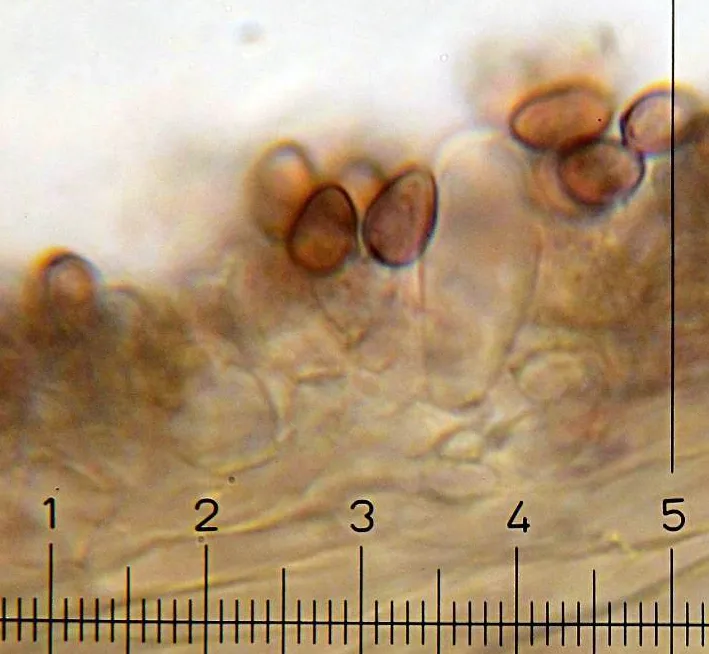
Foto yang diasosiasikan dengan Psilocybe hoogshagenii pada iNaturalist. Identifikasi mengikuti sumber; bukan penentuan spesimen independen.
Kredit dan penggunaan
(c) Alan Rockefeller, some rights reserved (CC BY-SA)
Ukuran dan format gambar disesuaikan tanpa pemotongan, retus, atau penambahan skala. Lisensi sumber dipertahankan.
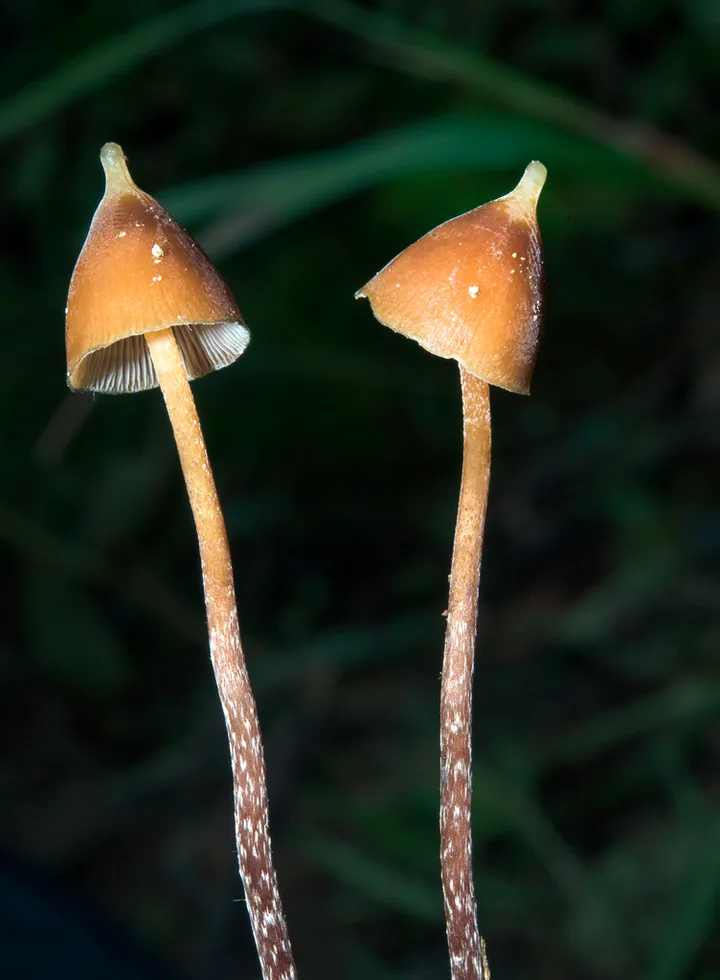
Foto yang diasosiasikan dengan Psilocybe hoogshagenii pada iNaturalist. Identifikasi mengikuti sumber; bukan penentuan spesimen independen.
Kredit dan penggunaan
(c) Alan Rockefeller, some rights reserved (CC BY), uploaded by Alan Rockefeller
Ukuran dan format gambar disesuaikan tanpa pemotongan, retus, atau penambahan skala. Lisensi sumber dipertahankan.
Sumber profil
- [1] Psilocybe hoogshagenii — Wikipedia (en)
- [2] Catalogue of Life Base2026-09-11 — Psilocybe hoogshagenii
- [3] Dokumentasi visual — Psilocybe hoogshagenii
- [4] Dokumentasi visual — Psilocybe hoogshagenii
- [5] Dokumentasi visual — Psilocybe hoogshagenii
Rujukan halaman ini
Fungi. Psilocybe hoogshagenii. Rilis data fungi-2026-10-12-expansion-2. https://fungi-atlas.mgadib.chatgpt.site/jamur/psilocybe-hoogshagenii/.
Status: impor sumber; pemeriksaan editorial per profil belum selesai. Untuk klaim biologis, gunakan rujukan pada bagian terkait dan periksa konteks sumber aslinya.