Ciri dan struktur
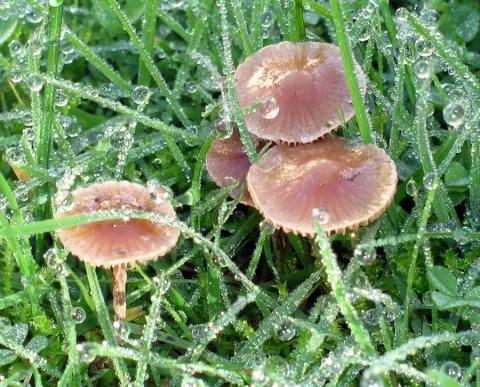
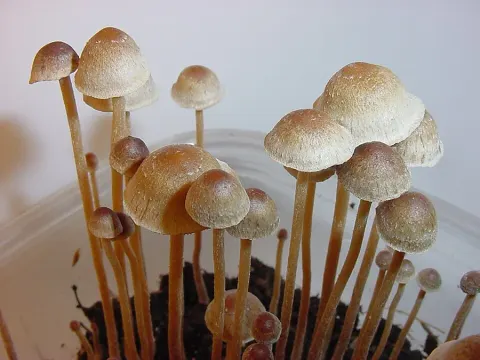
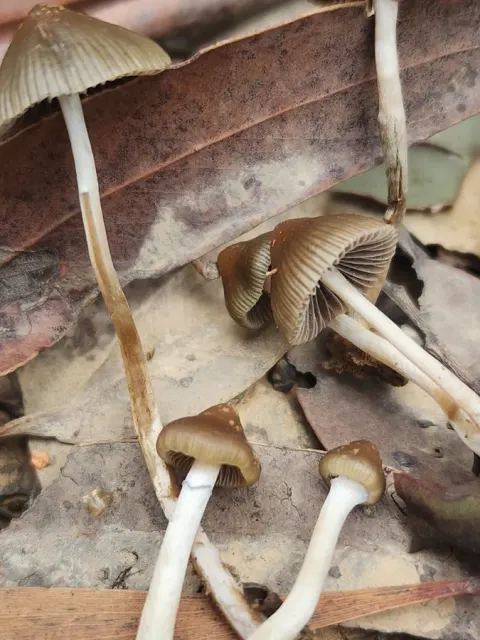
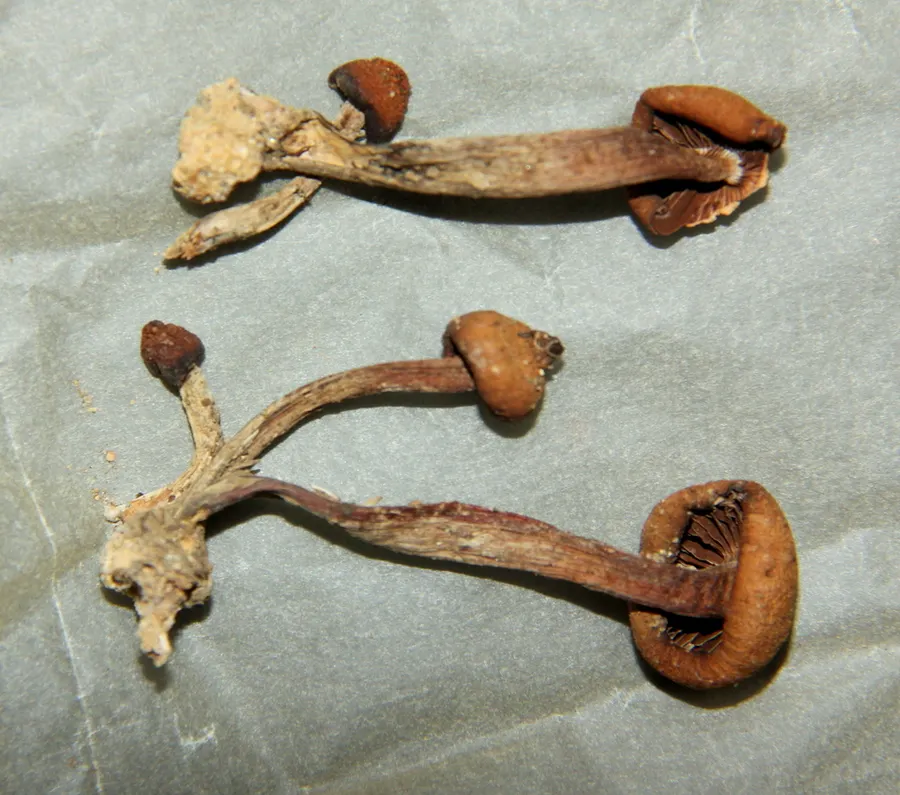
The fruit bodies of Psilocybe subcaerulipes have caps that are 2.5 to 6 cm in diameter, initially conic or bell-shaped but expanding to become convex, then finally somewhat flattened in maturity. A well-defined umbo (a rounded elevation resembling a nipple) is typically present. The cap color is chestnut brown when wet, but the species is hygrophanous, and when dried, changes color to become a lighter shade of brown. As is characteristic of psilocybin-containing species, P. subcaerulipes stains blue where it has been bruised or injured. The cap margins of young specimens are usually curved inwards, and have irregular, wavy edges; young specimens may also have fragments of the partial veil hanging off the margin. The whitish partial veil is similar to those of the genus Cortinarius—cobwebby, and made of silky fibrils. When the cap expands and the veil rips, the fibrils remains briefly as an annular zone on the stem, before fading into nothing. The gills have an adnate or adnexed attachment to the stem, which later becomes seceding (pulled away from the stem). The gills are a grayish-orange color initially, later turning purple-brown with whitish edges. The stem is 6 to 8 cm long and 0.2 to 0.4 cm thick, and has roughly the same width throughout its length, except for a widening at the base due to the whitish rhizomorphs present. Initially a whitish color, it matures to become yellowish, then brown or reddish brown. It may have white veil fragments attached to the lower two-thirds of its length, and has a pseudorhiza at the base. Viewed in deposit, as with a spore print, the spores are a dark purple-brown color.
Habitat dan peran ekologis
Spesies ini tumbuh dalam kelompok, atau berkumpul bersama di tanah di tanah yang kaya dengan puing-puing kayu. Hal ini telah dicatat tumbuh di dekat spesies pohon Cryptomeria japonica (dikenal secara lokal sebagai Sugi), Taiwan, Quercus glauca (Jepang Oak Biru), dan Pinus taeda (Loblolly Pine). Hal ini telah ditemukan di Jepang (khususnya, di Kyoto, Osaka, Shiga, Saitama, Niigata, dan Miyagi), Jeju Province in Korea Selatan, Taiwan and Thailand.
- Habitat atau konteks temuan
- Informasi belum tersedia pada sumber rilis ini.
- Substrat
- tanah
- Peran atau konteks
- Belum dikategorikan pada rilis ini.
Reproduksi
Viewed in deposit, as with a spore print, the spores are a dark purple-brown color. Viewed microscopically, spores are roughly ellipsoid in shape, with dimensions of (5–) 6–7.5 (–8) by (3–) 4–4.5 (–5) by (3–) 3.5–4 μm. The spore-bearing cells, the basidia, are four-spored. The pleurocystidia are (11‒) 15‒20 (‒32) × (3‒) 4‒6 (‒10.5) μm, hyaline, polymorphous with many forms – ventricose-capitate or broadly globose, subclavate, subfusoid to sublageniform, sometimes subcylindric or ventricose, usually a short neck but sometimes with two or three necks, occasionally irregularly branching. The cheilocystidia (cystidia located on the gill edge) are (11‒) 14‒22 (‒40) × (3‒) (4‒) 5‒7 (19) μm, and are shaped like the pleurocystidia.
Catatan identitas dan cakupan
- Nama diterima mengikuti Catalogue of Life Base2026-09-11; uraian mempertahankan konsep dan nama sumber aslinya.
- Original geographic, specimen and life-cycle scope retained; source import awaits individual editorial review.
- Impor dan terjemahan otomatis belum diperiksa editorial per profil. Struktur reproduktif yang disebutkan tidak membuktikan seluruh siklus hidup diketahui.
- Pengukuran pada uraian mengikuti spesimen, kultur, dan metode sumber; angka tidak diperluas ke semua populasi.
Catatan distribusi dalam narasi mengikuti sumbernya. Dokumentasi spesimen atau foto mengikuti catatan sumber. Bukti wilayah Indonesia dan penilaian konservasi tidak disimpulkan dari gambar.
Melihat dengan konteks
Dokumentasi Psilocybe subcaerulipes menurut asosiasi foto pada record takson iNaturalist. Kredit: Alan Rockefeller. Identitas mengikuti sumber; bukan penentuan spesimen independen.
- Jenis
- Fotografi
- Kredit
- (c) Alan Rockefeller, some rights reserved (CC BY), uploaded by Alan Rockefeller
- Lisensi
- CC BY 4.0
- Sumber media
- Buka entri sumber
Dokumentasi tambahan
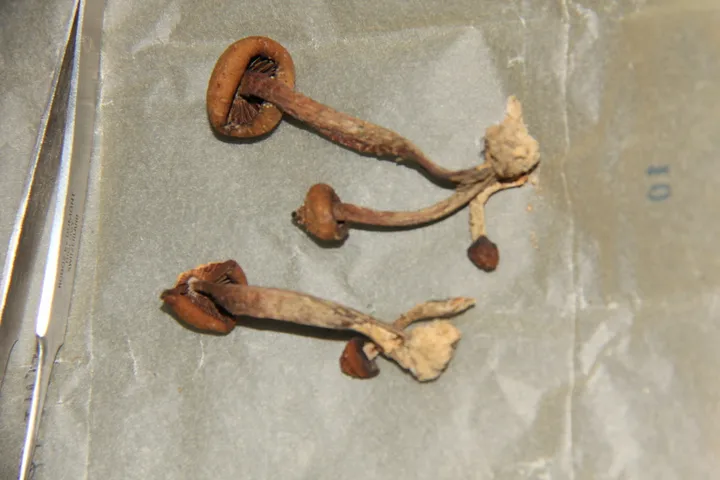
Foto yang diasosiasikan dengan Psilocybe subcaerulipes pada iNaturalist. Identifikasi mengikuti sumber; bukan penentuan spesimen independen.
Kredit dan penggunaan
(c) Alan Rockefeller, some rights reserved (CC BY), uploaded by Alan Rockefeller
Ukuran dan format gambar disesuaikan tanpa pemotongan, retus, atau penambahan skala. Lisensi sumber dipertahankan.
Sumber profil
- [1] Psilocybe subcaerulipes — Wikipedia (en)
- [2] Catalogue of Life Base2026-09-11 — Psilocybe subcaerulipes
- [3] Dokumentasi visual — Psilocybe subcaerulipes
- [4] Dokumentasi visual — Psilocybe subcaerulipes
Rujukan halaman ini
Fungi. Psilocybe subcaerulipes. Rilis data fungi-2026-10-12-expansion-2. https://fungi-atlas.mgadib.chatgpt.site/jamur/psilocybe-subcaerulipes/.
Status: impor sumber; pemeriksaan editorial per profil belum selesai. Untuk klaim biologis, gunakan rujukan pada bagian terkait dan periksa konteks sumber aslinya.