01 / Morfologi

Ciri dan struktur

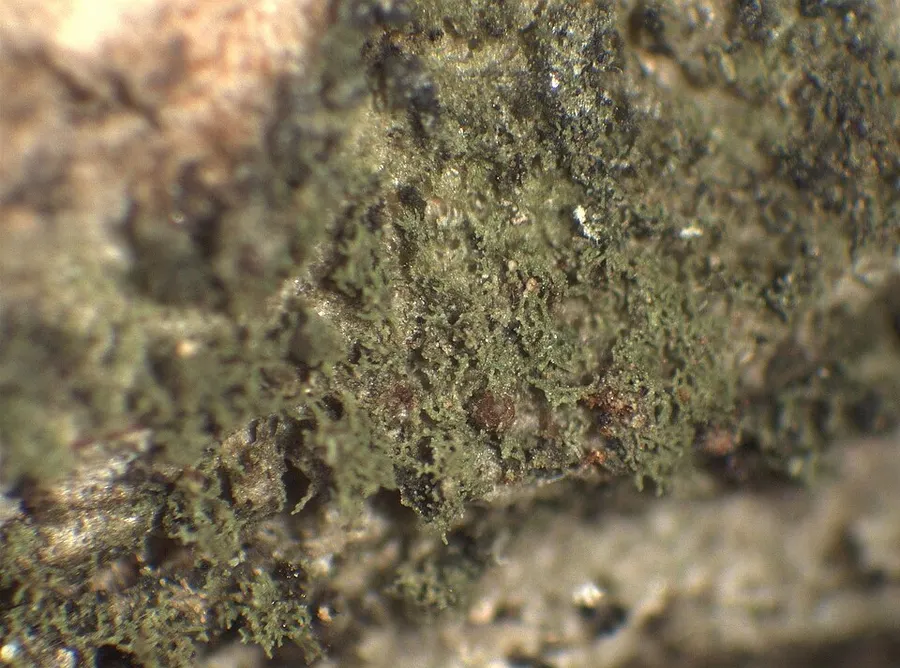
Psoroglaena stigonemoides has several distinctive characteristics. The thallus (main body) is pale green and filamentous (thread-like), forming a densely branched structure reaching 50–600 micrometres (μm) in height. Under magnification, the branches appear cylindrical with a width of 12–35 μm. The surface cells of the thallus have distinctive conical (small bumps or protrusions), which is an important identifying feature. A distinctive characteristic of P. stigonemoides is that its filamentous branches often break apart into fragments, creating paler green areas on the thallus. In some specimens, especially smaller sterile ones, the lichen may appear almost entirely granular rather than filamentous. The reproductive structures (perithecia) are pale brown when dry and ovoid to pear-shaped, measuring 200–340 μm wide and 230–420 μm high. When wet, they can expand to 380 μm wide and 480 μm high. The perithecia lack the dark pigmentation typically found in other members of the family Verrucariaceae. The spores produced are colourless, -ellipsoid (spindle to oval shaped), with 3–5 cross-walls (septa), and measure roughly 16–21 by 5–6 μm.

Sebagian uraian ditampilkan dalam bahasa sumber; terjemahannya belum tersedia atau belum lolos pemeriksaan.

Rujukan: [1]

Pengukuran mengikuti objek, spesimen atau kultur, dan metode yang disebutkan sumber. Baca uraian asli untuk konteks lengkap.

02 / Kehidupan

Habitat dan peran ekologis

Psoroglaena stigonemoides occupies a specific ecological niche, primarily growing on bark with higher moisture retention capabilities and relatively elevated pH levels. While it shows a strong preference for elder (Sambucus nigra), the species has also been documented on several other tree species including sycamore (Acer pseudoplatanus), oak (Quercus sp.), white and crack willow (Salix alba and Salix × fragilis), and wych elm (Ulmus glabra). The lichen often establishes itself within the crevices and fissures of bark, though not necessarily in areas that are completely sheltered from rainfall. In Wales, P. stigonemoides is predominantly found in locations characterized by higher humidity and shelter, frequently in shaded environments. These habitats include deciduous woodlands, conifer plantations, and protected field boundaries, although it is known to also colonise more exposed settings such as hedgerows and urban park environments. Psoroglaena stigonemoides typically grows in species-poor communities or in areas dominated by bryophytes (mosses and liverworts). It frequently occurs with few accompanying lichen species, though it has been observed growing alongside Anisomeridium nyssaegenum with some regularity.

Sebagian uraian ditampilkan dalam bahasa sumber; terjemahannya belum tersedia atau belum lolos pemeriksaan.

Rujukan: [1]

Habitat atau konteks temuan
Informasi belum tersedia pada sumber rilis ini.
Substrat
kulit kayu
Peran atau konteks
Pembentuk liken
Temukan hubungan serupa
03 / Siklus hidup

Reproduksi

The reproductive structures (perithecia) are pale brown when dry and ovoid to pear-shaped, measuring 200–340 μm wide and 230–420 μm high. When wet, they can expand to 380 μm wide and 480 μm high. The perithecia lack the dark pigmentation typically found in other members of the family Verrucariaceae. The spores produced are colourless, -ellipsoid (spindle to oval shaped), with 3–5 cross-walls (septa), and measure roughly 16–21 by 5–6 μm.

Sebagian uraian ditampilkan dalam bahasa sumber; terjemahannya belum tersedia atau belum lolos pemeriksaan.

Rujukan: [1]

Sinonim menurut acuan taksonomi rilis: Leucocarpia stigonemoides; Macentina stigonemoides
04 / Batas informasi

Catatan identitas dan cakupan

  • Nama diterima mengikuti Catalogue of Life Base2026-09-11; uraian mempertahankan konsep dan nama sumber aslinya.
  • Original geographic, specimen and life-cycle scope retained; source import awaits individual editorial review.
  • Impor dan terjemahan otomatis belum diperiksa editorial per profil. Struktur reproduktif yang disebutkan tidak membuktikan seluruh siklus hidup diketahui.
  • Pengukuran pada uraian mengikuti spesimen, kultur, dan metode sumber; angka tidak diperluas ke semua populasi.

Catatan distribusi dalam narasi mengikuti sumbernya. Dokumentasi spesimen atau foto mengikuti catatan sumber. Bukti wilayah Indonesia dan penilaian konservasi tidak disimpulkan dari gambar.

05 / Dokumentasi

Melihat dengan konteks

Dokumentasi Psoroglaena stigonemoides dari Wikimedia Commons. The bark-dwelling lichen Psoroglaena stigonemoides Identifikasi mengikuti record berkas sumber.

Jenis
Fotografi
Kredit
E. Pittao
Sumber media
Buka entri sumber

Gambar menunjukkan objek menurut identifikasi sumber, bukan verifikasi independen spesimen oleh Fungi. Tidak ada skala baru yang ditambahkan.

06 / Rujukan

Sumber profil

  1. [1] Psoroglaena stigonemoides — Wikipedia (en)Bagian sumber: Frozen revision 1336161103
    Tanggal penghimpunan sumber: 2026-10-12
    Teks sumber: CC BY-SA4.0 · Wikipedia contributors
  2. [2] Catalogue of Life Base2026-09-11 — Psoroglaena stigonemoidesBagian sumber: ColDP NameUsage.tsv ID 4PLTF; accepted species; source 2073
    Tanggal penghimpunan sumber: 2026-10-12
  3. [3] Dokumentasi visual — Psoroglaena stigonemoidesBagian sumber: Individual media record; identification follows the source, not independent determination
    Tanggal penghimpunan sumber: 2026-10-12
    Media sumber: CC BY-SA 4.0 · E. Pittao

Adaptasi teks: CC BY-SA 4.0. Wikipedia contributors — Psoroglaena stigonemoides — Wikipedia (en)

Uraian asli dan riwayat sumber

Riwayat atau halaman sumber

Ringkasan sumber

Psoroglaena stigonemoides is a species of corticolous (bark-dwelling) lichen in the family Verrucariaceae. It grows primarily on tree bark in humid environments throughout Great Britain, Ireland and parts of Europe. First scientifically described in 1989, it forms distinctive thread-like structures that often break into fragments less than a millimetre in height. The species shows a preference for elder trees but can also be found on sycamore, oak, willow and elm, typically in sheltered woodland locations with high humidity.

Revisi sumber

Morfologi sumber

Psoroglaena stigonemoides has several distinctive characteristics. The thallus (main body) is pale green and filamentous (thread-like), forming a densely branched structure reaching 50–600 micrometres (μm) in height. Under magnification, the branches appear cylindrical with a width of 12–35 μm. The surface cells of the thallus have distinctive conical (small bumps or protrusions), which is an important identifying feature. A distinctive characteristic of P. stigonemoides is that its filamentous branches often break apart into fragments, creating paler green areas on the thallus. In some specimens, especially smaller sterile ones, the lichen may appear almost entirely granular rather than filamentous. The reproductive structures (perithecia) are pale brown when dry and ovoid to pear-shaped, measuring 200–340 μm wide and 230–420 μm high. When wet, they can expand to 380 μm wide and 480 μm high. The perithecia lack the dark pigmentation typically found in other members of the family Verrucariaceae. The spores produced are colourless, -ellipsoid (spindle to oval shaped), with 3–5 cross-walls (septa), and measure roughly 16–21 by 5–6 μm.

Revisi sumber

Ekologi sumber

Psoroglaena stigonemoides occupies a specific ecological niche, primarily growing on bark with higher moisture retention capabilities and relatively elevated pH levels. While it shows a strong preference for elder (Sambucus nigra), the species has also been documented on several other tree species including sycamore (Acer pseudoplatanus), oak (Quercus sp.), white and crack willow (Salix alba and Salix × fragilis), and wych elm (Ulmus glabra). The lichen often establishes itself within the crevices and fissures of bark, though not necessarily in areas that are completely sheltered from rainfall. In Wales, P. stigonemoides is predominantly found in locations characterized by higher humidity and shelter, frequently in shaded environments. These habitats include deciduous woodlands, conifer plantations, and protected field boundaries, although it is known to also colonise more exposed settings such as hedgerows and urban park environments. Psoroglaena stigonemoides typically grows in species-poor communities or in areas dominated by bryophytes (mosses and liverworts). It frequently occurs with few accompanying lichen species, though it has been observed growing alongside Anisomeridium nyssaegenum with some regularity.

Revisi sumber

Struktur reproduksi sumber

The reproductive structures (perithecia) are pale brown when dry and ovoid to pear-shaped, measuring 200–340 μm wide and 230–420 μm high. When wet, they can expand to 380 μm wide and 480 μm high. The perithecia lack the dark pigmentation typically found in other members of the family Verrucariaceae. The spores produced are colourless, -ellipsoid (spindle to oval shaped), with 3–5 cross-walls (septa), and measure roughly 16–21 by 5–6 μm.

Revisi sumber

Rujukan halaman ini

Fungi. Psoroglaena stigonemoides. Rilis data fungi-2026-10-12-expansion-2. https://fungi-atlas.mgadib.chatgpt.site/jamur/psoroglaena-stigonemoides/.

Status: impor sumber; pemeriksaan editorial per profil belum selesai. Untuk klaim biologis, gunakan rujukan pada bagian terkait dan periksa konteks sumber aslinya.