Ciri dan struktur
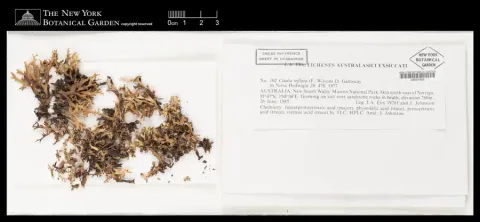
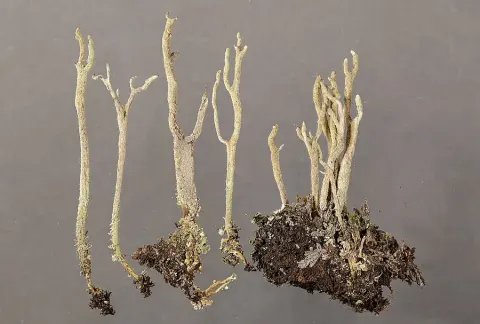
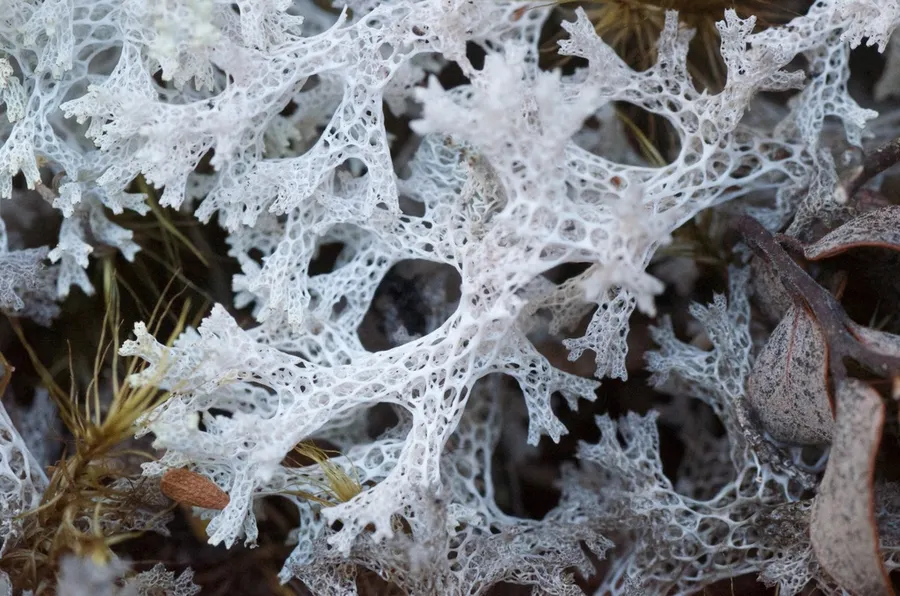
Like most species in the family Cladoniaceae, Pulchrocladia retipora has a growth form, meaning it has both a primary (horizontal) and secondary (vertical) thallus. The is nodular (i.e. with small raised areas or swellings), white, and only lasts for a short period. are the that originate from the primary thallus. The podetia are typically up to 5 cm tall, white to pale grey in colour, sometimes tinged pinkish or yellowing or superficially blackening at tips. They are rigid when dry, but become spongy when wet. They are irregularly or dichotomously branched, forming cushiony clumps. The wall is highly perforated (about 5–11 perforations per centimetre), with large, round to ellipsoidal holes. The surface of the podetium is continuously and lacks soredia. The inner medulla is made of twisted strands of hyphae with a cobweb-like form. The lichen, nonetheless, generates soredia-like clusters of algal cells and hyphae within the strands of the inner medulla. Apothecia occur infrequently. When present, they are small, black, , and crowd together at the ends of small, terminal branches (). The colour of the hymenium ranges from dark reddish-brown to black. Ascospores have dimensions of 25–27 by 5 μm. The conidiomata end on branchlets, and are covered with translucent slime; they produce curved or straight conidia measuring 6 by 1 μm. Specimens collected in Australia tend to have a brownish colouring, while New Zealand specimens range from pure white to grey, to grayish-green, or slightly yellowish. The photobiont partner is green algae from the Trebouxia. Occasionally, free-living algae become trapped in the irregularly intertwined hyphae of the medulla.
Habitat dan peran ekologis
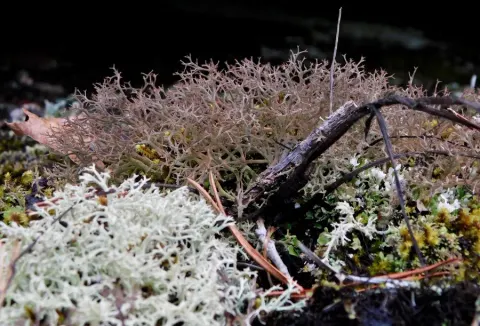
Pulchrocladia retipora is widely distributed throughout Australasia. In Australia, it has been recorded from the Australian Capital Territory, New South Wales, Queensland, Victoria, and Tasmania. In New Zealand, it is known from both the North and South Islands as well as the Antipodes Islands, Auckland Islands, Campbell Island, and Chatham Islands. In the Pacific, it occurs in New Caledonia. The coral lichen is common in subalpine peat bogs; it is often found in association with the lichens Cladonia confusa, Rexiella sullivani, and Stereocaulon ramulosum. It is found on peaty soils among tussocks or in heaths comprising Dracophyllum and Leptospermum, most often at the margins of Nothofagus forests, in fellfield, or rarely on surfaces such as rocks, logs, and sand dunes. In the moorlands of the Meredith Range area in Tasmania, it thrives in well-drained, elevated locations, especially close to decomposing buttongrass hummocks. The lichen replicates vegetatively when new podetia grow from fragments of old podetia. It has highly variable growth rates, ranging from less than 1 mm per year to up to a few centimetres per year. It has been noted to grow in clusters, sometimes up a metre in diameter.
- Habitat atau konteks temuan
- hutan
- Substrat
- Informasi belum tersedia pada sumber rilis ini.
- Peran atau konteks
- Pembentuk liken
Reproduksi
Like most species in the family Cladoniaceae, Pulchrocladia retipora has a growth form, meaning it has both a primary (horizontal) and secondary (vertical) thallus. The is nodular (i.e. with small raised areas or swellings), white, and only lasts for a short period. are the that originate from the primary thallus. The podetia are typically up to 5 cm tall, white to pale grey in colour, sometimes tinged pinkish or yellowing or superficially blackening at tips. They are rigid when dry, but become spongy when wet. They are irregularly or dichotomously branched, forming cushiony clumps. The wall is highly perforated (about 5–11 perforations per centimetre), with large, round to ellipsoidal holes.
Catatan identitas dan cakupan
- Nama diterima mengikuti Catalogue of Life Base2026-09-11; uraian mempertahankan konsep dan nama sumber aslinya.
- Original geographic, specimen and life-cycle scope retained; source import awaits individual editorial review.
- Impor dan terjemahan otomatis belum diperiksa editorial per profil. Struktur reproduktif yang disebutkan tidak membuktikan seluruh siklus hidup diketahui.
- Pengukuran pada uraian mengikuti spesimen, kultur, dan metode sumber; angka tidak diperluas ke semua populasi.
Catatan distribusi dalam narasi mengikuti sumbernya. Dokumentasi spesimen atau foto mengikuti catatan sumber. Bukti wilayah Indonesia dan penilaian konservasi tidak disimpulkan dari gambar.
Melihat dengan konteks
Dokumentasi Pulchrocladia retipora menurut asosiasi foto pada record takson iNaturalist. Kredit: Jon Sullivan. Identitas mengikuti sumber; bukan penentuan spesimen independen.
- Jenis
- Fotografi
- Kredit
- (c) Jon Sullivan, some rights reserved (CC BY)
- Lisensi
- CC BY 4.0
- Sumber media
- Buka entri sumber
Dokumentasi tambahan
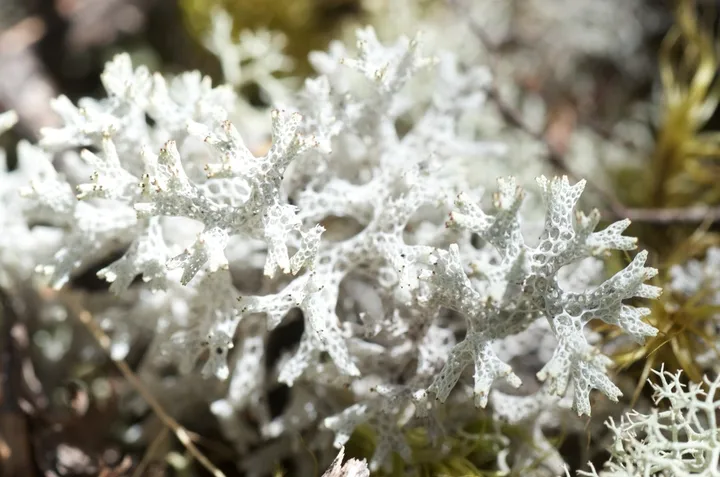
Foto yang diasosiasikan dengan Pulchrocladia retipora pada iNaturalist. Identifikasi mengikuti sumber; bukan penentuan spesimen independen.
Kredit dan penggunaan
(c) Jon Sullivan, some rights reserved (CC BY)
Ukuran dan format gambar disesuaikan tanpa pemotongan, retus, atau penambahan skala. Lisensi sumber dipertahankan.
Sumber profil
- [1] Pulchrocladia retipora — Wikipedia (en)
- [2] Catalogue of Life Base2026-09-11 — Pulchrocladia retipora
- [3] Dokumentasi visual — Pulchrocladia retipora
- [4] Dokumentasi visual — Pulchrocladia retipora
Rujukan halaman ini
Fungi. Pulchrocladia retipora. Rilis data fungi-2026-10-12-expansion-2. https://fungi-atlas.mgadib.chatgpt.site/jamur/pulchrocladia-retipora/.
Status: impor sumber; pemeriksaan editorial per profil belum selesai. Untuk klaim biologis, gunakan rujukan pada bagian terkait dan periksa konteks sumber aslinya.