01 / Morfologi

Ciri dan struktur

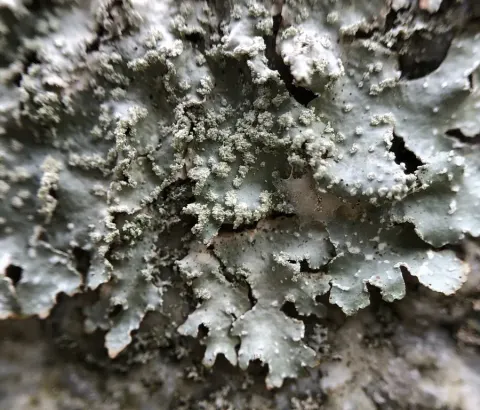
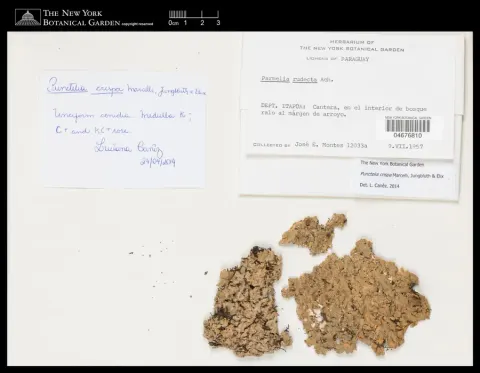
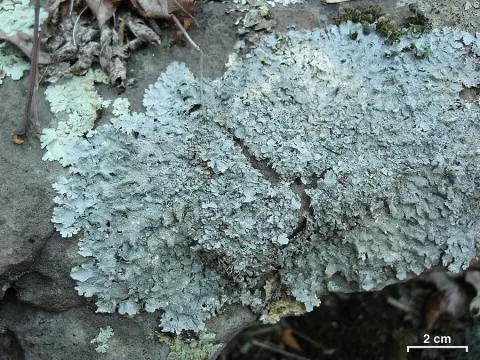
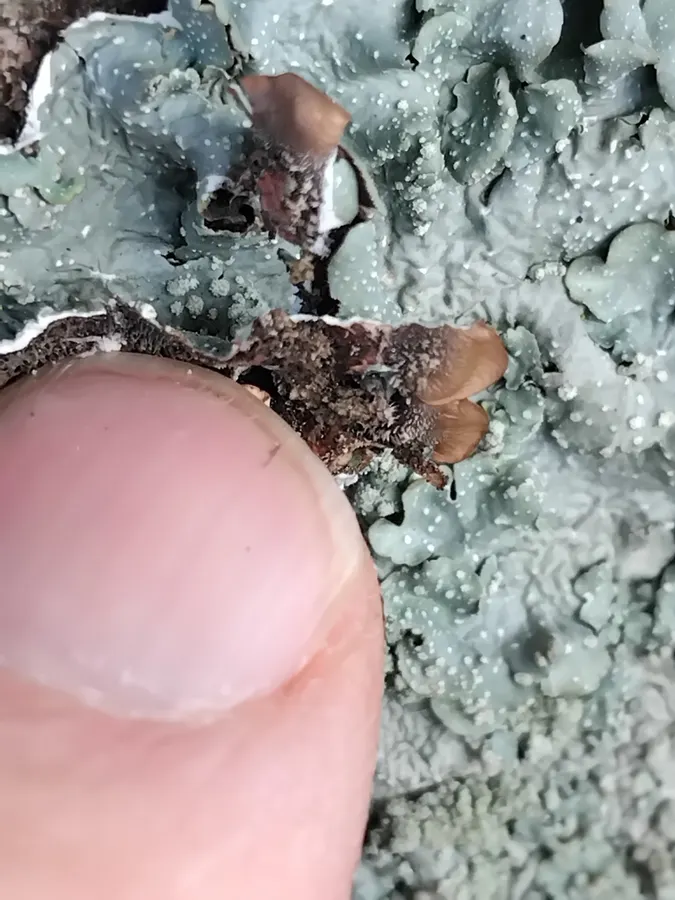
The thallus of Punctelia borreri is foliose (leafy), forming rosettes that are closely attached to their substrate, measuring up to 10 cm in diameter. The colour of the upper thallus surface ranges from grey to bluish-grey, greenish-grey, or yellowish-grey. Old herbarium specimens turn buff. Sometimes, the margins of the thallus are whitish from pruina (a powdery coating); at other times they have a brownish tinge. The pruina is often abundant, but not present on all the lobes. In fresh specimens, the pruina gives the lobes a glaucous colour (dull bluish-green). Pruina consists of crystals of calcium oxalate, an insoluble organic calcium salt that is excreted on the thallus surface. The surface has a smooth and shiny texture, with some wrinkling near the centre of the thallus. Lobes comprising the thallus are flat or concave, measuring 4 – 8 mm wide. Pseudocyphellae are small (up to 300 μm wide), roughly circular, and point-like (punctate); they are more prominent towards the periphery of the thallus. Closer to the centre of the thallus they aggregate in regions with powdery propagules called soralia. The soralia are dot-like, whitish, and distinctly rounded. They arise from pseudocyphellae that are small and punctiform, which often become confluent in age. The soredia are farinose (powdery) to more or less granular on older thalli. Apothecia (sexual propagules) are rarely made by this species; when present, they are lecanorine in form with a width of 2 – 8 mm, and with a thalline margin that is often sorediate. Because of the rarity of apothecia, the lichen is thought to reproduce largely asexually through its soredia or soredia-like structures, such as blastidia.

Sebagian uraian ditampilkan dalam bahasa sumber; terjemahannya belum tersedia atau belum lolos pemeriksaan.

Rujukan: [1]

Pengukuran mengikuti objek, spesimen atau kultur, dan metode yang disebutkan sumber. Baca uraian asli untuk konteks lengkap.

02 / Kehidupan

Habitat dan peran ekologis

Punctelia borreri usually grows on bark, but is occasionally found growing on rock. The lichen has a cosmopolitan distribution, having been recorded from Africa, Asia, Europe, North America, Oceania, Macaronesia, and South America. Its distribution in North America is largely limited to the west coast from California to Canada. Although some occurrences have been reported in Ohio and West Virginia, it is rare in eastern North America. In Mexico, it only occurs in Veracruz. In Australasia, Punctelia borreri is widely distributed, having been reported throughout eastern Australia and New Zealand. It is fairly common in eastern Australia (including Queensland, New South Wales, and Victoria) but is rare in New Zealand. In India it occurs in subtropical and lower temperate regions at altitudes of 1500 – 2200 m. A 2017 record from the Hunza Valley in Pakistan was the first documented occurrence for that country. Before its range expansion in Europe, Punctelia borreri was noted to have a strongly oceanic distribution with scattered occurrences in the central part of the continent. In a 2008 checklist of all parmelioid lichens in Europe (updated in 2011), P. borreri was noted to have been recorded from 21 countries and island groups.

Sebagian uraian ditampilkan dalam bahasa sumber; terjemahannya belum tersedia atau belum lolos pemeriksaan.

Rujukan: [1]

Habitat atau konteks temuan
Informasi belum tersedia pada sumber rilis ini.
Substrat
kulit kayu
Peran atau konteks
Pembentuk liken
Temukan hubungan serupa
03 / Siklus hidup

Reproduksi

The surface has a smooth and shiny texture, with some wrinkling near the centre of the thallus. Lobes comprising the thallus are flat or concave, measuring 4 – 8 mm wide. Pseudocyphellae are small (up to 300 μm wide), roughly circular, and point-like (punctate); they are more prominent towards the periphery of the thallus. Closer to the centre of the thallus they aggregate in regions with powdery propagules called soralia. The soralia are dot-like, whitish, and distinctly rounded. They arise from pseudocyphellae that are small and punctiform, which often become confluent in age. The soredia are farinose (powdery) to more or less granular on older thalli. Apothecia (sexual propagules) are rarely made by this species; when present, they are lecanorine in form with a width of 2 – 8 mm, and with a thalline margin that is often sorediate.

Sebagian uraian ditampilkan dalam bahasa sumber; terjemahannya belum tersedia atau belum lolos pemeriksaan.

Rujukan: [1]

Sinonim menurut acuan taksonomi rilis: Imbricaria borreri; Lichen borreri; Parmelia borreri var. pseudoborreri
04 / Batas informasi

Catatan identitas dan cakupan

  • Nama diterima mengikuti Catalogue of Life Base2026-09-11; uraian mempertahankan konsep dan nama sumber aslinya.
  • Original geographic, specimen and life-cycle scope retained; source import awaits individual editorial review.
  • Impor dan terjemahan otomatis belum diperiksa editorial per profil. Struktur reproduktif yang disebutkan tidak membuktikan seluruh siklus hidup diketahui.
  • Pengukuran pada uraian mengikuti spesimen, kultur, dan metode sumber; angka tidak diperluas ke semua populasi.

Catatan distribusi dalam narasi mengikuti sumbernya. Dokumentasi spesimen atau foto mengikuti catatan sumber. Bukti wilayah Indonesia dan penilaian konservasi tidak disimpulkan dari gambar.

05 / Dokumentasi

Melihat dengan konteks

Dokumentasi Punctelia borreri menurut asosiasi foto pada record takson iNaturalist. Kredit: Owen and Carol Fawcett.. Identitas mengikuti sumber; bukan penentuan spesimen independen.

Jenis
Fotografi
Kredit
(c) Owen and Carol Fawcett., some rights reserved (CC BY), uploaded by Owen and Carol Fawcett.
Lisensi
CC BY 4.0
Sumber media
Buka entri sumber

Gambar menunjukkan objek menurut identifikasi sumber, bukan verifikasi independen spesimen oleh Fungi. Tidak ada skala baru yang ditambahkan.

06 / Rujukan

Sumber profil

  1. [1] Punctelia borreri — Wikipedia (en)Bagian sumber: Frozen revision 1324825000
    Tanggal penghimpunan sumber: 2026-10-12
    Teks sumber: CC BY-SA4.0 · Wikipedia contributors
  2. [2] Catalogue of Life Base2026-09-11 — Punctelia borreriBagian sumber: ColDP NameUsage.tsv ID 4QHN6; accepted species; source 2073
    Tanggal penghimpunan sumber: 2026-10-12
  3. [3] Dokumentasi visual — Punctelia borreriBagian sumber: Individual media record; identification follows the source, not independent determination
    Tanggal penghimpunan sumber: 2026-10-12
    Media sumber: CC BY 4.0 · (c) Owen and Carol Fawcett., some rights reserved (CC BY), uploaded by Owen and Carol Fawcett.

Adaptasi teks: CC BY-SA 4.0. Wikipedia contributors — Punctelia borreri — Wikipedia (en)

Uraian asli dan riwayat sumber

Riwayat atau halaman sumber

Ringkasan sumber

The thallus of Punctelia borreri is foliose (leafy), forming rosettes that are closely attached to their substrate, measuring up to 10 cm in diameter. The colour of the upper thallus surface ranges from grey to bluish-grey, greenish-grey, or yellowish-grey. Old herbarium specimens turn buff. Sometimes, the margins of the thallus are whitish from pruina (a powdery coating); at other times they have a brownish tinge. The pruina is often abundant, but not present on all the lobes. In fresh specimens, the pruina gives the lobes a glaucous colour (dull bluish-green).

Revisi sumber

Morfologi sumber

The thallus of Punctelia borreri is foliose (leafy), forming rosettes that are closely attached to their substrate, measuring up to 10 cm in diameter. The colour of the upper thallus surface ranges from grey to bluish-grey, greenish-grey, or yellowish-grey. Old herbarium specimens turn buff. Sometimes, the margins of the thallus are whitish from pruina (a powdery coating); at other times they have a brownish tinge. The pruina is often abundant, but not present on all the lobes. In fresh specimens, the pruina gives the lobes a glaucous colour (dull bluish-green). Pruina consists of crystals of calcium oxalate, an insoluble organic calcium salt that is excreted on the thallus surface. The surface has a smooth and shiny texture, with some wrinkling near the centre of the thallus. Lobes comprising the thallus are flat or concave, measuring 4 – 8 mm wide. Pseudocyphellae are small (up to 300 μm wide), roughly circular, and point-like (punctate); they are more prominent towards the periphery of the thallus. Closer to the centre of the thallus they aggregate in regions with powdery propagules called soralia. The soralia are dot-like, whitish, and distinctly rounded. They arise from pseudocyphellae that are small and punctiform, which often become confluent in age. The soredia are farinose (powdery) to more or less granular on older thalli. Apothecia (sexual propagules) are rarely made by this species; when present, they are lecanorine in form with a width of 2 – 8 mm, and with a thalline margin that is often sorediate. Because of the rarity of apothecia, the lichen is thought to reproduce largely asexually through its soredia or soredia-like structures, such as blastidia.

Revisi sumber

Ekologi sumber

Punctelia borreri usually grows on bark, but is occasionally found growing on rock. The lichen has a cosmopolitan distribution, having been recorded from Africa, Asia, Europe, North America, Oceania, Macaronesia, and South America. Its distribution in North America is largely limited to the west coast from California to Canada. Although some occurrences have been reported in Ohio and West Virginia, it is rare in eastern North America. In Mexico, it only occurs in Veracruz. In Australasia, Punctelia borreri is widely distributed, having been reported throughout eastern Australia and New Zealand. It is fairly common in eastern Australia (including Queensland, New South Wales, and Victoria) but is rare in New Zealand. In India it occurs in subtropical and lower temperate regions at altitudes of 1500 – 2200 m. A 2017 record from the Hunza Valley in Pakistan was the first documented occurrence for that country. Before its range expansion in Europe, Punctelia borreri was noted to have a strongly oceanic distribution with scattered occurrences in the central part of the continent. In a 2008 checklist of all parmelioid lichens in Europe (updated in 2011), P. borreri was noted to have been recorded from 21 countries and island groups.

Revisi sumber

Struktur reproduksi sumber

The surface has a smooth and shiny texture, with some wrinkling near the centre of the thallus. Lobes comprising the thallus are flat or concave, measuring 4 – 8 mm wide. Pseudocyphellae are small (up to 300 μm wide), roughly circular, and point-like (punctate); they are more prominent towards the periphery of the thallus. Closer to the centre of the thallus they aggregate in regions with powdery propagules called soralia. The soralia are dot-like, whitish, and distinctly rounded. They arise from pseudocyphellae that are small and punctiform, which often become confluent in age. The soredia are farinose (powdery) to more or less granular on older thalli. Apothecia (sexual propagules) are rarely made by this species; when present, they are lecanorine in form with a width of 2 – 8 mm, and with a thalline margin that is often sorediate.

Revisi sumber

Rujukan halaman ini

Fungi. Punctelia borreri. Rilis data fungi-2026-10-12-expansion-2. https://fungi-atlas.mgadib.chatgpt.site/jamur/punctelia-borreri/.

Status: impor sumber; pemeriksaan editorial per profil belum selesai. Untuk klaim biologis, gunakan rujukan pada bagian terkait dan periksa konteks sumber aslinya.