01 / Morfologi

Ciri dan struktur

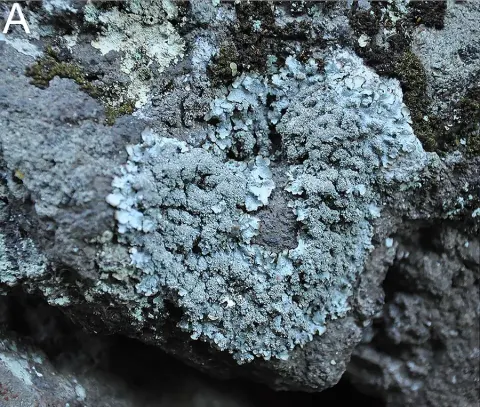
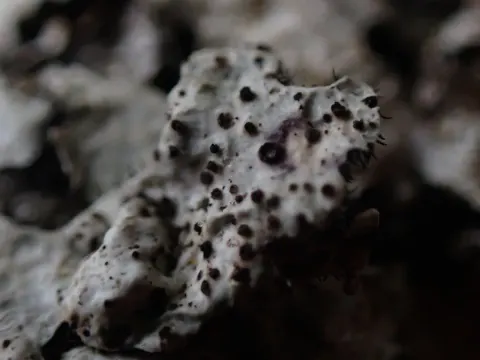
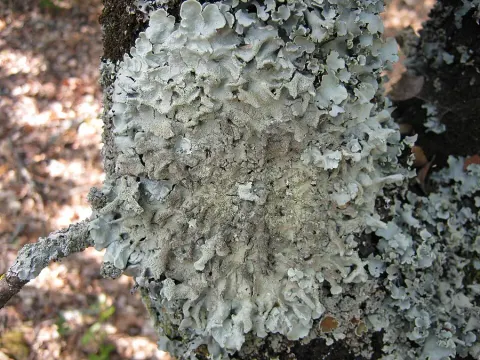
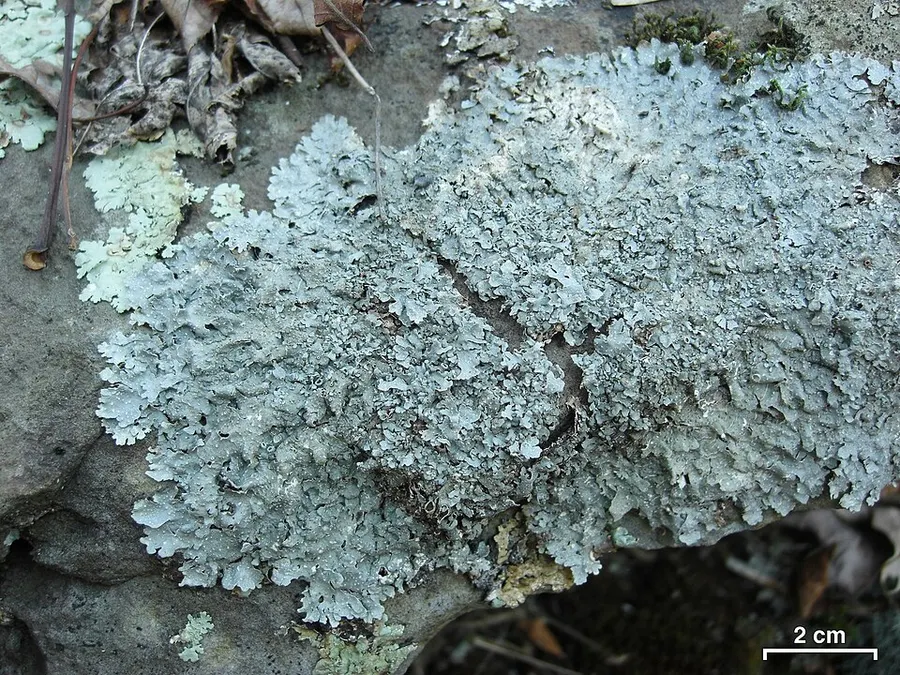
The thallus of Punctelia graminicola measures 3.0 – 14.5 cm in diameter. It comprises irregularly branched lobes, often crowded or overlapping, measuring 2 – 4 mm wide. The upper thallus surface is blue-grey to greenish-grey, often with brown margins, and usually smooth and without pruina. Herbarium specimens tend to turn brown. Pseudocyphellae on the thallus surface range in number from occasional to abundant. They are circular to irregularly shaped, measuring 0.03–0.6 by 0.03–0.4 mm. The medulla is white. Propagules such as isidia or soralia are absent in this species, but sometimes the lichen forms lobules – small lobes (lacinulae) on the lobe margins that project out from the surface. Adriano Spielmann and Marcelo Marcelli have noted that Punctelia graminicola has a broad species concept, as it include individuals both with and without lacinulae. The thallus undersurface ranges in color from pale tan to light to medium brown, with sparse, light-colored rhizines. These rhizines are completely covered by a cortex. The upper cortex is paraplenctenchymatous; this means that it is made of a type of tissue in which the hyphae are oriented in all directions, analogous to the parenchyma of plants. Depending on the dimensions of the thallus, the upper cortex is between 3 and 7 cells thick. It comprises three distinct layers: the top layer is made of small rounded cells that contact the epicortex; the lower layer is itself organised into two layers of larger, thicker-walled cells with a gelatinous appearance. Covering the upper cortex is a thin epicortex, which is continuous even over the pseudocyphellae.

Sebagian uraian ditampilkan dalam bahasa sumber; terjemahannya belum tersedia atau belum lolos pemeriksaan.

Rujukan: [1]

Pengukuran mengikuti objek, spesimen atau kultur, dan metode yang disebutkan sumber. Baca uraian asli untuk konteks lengkap.

02 / Kehidupan

Habitat dan peran ekologis

Punctelia graminicola grows on rocks, or on mosses that are on rocks. It has been recorded growing on a wide variety of rocks: basalt, conglomerate, granite, limestone, rhyolite, sandstone, schist, and volcanic. Much less frequently, it grows on bark. Recorded bark substrates include Fouquieria, Cupressus, and Quercus. In the United States, Punctelia graminicola occurs in the central US east to the Appalachians. It is common in the Great Plains region, extending to the southwestern part of the country. The Culbersons note that in the US, the lichen is only commonly found on trees in the centre of its range, while being largely confined to rock in the peripheries of its range. They suggest that the lichen "is primarily adapted to life on rock, extending substrate tolerance to bark only under the most favorable ecological conditions". In Mexico Punctelia graminicola is widely distributed across the northern and central parts of the country. Its range continues south into Central America. In South America, its distribution includes Argentina and Brazil. In East Africa (where it was recorded as P. semansiana), it is rare; it is known from Ethiopia, Kenya, and Tanzania.

Sebagian uraian ditampilkan dalam bahasa sumber; terjemahannya belum tersedia atau belum lolos pemeriksaan.

Rujukan: [1]

Habitat atau konteks temuan
Informasi belum tersedia pada sumber rilis ini.
Substrat
kulit kayu
Peran atau konteks
Pembentuk liken
Temukan hubungan serupa
03 / Siklus hidup

Reproduksi

The thallus of Punctelia graminicola measures 3.0 – 14.5 cm in diameter. It comprises irregularly branched lobes, often crowded or overlapping, measuring 2 – 4 mm wide. The upper thallus surface is blue-grey to greenish-grey, often with brown margins, and usually smooth and without pruina. Herbarium specimens tend to turn brown. Pseudocyphellae on the thallus surface range in number from occasional to abundant. They are circular to irregularly shaped, measuring 0.03–0.6 by 0.03–0.4 mm. The medulla is white. Propagules such as isidia or soralia are absent in this species, but sometimes the lichen forms lobules – small lobes (lacinulae) on the lobe margins that project out from the surface. Adriano Spielmann and Marcelo Marcelli have noted that Punctelia graminicola has a broad species concept, as it include individuals both with and without lacinulae.

Sebagian uraian ditampilkan dalam bahasa sumber; terjemahannya belum tersedia atau belum lolos pemeriksaan.

Rujukan: [1]

Sinonim menurut acuan taksonomi rilis: Parmelia graminicola
04 / Batas informasi

Catatan identitas dan cakupan

  • Nama diterima mengikuti Catalogue of Life Base2026-09-11; uraian mempertahankan konsep dan nama sumber aslinya.
  • Original geographic, specimen and life-cycle scope retained; source import awaits individual editorial review.
  • Impor dan terjemahan otomatis belum diperiksa editorial per profil. Struktur reproduktif yang disebutkan tidak membuktikan seluruh siklus hidup diketahui.
  • Pengukuran pada uraian mengikuti spesimen, kultur, dan metode sumber; angka tidak diperluas ke semua populasi.

Catatan distribusi dalam narasi mengikuti sumbernya. Dokumentasi spesimen atau foto mengikuti catatan sumber. Bukti wilayah Indonesia dan penilaian konservasi tidak disimpulkan dari gambar.

05 / Dokumentasi

Melihat dengan konteks

Dokumentasi Punctelia graminicola dari Wikimedia Commons. The foliose lichen species Punctelia graminicola , photographed in Dabney Creek, Madison Co., Arkansas, USA. medulla C+r Identifikasi mengikuti record berkas sumber.

Jenis
Fotografi
Kredit
Jason Hollinger
Sumber media
Buka entri sumber

Gambar menunjukkan objek menurut identifikasi sumber, bukan verifikasi independen spesimen oleh Fungi. Tidak ada skala baru yang ditambahkan.

06 / Rujukan

Sumber profil

  1. [1] Punctelia graminicola — Wikipedia (en)Bagian sumber: Frozen revision 1337655045
    Tanggal penghimpunan sumber: 2026-10-12
    Teks sumber: CC BY-SA4.0 · Wikipedia contributors
  2. [2] Catalogue of Life Base2026-09-11 — Punctelia graminicolaBagian sumber: ColDP NameUsage.tsv ID 78PDT; accepted species; source 2073
    Tanggal penghimpunan sumber: 2026-10-12
  3. [3] Dokumentasi visual — Punctelia graminicolaBagian sumber: Individual media record; identification follows the source, not independent determination
    Tanggal penghimpunan sumber: 2026-10-12
    Media sumber: CC BY-SA 3.0 · Jason Hollinger

Adaptasi teks: CC BY-SA 4.0. Wikipedia contributors — Punctelia graminicola — Wikipedia (en)

Uraian asli dan riwayat sumber

Riwayat atau halaman sumber

Ringkasan sumber

Punctelia graminicola is a species of foliose (leafy) lichen in the family Parmeliaceae. It grows on rocks, and, less frequently, on bark in North America, South America, and East Africa. It has a blue-grey thallus measuring up to about 15 cm, covered with tiny pores called pseudocyphellae. Sometimes the lichen forms small lobes that project out from the surface. Fruiting bodies are uncommon in this species; if present, they resemble small cups with a brown internal disc measuring 3 – 10 mm in diameter.

Revisi sumber

Morfologi sumber

The thallus of Punctelia graminicola measures 3.0 – 14.5 cm in diameter. It comprises irregularly branched lobes, often crowded or overlapping, measuring 2 – 4 mm wide. The upper thallus surface is blue-grey to greenish-grey, often with brown margins, and usually smooth and without pruina. Herbarium specimens tend to turn brown. Pseudocyphellae on the thallus surface range in number from occasional to abundant. They are circular to irregularly shaped, measuring 0.03–0.6 by 0.03–0.4 mm. The medulla is white. Propagules such as isidia or soralia are absent in this species, but sometimes the lichen forms lobules – small lobes (lacinulae) on the lobe margins that project out from the surface. Adriano Spielmann and Marcelo Marcelli have noted that Punctelia graminicola has a broad species concept, as it include individuals both with and without lacinulae. The thallus undersurface ranges in color from pale tan to light to medium brown, with sparse, light-colored rhizines. These rhizines are completely covered by a cortex. The upper cortex is paraplenctenchymatous; this means that it is made of a type of tissue in which the hyphae are oriented in all directions, analogous to the parenchyma of plants. Depending on the dimensions of the thallus, the upper cortex is between 3 and 7 cells thick. It comprises three distinct layers: the top layer is made of small rounded cells that contact the epicortex; the lower layer is itself organised into two layers of larger, thicker-walled cells with a gelatinous appearance. Covering the upper cortex is a thin epicortex, which is continuous even over the pseudocyphellae.

Revisi sumber

Ekologi sumber

Punctelia graminicola grows on rocks, or on mosses that are on rocks. It has been recorded growing on a wide variety of rocks: basalt, conglomerate, granite, limestone, rhyolite, sandstone, schist, and volcanic. Much less frequently, it grows on bark. Recorded bark substrates include Fouquieria, Cupressus, and Quercus. In the United States, Punctelia graminicola occurs in the central US east to the Appalachians. It is common in the Great Plains region, extending to the southwestern part of the country. The Culbersons note that in the US, the lichen is only commonly found on trees in the centre of its range, while being largely confined to rock in the peripheries of its range. They suggest that the lichen "is primarily adapted to life on rock, extending substrate tolerance to bark only under the most favorable ecological conditions". In Mexico Punctelia graminicola is widely distributed across the northern and central parts of the country. Its range continues south into Central America. In South America, its distribution includes Argentina and Brazil. In East Africa (where it was recorded as P. semansiana), it is rare; it is known from Ethiopia, Kenya, and Tanzania.

Revisi sumber

Struktur reproduksi sumber

The thallus of Punctelia graminicola measures 3.0 – 14.5 cm in diameter. It comprises irregularly branched lobes, often crowded or overlapping, measuring 2 – 4 mm wide. The upper thallus surface is blue-grey to greenish-grey, often with brown margins, and usually smooth and without pruina. Herbarium specimens tend to turn brown. Pseudocyphellae on the thallus surface range in number from occasional to abundant. They are circular to irregularly shaped, measuring 0.03–0.6 by 0.03–0.4 mm. The medulla is white. Propagules such as isidia or soralia are absent in this species, but sometimes the lichen forms lobules – small lobes (lacinulae) on the lobe margins that project out from the surface. Adriano Spielmann and Marcelo Marcelli have noted that Punctelia graminicola has a broad species concept, as it include individuals both with and without lacinulae.

Revisi sumber

Rujukan halaman ini

Fungi. Punctelia graminicola. Rilis data fungi-2026-10-12-expansion-2. https://fungi-atlas.mgadib.chatgpt.site/jamur/punctelia-graminicola/.

Status: impor sumber; pemeriksaan editorial per profil belum selesai. Untuk klaim biologis, gunakan rujukan pada bagian terkait dan periksa konteks sumber aslinya.