Ciri dan struktur
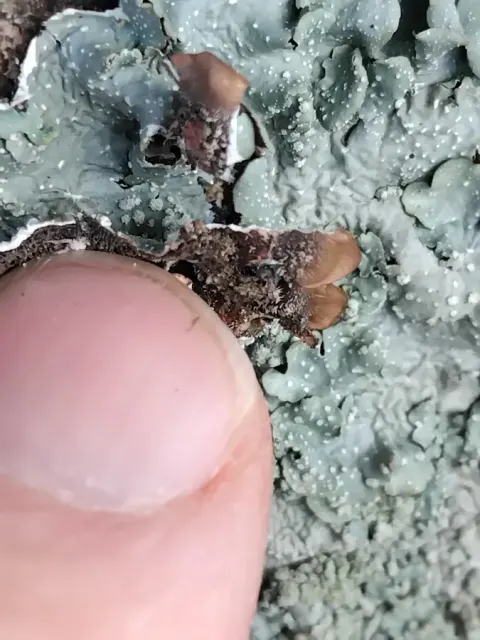
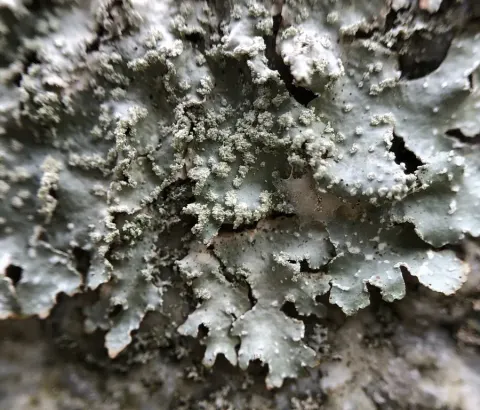
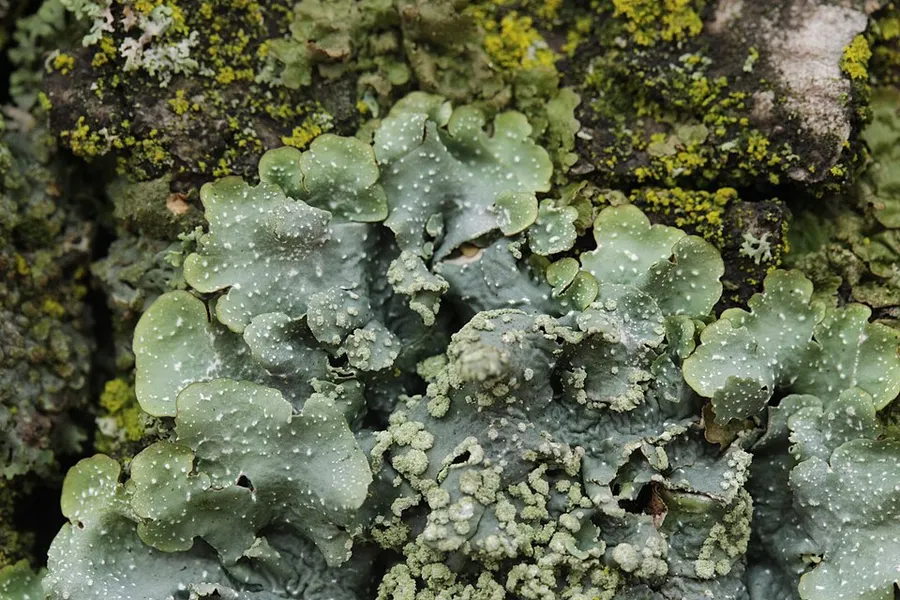
The thallus of Punctelia subrudecta is foliose and usually forms loosened rosettes several centimetres across. Lobes are rather narrow (mostly 2–4 mm wide), flat to slightly ridged, and display a pale grey-green colour that darkens when wet. The upper surface is smooth and lacks the shallow pits () that give P. perreticulata its look; it is also free of the frost-like bloom () that dusts the lobe tips of P. jeckeri. Minute white pores (pseudocyphellae) are scattered but never abundant. Vegetative reproduction dominates in P. subrudecta. Powdery propagules called soredia—tiny balls of algal cells wrapped in fungal threads—break through the cortex in discrete patches known as soralia. In P. subrudecta the soralia first appear along lobe edges and secondary lobes; older parts of the thallus may also develop scattered soralia, but the soredia remain fine and never coarsen into granules. The lower surface is characteristically pale off-white to light tan (never black) and bears sparse, similarly pale anchoring rhizines, a combination that helps separate the species from dark-undersided members of the genus. Microscopically the pycnidia produce (gently hook-shaped) conidia only 4–6 μm long—one of the most reliable diagnostic characters, because related North-American taxa have straight, much longer conidia. Apothecia are rare; when present they are (thallus-coloured rim) and may develop sorediate margins. The ascospores have been reported as broadly ellipsoid, 14–17 × 10–12 μm, though most populations reproduce purely by soredia. Adler and Ahti measured 25 % of their worldwide collections and found that the unciform conidia of P. subrudecta have a modal length of 4–5.5 μm (range 3.5–6.5 μm) and are sometimes intermixed with a few straight conidia, whereas lobe width spans (1–)2–4(–8) mm, overlapping completely with that of P. perreticulata; they therefore dismissed lobe width as a diagnostic trait.
Habitat dan peran ekologis
Punctelia subrudecta is predominantly corticolous, forming tightly attached rosettes on the bark of trees in temperate and Mediterranean woodlands; specimens examined from the Iberian Peninsula were taken almost exclusively from trunks and branches, with only occasional collections on siliceous rock faces that mimic bark microclimates. Populations recorded in Atlantic oak forests and in the drier, eastern Mediterranean mountains show that the species tolerates a broad moisture gradient, provided atmospheric pollution remains low. Thalli from heavily trafficked coastal sites in eastern Spain show pink central necrosis and marginal bleaching, symptoms the authors link to chronic oxidant and nitrogen pollution. Polish herbarium data show the species colonises a wide range of phorophytes, most frequently oak (Quercus, 26 % of records) but also alder (Alnus, 13 %), European ash (Fraxinus excelsior, 11 %), small-leaved linden (Tilia cordata, 11 %), willow (Salix, 10 %) and a suite of other broad-leaved hosts; rare saxicolous thalli have even been found on wood and concrete. Sequence-verified collections confirm an essentially Old-World range stretching from Fennoscandia south to the Mediterranean, eastwards into Kenya and at least parts of China and Australasia; records from the Americas are now considered misidentifications.
- Habitat atau konteks temuan
- hutan
- Substrat
- kayu
- Peran atau konteks
- Pembentuk liken
Reproduksi
Vegetative reproduction dominates in P. subrudecta. Powdery propagules called soredia—tiny balls of algal cells wrapped in fungal threads—break through the cortex in discrete patches known as soralia. In P. subrudecta the soralia first appear along lobe edges and secondary lobes; older parts of the thallus may also develop scattered soralia, but the soredia remain fine and never coarsen into granules. The lower surface is characteristically pale off-white to light tan (never black) and bears sparse, similarly pale anchoring rhizines, a combination that helps separate the species from dark-undersided members of the genus. Microscopically the pycnidia produce (gently hook-shaped) conidia only 4–6 μm long—one of the most reliable diagnostic characters, because related North-American taxa have straight, much longer conidia.
Catatan identitas dan cakupan
- Nama diterima mengikuti Catalogue of Life Base2026-09-11; uraian mempertahankan konsep dan nama sumber aslinya.
- Original geographic, specimen and life-cycle scope retained; source import awaits individual editorial review.
- Impor dan terjemahan otomatis belum diperiksa editorial per profil. Struktur reproduktif yang disebutkan tidak membuktikan seluruh siklus hidup diketahui.
- Pengukuran pada uraian mengikuti spesimen, kultur, dan metode sumber; angka tidak diperluas ke semua populasi.
Catatan distribusi dalam narasi mengikuti sumbernya. Dokumentasi spesimen atau foto mengikuti catatan sumber. Bukti wilayah Indonesia dan penilaian konservasi tidak disimpulkan dari gambar.
Melihat dengan konteks
Dokumentasi Punctelia subrudecta dari Wikimedia Commons. Punctelia subrudecta Identifikasi mengikuti record berkas sumber.
- Jenis
- Fotografi
- Kredit
- Björn S...
- Lisensi
- CC BY-SA 2.0
- Sumber media
- Buka entri sumber
Sumber profil
- [1] Punctelia subrudecta — Wikipedia (en)
- [2] Catalogue of Life Base2026-09-11 — Punctelia subrudecta
- [3] Dokumentasi visual — Punctelia subrudecta
Rujukan halaman ini
Fungi. Punctelia subrudecta. Rilis data fungi-2026-10-12-expansion-2. https://fungi-atlas.mgadib.chatgpt.site/jamur/punctelia-subrudecta/.
Status: impor sumber; pemeriksaan editorial per profil belum selesai. Untuk klaim biologis, gunakan rujukan pada bagian terkait dan periksa konteks sumber aslinya.