01 / Morfologi

Ciri dan struktur

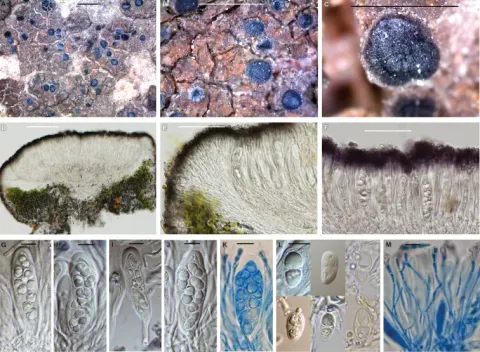
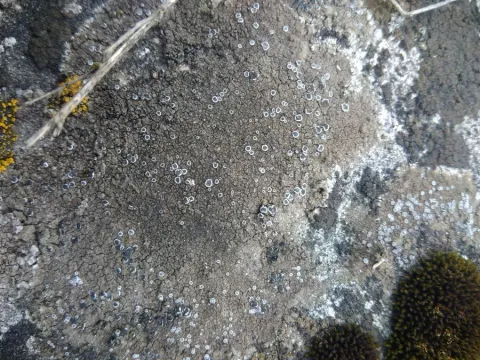
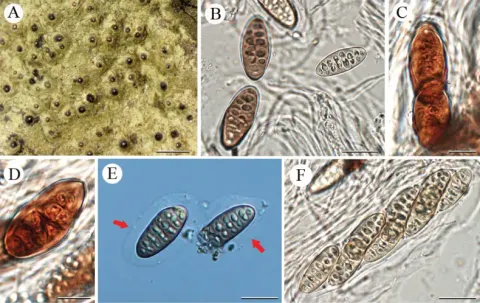
Pyrenocollema elegans is characterized by its distinctive thallus, which forms rosettes up to 10 mm in diameter. These rosettes may appear either as isolated formations or merge together to create a continuous spread. The thallus has a thin, dark brown base layer that is marked by distinctive black warts measuring 0.1–0.3 mm across, and ridges extending up to 0.15 by 0.7 mm. At the thallus periphery, these ridges form a radiating pattern and appear flattened, while in the central regions, they become more irregular. While typically flat, these ridges can occasionally become raised and sharp, reaching heights of 35–50 μm. The species produces scattered (reproductive structures) that are usually sparse but can occasionally be abundant. These perithecia measure 0.1–0.5 mm in diameter and are prominently displayed, with an irregularly somewhat shape featuring a flattened to concave top that can sometimes appear deeply . The internal structure reveals a thallus thickness of 20–50 μm, composed primarily of vertical rows of angular to rounded cells. The is a cyanobacterium with yellowish-brown cells measuring 3–5.5 μm in diameter. The reproductive characteristics include asci that are , , or nearly cylindrical, measuring 40–60 by 12–18 μm. The paraphyses are persistent, branched, and anastomosing, approximately 1 μm thick with sparse septation. Each ascus typically contains 8 colourless, 1-septate spores that are ellipsoid to ovate with rounded ends. The upper cell of these spores is usually slightly broader, and they measure 11.5–20 by 3.5–7 μm, showing no constriction at the septum.

Sebagian uraian ditampilkan dalam bahasa sumber; terjemahannya belum tersedia atau belum lolos pemeriksaan.

Rujukan: [1]

Pengukuran mengikuti objek, spesimen atau kultur, dan metode yang disebutkan sumber. Baca uraian asli untuk konteks lengkap.

02 / Kehidupan

Habitat dan peran ekologis

Pyrenocollema elegans is a marine lichen that inhabits the intertidal zone of coastal areas. It shows a strong preference for siliceous seashore rocks, particularly those composed of schist or granite, though it occasionally occurs on calcareous substrates. The species typically occupies the lower littoral fringe or the uppermost section of the eulittoral zone (also known as the hydrohaline zone), where it receives regular seawater immersion. The species has a wide geographic distribution. Along the Atlantic coast of Europe, it ranges from mid-Norway southward to northern Spain. In the Pacific, it has been documented at several locations along the western coasts of North and South America, including California (USA), Peru, and Chile. While no specimens had been recorded from the Atlantic coast of North America as of 1992, its presence there was considered likely but undocumented. In its typical habitat, P. elegans frequently grows in association with barnacles – specifically Semibalanus balanoides in Norwegian waters and Chthamalus species in more southerly regions. The species shows a preference for exposed rocky areas rather than sheltered locations. While it can exist as the sole lichen species in an area, it commonly forms communities with other marine lichens including Verrucaria striatula, V. ditmarsica, V. halizoa, Wahlenbergiella mucosa, Hydropunctaria amphibia, Pyrenocollema halodytes, and P. sublitoralis.

Sebagian uraian ditampilkan dalam bahasa sumber; terjemahannya belum tersedia atau belum lolos pemeriksaan.

Rujukan: [1]

Habitat atau konteks temuan
Informasi belum tersedia pada sumber rilis ini.
Substrat
Informasi belum tersedia pada sumber rilis ini.
Peran atau konteks
Pembentuk liken
Temukan hubungan serupa
03 / Siklus hidup

Reproduksi

The species produces scattered (reproductive structures) that are usually sparse but can occasionally be abundant. These perithecia measure 0.1–0.5 mm in diameter and are prominently displayed, with an irregularly somewhat shape featuring a flattened to concave top that can sometimes appear deeply . The internal structure reveals a thallus thickness of 20–50 μm, composed primarily of vertical rows of angular to rounded cells. The is a cyanobacterium with yellowish-brown cells measuring 3–5.5 μm in diameter. The reproductive characteristics include asci that are , , or nearly cylindrical, measuring 40–60 by 12–18 μm. The paraphyses are persistent, branched, and anastomosing, approximately 1 μm thick with sparse septation.

Sebagian uraian ditampilkan dalam bahasa sumber; terjemahannya belum tersedia atau belum lolos pemeriksaan.

Rujukan: [1]

Sinonim menurut acuan taksonomi rilis: Collemopsidium elegans
04 / Batas informasi

Catatan identitas dan cakupan

  • Nama diterima mengikuti Catalogue of Life Base2026-09-11; uraian mempertahankan konsep dan nama sumber aslinya.
  • Original geographic, specimen and life-cycle scope retained; source import awaits individual editorial review.
  • Impor dan terjemahan otomatis belum diperiksa editorial per profil. Struktur reproduktif yang disebutkan tidak membuktikan seluruh siklus hidup diketahui.
  • Pengukuran pada uraian mengikuti spesimen, kultur, dan metode sumber; angka tidak diperluas ke semua populasi.

Catatan distribusi dalam narasi mengikuti sumbernya. Dokumentasi spesimen atau foto mengikuti catatan sumber. Bukti wilayah Indonesia dan penilaian konservasi tidak disimpulkan dari gambar.

05 / Dokumentasi

Melihat dengan konteks

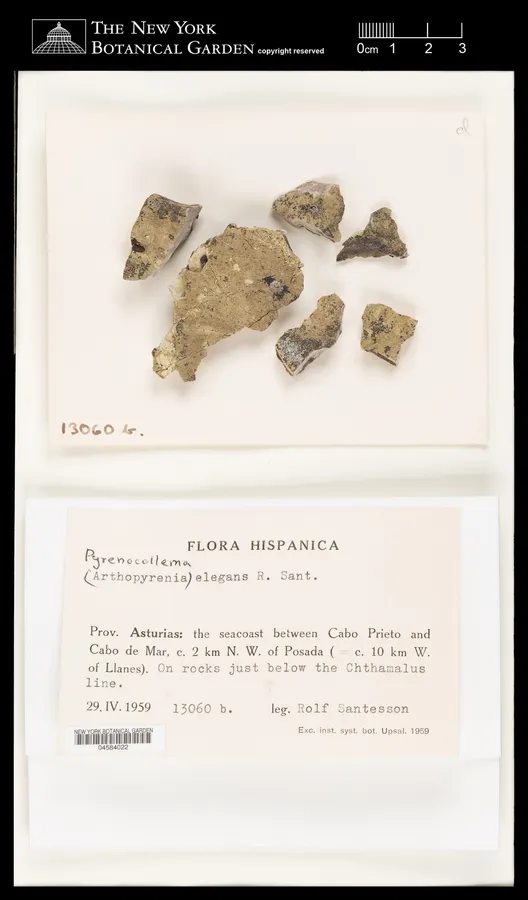
Voucher herbarium Pyrenocollema elegans (04584022), The New York Botanical Garden. Identifikasi mengikuti record spesimen sumber. Foto bahan, kemasan, atau label herbarium sebagaimana tersedia pada record institusi; bukan foto lapangan atau penentuan spesimen independen.

Jenis
Voucher herbarium
Kredit
The New York Botanical Garden
Lisensi
CC BY 4.0
Sumber media
Buka entri sumber

Gambar menunjukkan objek menurut identifikasi sumber, bukan verifikasi independen spesimen oleh Fungi. Tidak ada skala baru yang ditambahkan.

06 / Rujukan

Sumber profil

  1. [1] Pyrenocollema elegans — Wikipedia (en)Bagian sumber: Frozen revision 1342616414
    Tanggal penghimpunan sumber: 2026-10-12
    Teks sumber: CC BY-SA4.0 · Wikipedia contributors
  2. [2] Catalogue of Life Base2026-09-11 — Pyrenocollema elegansBagian sumber: ColDP NameUsage.tsv ID 78R4P; accepted species; source 2073
    Tanggal penghimpunan sumber: 2026-10-12
  3. [3] Dokumentasi visual — Pyrenocollema elegansBagian sumber: Individual media record; identification follows the source, not independent determination
    Tanggal penghimpunan sumber: 2026-10-12
    Media sumber: CC BY 4.0 · The New York Botanical Garden

Adaptasi teks: CC BY-SA 4.0. Wikipedia contributors — Pyrenocollema elegans — Wikipedia (en)

Uraian asli dan riwayat sumber

Riwayat atau halaman sumber

Ringkasan sumber

Pyrenocollema elegans is a lichen-forming fungus species that grows in marine environments along rocky coastlines. First recognized in 1937 and formally described by the Swedish lichenologist Rolf Santesson in 1992, it is distinguished by its dark brown thallus that forms rosettes up to 10 mm in diameter bearing characteristic black ridges and warts. The species inhabits the intertidal zone, particularly on siliceous rocks, where it commonly associates with barnacles and other marine lichens. It has a wide geographic distribution, occurring along the Atlantic coast of Europe from Norway to northern Spain, and along the Pacific coasts of North and South America.

Revisi sumber

Morfologi sumber

Pyrenocollema elegans is characterized by its distinctive thallus, which forms rosettes up to 10 mm in diameter. These rosettes may appear either as isolated formations or merge together to create a continuous spread. The thallus has a thin, dark brown base layer that is marked by distinctive black warts measuring 0.1–0.3 mm across, and ridges extending up to 0.15 by 0.7 mm. At the thallus periphery, these ridges form a radiating pattern and appear flattened, while in the central regions, they become more irregular. While typically flat, these ridges can occasionally become raised and sharp, reaching heights of 35–50 μm. The species produces scattered (reproductive structures) that are usually sparse but can occasionally be abundant. These perithecia measure 0.1–0.5 mm in diameter and are prominently displayed, with an irregularly somewhat shape featuring a flattened to concave top that can sometimes appear deeply . The internal structure reveals a thallus thickness of 20–50 μm, composed primarily of vertical rows of angular to rounded cells. The is a cyanobacterium with yellowish-brown cells measuring 3–5.5 μm in diameter. The reproductive characteristics include asci that are , , or nearly cylindrical, measuring 40–60 by 12–18 μm. The paraphyses are persistent, branched, and anastomosing, approximately 1 μm thick with sparse septation. Each ascus typically contains 8 colourless, 1-septate spores that are ellipsoid to ovate with rounded ends. The upper cell of these spores is usually slightly broader, and they measure 11.5–20 by 3.5–7 μm, showing no constriction at the septum.

Revisi sumber

Ekologi sumber

Pyrenocollema elegans is a marine lichen that inhabits the intertidal zone of coastal areas. It shows a strong preference for siliceous seashore rocks, particularly those composed of schist or granite, though it occasionally occurs on calcareous substrates. The species typically occupies the lower littoral fringe or the uppermost section of the eulittoral zone (also known as the hydrohaline zone), where it receives regular seawater immersion. The species has a wide geographic distribution. Along the Atlantic coast of Europe, it ranges from mid-Norway southward to northern Spain. In the Pacific, it has been documented at several locations along the western coasts of North and South America, including California (USA), Peru, and Chile. While no specimens had been recorded from the Atlantic coast of North America as of 1992, its presence there was considered likely but undocumented. In its typical habitat, P. elegans frequently grows in association with barnacles – specifically Semibalanus balanoides in Norwegian waters and Chthamalus species in more southerly regions. The species shows a preference for exposed rocky areas rather than sheltered locations. While it can exist as the sole lichen species in an area, it commonly forms communities with other marine lichens including Verrucaria striatula, V. ditmarsica, V. halizoa, Wahlenbergiella mucosa, Hydropunctaria amphibia, Pyrenocollema halodytes, and P. sublitoralis.

Revisi sumber

Struktur reproduksi sumber

The species produces scattered (reproductive structures) that are usually sparse but can occasionally be abundant. These perithecia measure 0.1–0.5 mm in diameter and are prominently displayed, with an irregularly somewhat shape featuring a flattened to concave top that can sometimes appear deeply . The internal structure reveals a thallus thickness of 20–50 μm, composed primarily of vertical rows of angular to rounded cells. The is a cyanobacterium with yellowish-brown cells measuring 3–5.5 μm in diameter. The reproductive characteristics include asci that are , , or nearly cylindrical, measuring 40–60 by 12–18 μm. The paraphyses are persistent, branched, and anastomosing, approximately 1 μm thick with sparse septation.

Revisi sumber

Rujukan halaman ini

Fungi. Pyrenocollema elegans. Rilis data fungi-2026-10-12-expansion-2. https://fungi-atlas.mgadib.chatgpt.site/jamur/pyrenocollema-elegans/.

Status: impor sumber; pemeriksaan editorial per profil belum selesai. Untuk klaim biologis, gunakan rujukan pada bagian terkait dan periksa konteks sumber aslinya.