Ciri dan struktur
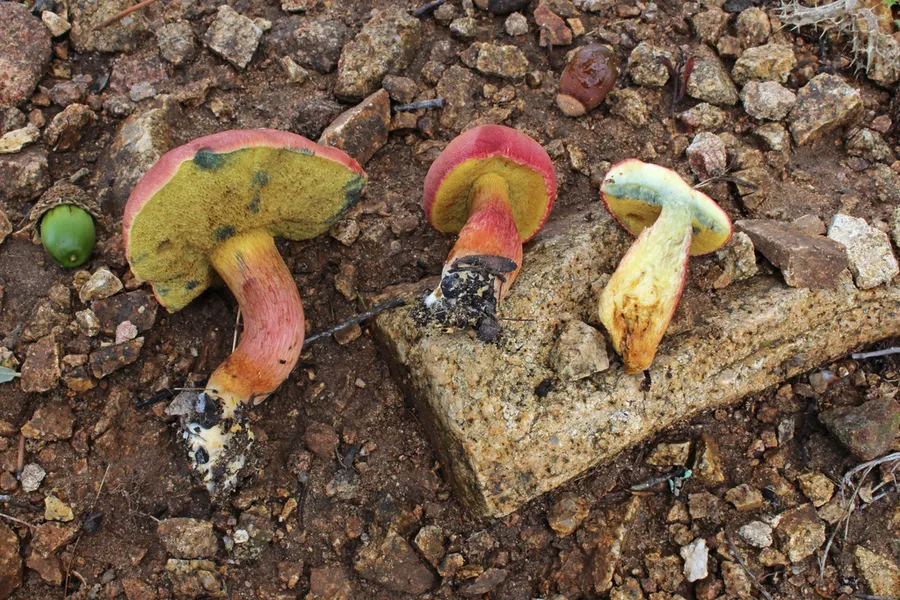
The cap is initially globular before expanding to become convex and flattening somewhat; it grows to a diameter of 2 – 6 cm. The cap margin initially adheres to the stipe and has a tendency to become lobed or undulated in age. The cap surface is first somewhat pubescent but later becomes smooth and hairless, and may develop cracks in age. Its color is orangish-apricot, aging to ochre. Tubes are initially pale yellow, but become more vivid in age, and eventually develop greenish-yellow to greenish-olive tones. They will become pale blue upon with bruising. The pores are circular or a bit angular, with the same coloring and bruising reaction as the tubes. The robust stipe measures 3 – 8 cm long by 0.5 – 1.5 cm thick. It is usually thicker in the middle or lower region, and its base roots into the substrate. The top part of the stipe is yellow; under this the coloration tends to be masked by a dense and fine reticulation that becomes brown to brownish-crimson in age. In some specimens the stipe cuticle cracks and pointed patches lift from the surface. The flesh is pale yellow in the cap, with a narrow strip of pinkish-yellow under the cuticle; in the stipe, the flesh is orange-ochre, with a reddish tint. The flesh sometimes shows a slight and temporary color change to blue when cut or otherwise injured, but this feature is not consistent. It has a pleasant odor and a fruity-acid taste. Spores are fusiform (spindle shaped), measuring 10–15 by 4.5–6 μm. The basidia (spore-bearing cells) are club-shaped, four-spored, and contain internal oil droplets; they measure 28–35 by 9–12 μm.
Habitat dan peran ekologis
It has been recorded forming ectomycorrhizal association with white poplar (Populus alba) in Hungary. Its ectomycorrhizae contain bright yellow pigments, especially the rhizomorphs, and have warts on the outer surfaces of both the rhizomorphs and the mantle. The ectomycorrhizae of R. armeniacus cannot be reliably distinguished from those of Xerocomus subtomentosus.
- Habitat atau konteks temuan
- Informasi belum tersedia pada sumber rilis ini.
- Substrat
- Informasi belum tersedia pada sumber rilis ini.
- Peran atau konteks
- Mitra tumbuhan
Reproduksi
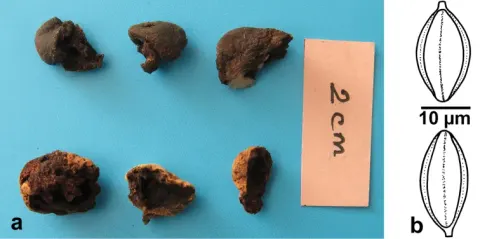
Spores are fusiform (spindle shaped), measuring 10–15 by 4.5–6 μm. The basidia (spore-bearing cells) are club-shaped, four-spored, and contain internal oil droplets; they measure 28–35 by 9–12 μm. The cystidia are fusiform, hyaline (translucent), and 40–55 by 9–12 μm.
Catatan identitas dan cakupan
- Nama diterima mengikuti Catalogue of Life Base2026-09-11; uraian mempertahankan konsep dan nama sumber aslinya.
- Original geographic, specimen and life-cycle scope retained; source import awaits individual editorial review.
- Impor dan terjemahan otomatis belum diperiksa editorial per profil. Struktur reproduktif yang disebutkan tidak membuktikan seluruh siklus hidup diketahui.
- Pengukuran pada uraian mengikuti spesimen, kultur, dan metode sumber; angka tidak diperluas ke semua populasi.
Catatan distribusi dalam narasi mengikuti sumbernya. Dokumentasi spesimen atau foto mengikuti catatan sumber. Bukti wilayah Indonesia dan penilaian konservasi tidak disimpulkan dari gambar.
Melihat dengan konteks
Dokumentasi Xerocomellus armeniacus menurut asosiasi foto pada record takson iNaturalist. Kredit: Davide Puddu. Identitas mengikuti sumber; bukan penentuan spesimen independen.
- Jenis
- Fotografi
- Kredit
- (c) Davide Puddu, some rights reserved (CC BY), uploaded by Davide Puddu
- Lisensi
- CC BY 4.0
- Sumber media
- Buka entri sumber
Sumber profil
- [1] Rheubarbariboletus armeniacus — Wikipedia (en)
- [2] Catalogue of Life Base2026-09-11 — Rheubarbariboletus armeniacus
- [3] Dokumentasi visual — Xerocomellus armeniacus
Rujukan halaman ini
Fungi. Rheubarbariboletus armeniacus. Rilis data fungi-2026-10-12-expansion-2. https://fungi-atlas.mgadib.chatgpt.site/jamur/rheubarbariboletus-armeniacus/.
Status: impor sumber; pemeriksaan editorial per profil belum selesai. Untuk klaim biologis, gunakan rujukan pada bagian terkait dan periksa konteks sumber aslinya.