01 / Morfologi

Ciri dan struktur

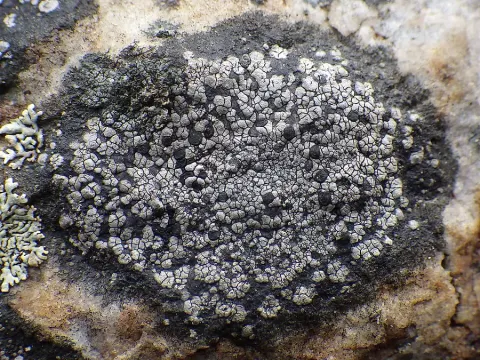
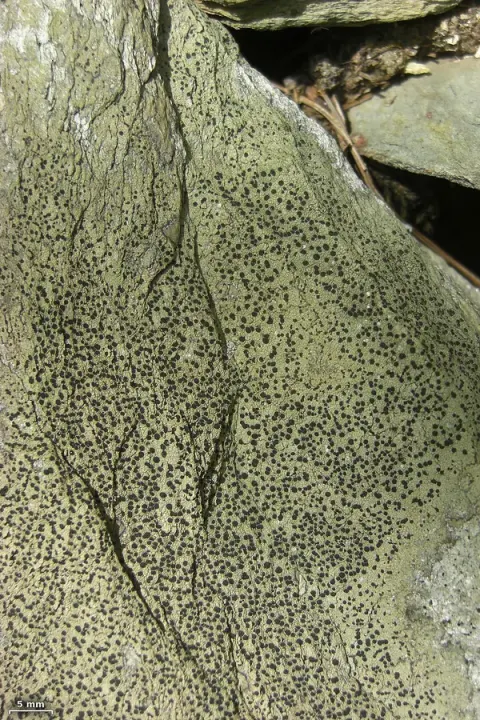
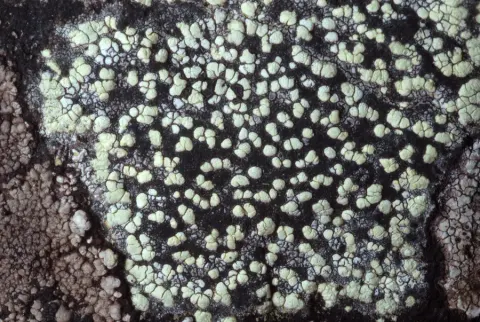
Rhizocarpon alpicola forms a broad, patch-like crust that can reach roughly 15 cm across. The edge of each colony is outlined by a conspicuous black —a band of fungal tissue that develops before the main body develops. The thallus itself is divided into tiny "tiles" () up to about 1.5 mm wide; these range from contiguous to widely scattered and are green-yellow because the concentrates rhizocarpic and psoromic acids. Individual areoles are flat to gently domed and often crack finely across their surface. Internally, the medulla shows no iodine reaction (I–). Reproduction is via black, button-like apothecia up to 1.5 mm in diameter. They sit flush with or slightly above the thallus and may be round or angular. The surrounding wall () is hard to discern externally but, when sectioned, reveals a red-brown inner layer that turns purplish-red with a drop of potassium hydroxide solution. The uppermost tissue () is pale to mid-brown and may give a faint purple tint with the same K test. Beneath lies a clear hymenium, and lower still a dark red-brown . Each club-shaped ascus contains eight ascospores; the mature spores measure 20–33 μm by 9–17 μm, are divided by a single cross-wall (occasionally a couple of extra thin ones), and darken to a deep brown as they age. No specialised asexual propagules have been observed in this species. A quick chemical spot test helps separate R. alpicola from look-alikes such as R. atroalbescens: the medulla of R. alpicola remains unresponsive to potassium hydroxide (K−) but flashes bright yellow with para-phenylenediamine (Pd+), whereas R. atroalbescens gives different colour changes because it produces alternate acids.

Sebagian uraian ditampilkan dalam bahasa sumber; terjemahannya belum tersedia atau belum lolos pemeriksaan.

Rujukan: [1]

Pengukuran mengikuti objek, spesimen atau kultur, dan metode yang disebutkan sumber. Baca uraian asli untuk konteks lengkap.

02 / Kehidupan

Habitat dan peran ekologis

A detailed size-frequency study on dated moraines in the Storbreen glacier foreland (Jotunheimen, south-west Norway) found that R. alpicola first establishes abundantly on rock surfaces that have been exposed for roughly a century and then shows little further recruitment. On the two oldest ridges examined (formed roughly 1750 and 1810), thalli were plentiful, whereas they were scarce on the 1852 moraine and essentially absent on later nineteenth- and twentieth-century ridges. Mean thallus diameters reflected this pattern of early colonisation followed by cohort ageing: averages rose from about 18 mm on the 1852 ridge to about 25 mm on the 1810 ridge and about 35–38 mm on the 1750 ridge, with occasional individuals approaching 80 mm. The frequency distributions became progressively more positively skewed and peaked, and their standard deviations widened, indicating that most thalli enlarge slowly over decades while few new individuals join the population. The author of the study proposed two, not mutually exclusive, explanations for the marked absence of small thalli on younger moraines: (1) a colonisation lag of roughly 100 years until suitable micro-substrate develops, or (2) a recent environmental shift (possibly climatic or chemical) that now limits establishment.

Sebagian uraian ditampilkan dalam bahasa sumber; terjemahannya belum tersedia atau belum lolos pemeriksaan.

Rujukan: [1]

Habitat atau konteks temuan
Informasi belum tersedia pada sumber rilis ini.
Substrat
Informasi belum tersedia pada sumber rilis ini.
Peran atau konteks
Pembentuk liken
Temukan hubungan serupa
03 / Siklus hidup

Reproduksi

Reproduction is via black, button-like apothecia up to 1.5 mm in diameter. They sit flush with or slightly above the thallus and may be round or angular. The surrounding wall () is hard to discern externally but, when sectioned, reveals a red-brown inner layer that turns purplish-red with a drop of potassium hydroxide solution. The uppermost tissue () is pale to mid-brown and may give a faint purple tint with the same K test. Beneath lies a clear hymenium, and lower still a dark red-brown . Each club-shaped ascus contains eight ascospores; the mature spores measure 20–33 μm by 9–17 μm, are divided by a single cross-wall (occasionally a couple of extra thin ones), and darken to a deep brown as they age.

Sebagian uraian ditampilkan dalam bahasa sumber; terjemahannya belum tersedia atau belum lolos pemeriksaan.

Rujukan: [1]

Sinonim menurut acuan taksonomi rilis: Buellia alpicola; Buellia alpicola conglomerata; Buellia deludens; Buellia geographica subsp. alpicola; Buellia geographica var. gerontica; Catocarpus alpicola; Catocarpus chionophilus; Catocarpus oreites; Diplotomma geographicum f. conglomeratum; Lecidea alpicola; Lecidea atrovirens var. alpicola; Lecidea atrovirens var. gerontica; Lecidea chionophila; Lecidea deludens; Lecidea geographica f. alpicola; Lecidea geographica f. conglomerata; Lecidea geographica f. gerontica; Lecidea geographica var. alpicola; Lecidea geographica var. conglomerata; Lecidea geographica var. gerontica; Lecidea oreites; Rhizocarpon chionophilum; Rhizocarpon conglomeratum; Rhizocarpon deludens; Rhizocarpon geographicum conglomeratum; Rhizocarpon geographicum f. conglomeratum; Rhizocarpon geographicum f. geronticum; Rhizocarpon geographicum var. alpicola; Rhizocarpon geographicum var. conglomeratum; Rhizocarpon geographicum var. geronticum; Rhizocarpon geronticum; Rhizocarpon oreites
04 / Batas informasi

Catatan identitas dan cakupan

  • Nama diterima mengikuti Catalogue of Life Base2026-09-11; uraian mempertahankan konsep dan nama sumber aslinya.
  • Original geographic, specimen and life-cycle scope retained; source import awaits individual editorial review.
  • Impor dan terjemahan otomatis belum diperiksa editorial per profil. Struktur reproduktif yang disebutkan tidak membuktikan seluruh siklus hidup diketahui.
  • Pengukuran pada uraian mengikuti spesimen, kultur, dan metode sumber; angka tidak diperluas ke semua populasi.

Catatan distribusi dalam narasi mengikuti sumbernya. Dokumentasi spesimen atau foto mengikuti catatan sumber. Bukti wilayah Indonesia dan penilaian konservasi tidak disimpulkan dari gambar.

05 / Dokumentasi

Melihat dengan konteks

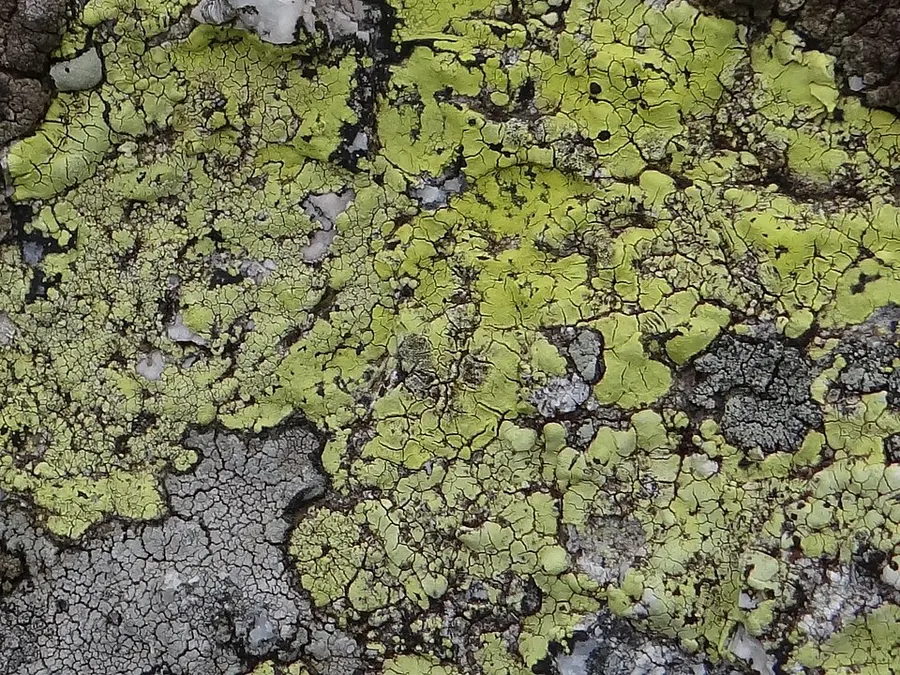
Dokumentasi Rhizocarpon alpicola dari Wikimedia Commons. Rhizocarpon alpicola (location: Tatra Mountains, Suchy Wierch Goryczkowy) Identifikasi mengikuti record berkas sumber.

Jenis
Fotografi
Kredit
Jerzy Opioła
Sumber media
Buka entri sumber

Gambar menunjukkan objek menurut identifikasi sumber, bukan verifikasi independen spesimen oleh Fungi. Tidak ada skala baru yang ditambahkan.

06 / Rujukan

Sumber profil

  1. [1] Rhizocarpon alpicola — Wikipedia (en)Bagian sumber: Frozen revision 1353399940
    Tanggal penghimpunan sumber: 2026-10-12
    Teks sumber: CC BY-SA4.0 · Wikipedia contributors
  2. [2] Catalogue of Life Base2026-09-11 — Rhizocarpon alpicolaBagian sumber: ColDP NameUsage.tsv ID 4SC3D; accepted species; source 2073
    Tanggal penghimpunan sumber: 2026-10-12
  3. [3] Dokumentasi visual — Rhizocarpon alpicolaBagian sumber: Individual media record; identification follows the source, not independent determination
    Tanggal penghimpunan sumber: 2026-10-12
    Media sumber: CC BY-SA 4.0 · Jerzy Opioła

Adaptasi teks: CC BY-SA 4.0. Wikipedia contributors — Rhizocarpon alpicola — Wikipedia (en)

Uraian asli dan riwayat sumber

Riwayat atau halaman sumber

Ringkasan sumber

Rhizocarpon alpicola is a species of saxicolous (rock-dwelling), crustose lichen in the family Rhizocarpaceae. The lichen grows as a patch-like crust up to 15 cm across, composed of small yellowish-green tiles that develop black, button-like reproductive structures. A member of the Rhizocarpon geographicum species complex, R. alpicola can usually be distinguished from related species by its large and smooth . R. alpicola is often utilised in lichenometry, a dating technique used to estimate the length of exposure of rock surfaces.

Revisi sumber

Morfologi sumber

Rhizocarpon alpicola forms a broad, patch-like crust that can reach roughly 15 cm across. The edge of each colony is outlined by a conspicuous black —a band of fungal tissue that develops before the main body develops. The thallus itself is divided into tiny "tiles" () up to about 1.5 mm wide; these range from contiguous to widely scattered and are green-yellow because the concentrates rhizocarpic and psoromic acids. Individual areoles are flat to gently domed and often crack finely across their surface. Internally, the medulla shows no iodine reaction (I–). Reproduction is via black, button-like apothecia up to 1.5 mm in diameter. They sit flush with or slightly above the thallus and may be round or angular. The surrounding wall () is hard to discern externally but, when sectioned, reveals a red-brown inner layer that turns purplish-red with a drop of potassium hydroxide solution. The uppermost tissue () is pale to mid-brown and may give a faint purple tint with the same K test. Beneath lies a clear hymenium, and lower still a dark red-brown . Each club-shaped ascus contains eight ascospores; the mature spores measure 20–33 μm by 9–17 μm, are divided by a single cross-wall (occasionally a couple of extra thin ones), and darken to a deep brown as they age. No specialised asexual propagules have been observed in this species. A quick chemical spot test helps separate R. alpicola from look-alikes such as R. atroalbescens: the medulla of R. alpicola remains unresponsive to potassium hydroxide (K−) but flashes bright yellow with para-phenylenediamine (Pd+), whereas R. atroalbescens gives different colour changes because it produces alternate acids.

Revisi sumber

Ekologi sumber

A detailed size-frequency study on dated moraines in the Storbreen glacier foreland (Jotunheimen, south-west Norway) found that R. alpicola first establishes abundantly on rock surfaces that have been exposed for roughly a century and then shows little further recruitment. On the two oldest ridges examined (formed roughly 1750 and 1810), thalli were plentiful, whereas they were scarce on the 1852 moraine and essentially absent on later nineteenth- and twentieth-century ridges. Mean thallus diameters reflected this pattern of early colonisation followed by cohort ageing: averages rose from about 18 mm on the 1852 ridge to about 25 mm on the 1810 ridge and about 35–38 mm on the 1750 ridge, with occasional individuals approaching 80 mm. The frequency distributions became progressively more positively skewed and peaked, and their standard deviations widened, indicating that most thalli enlarge slowly over decades while few new individuals join the population. The author of the study proposed two, not mutually exclusive, explanations for the marked absence of small thalli on younger moraines: (1) a colonisation lag of roughly 100 years until suitable micro-substrate develops, or (2) a recent environmental shift (possibly climatic or chemical) that now limits establishment.

Revisi sumber

Struktur reproduksi sumber

Reproduction is via black, button-like apothecia up to 1.5 mm in diameter. They sit flush with or slightly above the thallus and may be round or angular. The surrounding wall () is hard to discern externally but, when sectioned, reveals a red-brown inner layer that turns purplish-red with a drop of potassium hydroxide solution. The uppermost tissue () is pale to mid-brown and may give a faint purple tint with the same K test. Beneath lies a clear hymenium, and lower still a dark red-brown . Each club-shaped ascus contains eight ascospores; the mature spores measure 20–33 μm by 9–17 μm, are divided by a single cross-wall (occasionally a couple of extra thin ones), and darken to a deep brown as they age.

Revisi sumber

Rujukan halaman ini

Fungi. Rhizocarpon alpicola. Rilis data fungi-2026-10-12-expansion-2. https://fungi-atlas.mgadib.chatgpt.site/jamur/rhizocarpon-alpicola/.

Status: impor sumber; pemeriksaan editorial per profil belum selesai. Untuk klaim biologis, gunakan rujukan pada bagian terkait dan periksa konteks sumber aslinya.