01 / Morfologi

Ciri dan struktur

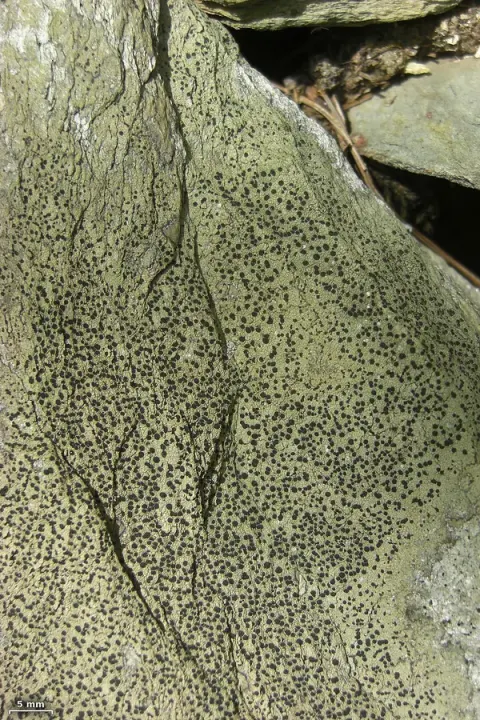
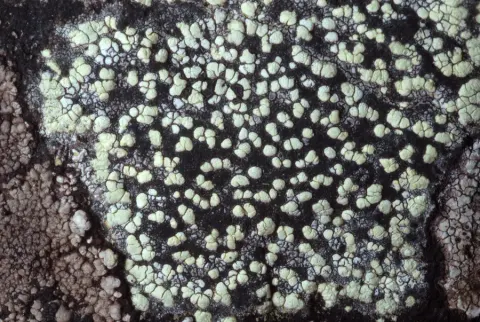
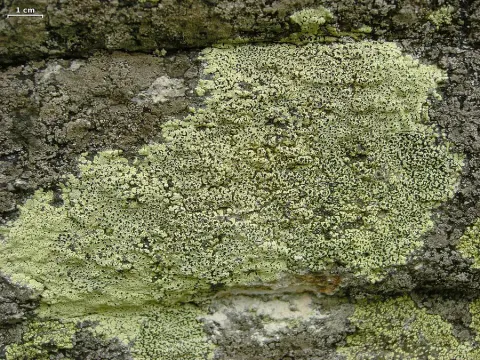
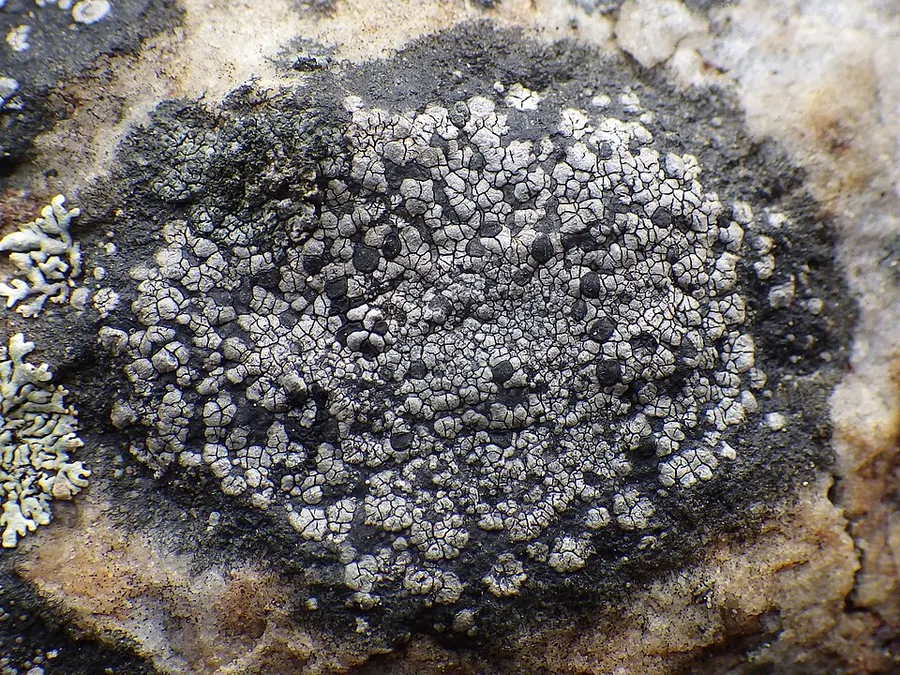
Rhizocarpon badioatrum spreads as a crust up to about 10 cm across. Its surface is broken into tile-like plates (), each no more than 2 mm wide. These plates are , medium- to dark-brown, often tinged pinkish or red-brown, and sit within a well-developed jet-black border of fungal tissue, the . The areoles are thick and mostly flat but can have scalloped edges; where they meet one another the thallus appears as a mosaic. Internally, the white fungal layer (the medulla) shows no iodine staining reaction (I–), and a drop of potassium hydroxide solution (the K test) may leave it unchanged or briefly yellow. Scattered between the areoles are the fruit-bodies (apothecia), black up to 1 mm in diameter that remain essentially flat. A narrow, dark wall called the surrounds each disc; in section the inner part looks red-brown and flashes purple-red with the K test. The very top layer of the disc (the ) is likewise red-brown and gives the same K-induced purple tint, sometimes releasing tiny red that dissolve in the reagent. Beneath this lies a clear spore-producing zone (the hymenium, about 110–120 μm tall) and a medium-brown foundation layer (the ), which shows no colour change with potassium hydroxide. Each club-shaped ascus produces eight ascospores; the mature spores measure 27–38 μm by 13–19 μm, are divided by a single cross-wall, and darken through blue-green to deep brown as they age. Para-phenylenediamine (the Pd test) is usually negative, though an orange flash or traces of stictic acid are occasionally detected.

Sebagian uraian ditampilkan dalam bahasa sumber; terjemahannya belum tersedia atau belum lolos pemeriksaan.

Rujukan: [1]

Pengukuran mengikuti objek, spesimen atau kultur, dan metode yang disebutkan sumber. Baca uraian asli untuk konteks lengkap.

02 / Kehidupan

Habitat dan peran ekologis

Rhizocarpon badioatrum occurs in Europe, Macaronesia, southern Africa, South-East Asia, Papua New Guinea, North America, Argentina and Antarctica. It is also found in Greenland. In Australia, it has been recorded from south-eastern Queensland, New South Wales, Victoria, Tasmania, and the Australian Capital Territory.

Sebagian uraian ditampilkan dalam bahasa sumber; terjemahannya belum tersedia atau belum lolos pemeriksaan.

Rujukan: [1]

Habitat atau konteks temuan
Informasi belum tersedia pada sumber rilis ini.
Substrat
Informasi belum tersedia pada sumber rilis ini.
Peran atau konteks
Pembentuk liken
Temukan hubungan serupa
03 / Siklus hidup

Reproduksi

Scattered between the areoles are the fruit-bodies (apothecia), black up to 1 mm in diameter that remain essentially flat. A narrow, dark wall called the surrounds each disc; in section the inner part looks red-brown and flashes purple-red with the K test. The very top layer of the disc (the ) is likewise red-brown and gives the same K-induced purple tint, sometimes releasing tiny red that dissolve in the reagent. Beneath this lies a clear spore-producing zone (the hymenium, about 110–120 μm tall) and a medium-brown foundation layer (the ), which shows no colour change with potassium hydroxide. Each club-shaped ascus produces eight ascospores; the mature spores measure 27–38 μm by 13–19 μm, are divided by a single cross-wall, and darken through blue-green to deep brown as they age.

Sebagian uraian ditampilkan dalam bahasa sumber; terjemahannya belum tersedia atau belum lolos pemeriksaan.

Rujukan: [1]

Sinonim menurut acuan taksonomi rilis: Buellia badioatra; Buellia badioatra var. applanata; Catocarpus applanatus; Catocarpus badioater; Catocarpus badioater var. incusus; Diphaeis badioatra; Lecidea alboatra var. badioatra; Lecidea applanata; Lecidea atroalba var. badioatra; Lecidea incusa; Rhizocarpon applanatum; Rhizocarpon badioatrum var. incusum
04 / Batas informasi

Catatan identitas dan cakupan

  • Nama diterima mengikuti Catalogue of Life Base2026-09-11; uraian mempertahankan konsep dan nama sumber aslinya.
  • Original geographic, specimen and life-cycle scope retained; source import awaits individual editorial review.
  • Impor dan terjemahan otomatis belum diperiksa editorial per profil. Struktur reproduktif yang disebutkan tidak membuktikan seluruh siklus hidup diketahui.
  • Pengukuran pada uraian mengikuti spesimen, kultur, dan metode sumber; angka tidak diperluas ke semua populasi.

Catatan distribusi dalam narasi mengikuti sumbernya. Dokumentasi spesimen atau foto mengikuti catatan sumber. Bukti wilayah Indonesia dan penilaian konservasi tidak disimpulkan dari gambar.

05 / Dokumentasi

Melihat dengan konteks

Dokumentasi Rhizocarpon badioatrum dari Wikimedia Commons. For more information about this, see the observation page at Mushroom Observer. Identifikasi mengikuti record berkas sumber.

Jenis
Fotografi
Kredit
This image was created by user zaca at Mushroom Observer , a source for mycological images. You can contact this user here .
Sumber media
Buka entri sumber

Gambar menunjukkan objek menurut identifikasi sumber, bukan verifikasi independen spesimen oleh Fungi. Tidak ada skala baru yang ditambahkan.

06 / Rujukan

Sumber profil

  1. [1] Rhizocarpon badioatrum — Wikipedia (en)Bagian sumber: Frozen revision 1320875654
    Tanggal penghimpunan sumber: 2026-10-12
    Teks sumber: CC BY-SA4.0 · Wikipedia contributors
  2. [2] Catalogue of Life Base2026-09-11 — Rhizocarpon badioatrumBagian sumber: ColDP NameUsage.tsv ID 78V6V; accepted species; source 2073
    Tanggal penghimpunan sumber: 2026-10-12
  3. [3] Dokumentasi visual — Rhizocarpon badioatrumBagian sumber: Individual media record; identification follows the source, not independent determination
    Tanggal penghimpunan sumber: 2026-10-12
    Media sumber: CC BY-SA 3.0 · This image was created by user zaca at Mushroom Observer , a source for mycological images. You can contact this user here .

Adaptasi teks: CC BY-SA 4.0. Wikipedia contributors — Rhizocarpon badioatrum — Wikipedia (en)

Uraian asli dan riwayat sumber

Riwayat atau halaman sumber

Ringkasan sumber

Rhizocarpon badioatrum is a widely distributed species of saxicolous (rock-dwelling), crustose lichen in the family Rhizocarpaceae. This lichen forms a brown crust broken into small tile-like plates surrounded by a distinctive jet-black border, with scattered black disc-shaped fruiting bodies up to 1 mm across. It has a very wide global distribution, being found across multiple continents including Europe, North America, Australia, Asia, Africa, and even Antarctica.

Revisi sumber

Morfologi sumber

Rhizocarpon badioatrum spreads as a crust up to about 10 cm across. Its surface is broken into tile-like plates (), each no more than 2 mm wide. These plates are , medium- to dark-brown, often tinged pinkish or red-brown, and sit within a well-developed jet-black border of fungal tissue, the . The areoles are thick and mostly flat but can have scalloped edges; where they meet one another the thallus appears as a mosaic. Internally, the white fungal layer (the medulla) shows no iodine staining reaction (I–), and a drop of potassium hydroxide solution (the K test) may leave it unchanged or briefly yellow. Scattered between the areoles are the fruit-bodies (apothecia), black up to 1 mm in diameter that remain essentially flat. A narrow, dark wall called the surrounds each disc; in section the inner part looks red-brown and flashes purple-red with the K test. The very top layer of the disc (the ) is likewise red-brown and gives the same K-induced purple tint, sometimes releasing tiny red that dissolve in the reagent. Beneath this lies a clear spore-producing zone (the hymenium, about 110–120 μm tall) and a medium-brown foundation layer (the ), which shows no colour change with potassium hydroxide. Each club-shaped ascus produces eight ascospores; the mature spores measure 27–38 μm by 13–19 μm, are divided by a single cross-wall, and darken through blue-green to deep brown as they age. Para-phenylenediamine (the Pd test) is usually negative, though an orange flash or traces of stictic acid are occasionally detected.

Revisi sumber

Ekologi sumber

Rhizocarpon badioatrum occurs in Europe, Macaronesia, southern Africa, South-East Asia, Papua New Guinea, North America, Argentina and Antarctica. It is also found in Greenland. In Australia, it has been recorded from south-eastern Queensland, New South Wales, Victoria, Tasmania, and the Australian Capital Territory.

Revisi sumber

Struktur reproduksi sumber

Scattered between the areoles are the fruit-bodies (apothecia), black up to 1 mm in diameter that remain essentially flat. A narrow, dark wall called the surrounds each disc; in section the inner part looks red-brown and flashes purple-red with the K test. The very top layer of the disc (the ) is likewise red-brown and gives the same K-induced purple tint, sometimes releasing tiny red that dissolve in the reagent. Beneath this lies a clear spore-producing zone (the hymenium, about 110–120 μm tall) and a medium-brown foundation layer (the ), which shows no colour change with potassium hydroxide. Each club-shaped ascus produces eight ascospores; the mature spores measure 27–38 μm by 13–19 μm, are divided by a single cross-wall, and darken through blue-green to deep brown as they age.

Revisi sumber

Rujukan halaman ini

Fungi. Rhizocarpon badioatrum. Rilis data fungi-2026-10-12-expansion-2. https://fungi-atlas.mgadib.chatgpt.site/jamur/rhizocarpon-badioatrum/.

Status: impor sumber; pemeriksaan editorial per profil belum selesai. Untuk klaim biologis, gunakan rujukan pada bagian terkait dan periksa konteks sumber aslinya.