01 / Morfologi

Ciri dan struktur

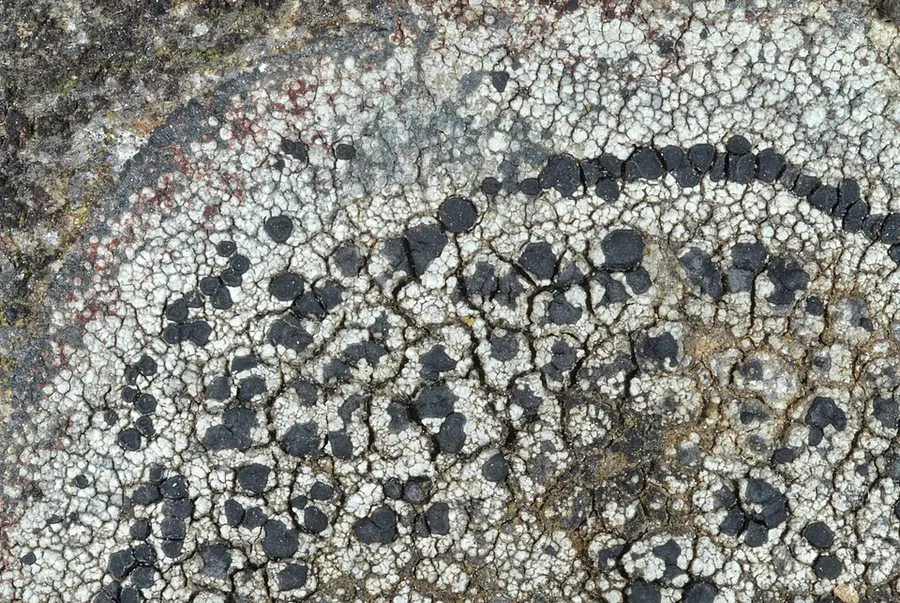
Rhizocarpon reductum grows directly on rock surfaces, forming either loose, spreading films or discrete patches one to two centimetres across that often merge into larger fields. Its thallus—a thin, crust-like body—ranges from pale grey to brown and cracks into tiny angular plates () about 0.2–0.4 mm wide; these plates are usually flat or gently domed, and in rare cases they lift slightly like minute scales. A thin black , the advance guard of fungal threads, usually rims each colony and can dominate shaded substrates where the main thallus is reduced. Black apothecia, the lichen's reproductive , are scattered among the areoles. At first they are flush with the surface () but may become stalk-less cups () that rise fractionally above it; each disc is 0.4–0.6 mm in diameter, rough-textured, and turns strongly convex as it over-matures. A narrow fungal wall () borders young apothecia; it is built from radiating hyphae whose outer cells are blue-black, but this rim can erode as the disc bulges. The transparent spore-bearing layer (hymenium) is 120–140 μm tall, overlaid by an olive-green that flashes blue with potassium hydroxide solution (K+ reaction) and brick-red with nitric acid (N+). Below lies a mid- to dark-brown . Slender —supporting filaments only about 1 μm thick—thread the hymenium; they branch rarely, do not swell at their tips, and lack a sharply pigmented cap. Each club-shaped ascus measures 65–80 × 25–33 μm and houses eight colourless ascospores. Mature spores are eumuriform, usually 24–26 × 8–10 μm, and divided into eight to ten (rarely twelve) chambers in optical view.

Sebagian uraian ditampilkan dalam bahasa sumber; terjemahannya belum tersedia atau belum lolos pemeriksaan.

Rujukan: [1]

Pengukuran mengikuti objek, spesimen atau kultur, dan metode yang disebutkan sumber. Baca uraian asli untuk konteks lengkap.

02 / Kehidupan

Habitat dan peran ekologis

Rhizocarpon reductum is widely distributed across the globe, with occurrences in Australia and New Zealand, the British Isles, continental Europe, Arctic Eurasia, Morocco, Tunisia, Turkey, Ukraine, Central Asia, China, South Africa, North America, Venezuela, Bolivia, Chile, Argentina, the Falkland Islands, and Antarctica. In Central Europe the species has been verified from siliceous sandstones of the Gorce Mountains (Western Beskids, Polish Carpathians) at 530–1,220 m elevation, where it colonises exposed, periodically sun-warmed boulders and road-cut faces.

Sebagian uraian ditampilkan dalam bahasa sumber; terjemahannya belum tersedia atau belum lolos pemeriksaan.

Rujukan: [1]

Habitat atau konteks temuan
Informasi belum tersedia pada sumber rilis ini.
Substrat
Informasi belum tersedia pada sumber rilis ini.
Peran atau konteks
Pembentuk liken
Temukan hubungan serupa
03 / Siklus hidup

Reproduksi

Black apothecia, the lichen's reproductive , are scattered among the areoles. At first they are flush with the surface () but may become stalk-less cups () that rise fractionally above it; each disc is 0.4–0.6 mm in diameter, rough-textured, and turns strongly convex as it over-matures. A narrow fungal wall () borders young apothecia; it is built from radiating hyphae whose outer cells are blue-black, but this rim can erode as the disc bulges. The transparent spore-bearing layer (hymenium) is 120–140 μm tall, overlaid by an olive-green that flashes blue with potassium hydroxide solution (K+ reaction) and brick-red with nitric acid (N+). Below lies a mid- to dark-brown . Slender —supporting filaments only about 1 μm thick—thread the hymenium; they branch rarely, do not swell at their tips, and lack a sharply pigmented cap.

Sebagian uraian ditampilkan dalam bahasa sumber; terjemahannya belum tersedia atau belum lolos pemeriksaan.

Rujukan: [1]

Sinonim menurut acuan taksonomi rilis: Rhizocarpon obscuratum f. reductum; Rhizocarpon obscuratum var. reductum
04 / Batas informasi

Catatan identitas dan cakupan

  • Nama diterima mengikuti Catalogue of Life Base2026-09-11; uraian mempertahankan konsep dan nama sumber aslinya.
  • Original geographic, specimen and life-cycle scope retained; source import awaits individual editorial review.
  • Impor dan terjemahan otomatis belum diperiksa editorial per profil. Struktur reproduktif yang disebutkan tidak membuktikan seluruh siklus hidup diketahui.
  • Pengukuran pada uraian mengikuti spesimen, kultur, dan metode sumber; angka tidak diperluas ke semua populasi.

Catatan distribusi dalam narasi mengikuti sumbernya. Dokumentasi spesimen atau foto mengikuti catatan sumber. Bukti wilayah Indonesia dan penilaian konservasi tidak disimpulkan dari gambar.

05 / Dokumentasi

Melihat dengan konteks

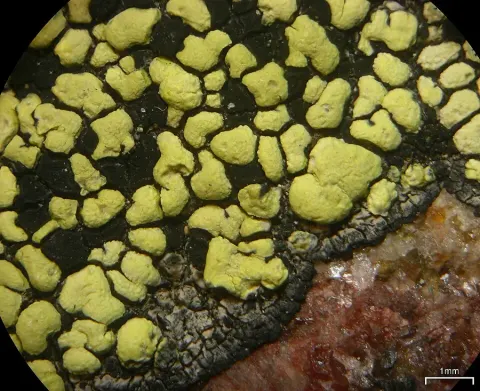
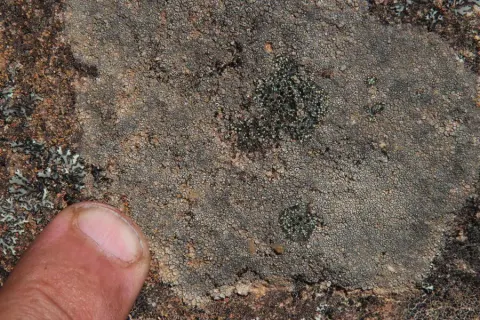
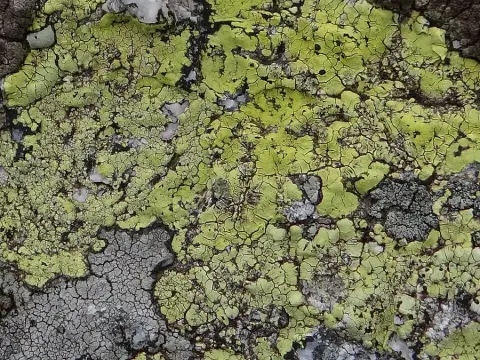
Dokumentasi Rhizocarpon reductum dari Wikimedia Commons. Rhizocarpon reductum Identifikasi mengikuti record berkas sumber.

Jenis
Fotografi
Kredit
Douglas Goldman
Sumber media
Buka entri sumber

Gambar menunjukkan objek menurut identifikasi sumber, bukan verifikasi independen spesimen oleh Fungi. Tidak ada skala baru yang ditambahkan.

06 / Rujukan

Sumber profil

  1. [1] Rhizocarpon reductum — Wikipedia (en)Bagian sumber: Frozen revision 1354779145
    Tanggal penghimpunan sumber: 2026-10-12
    Teks sumber: CC BY-SA4.0 · Wikipedia contributors
  2. [2] Catalogue of Life Base2026-09-11 — Rhizocarpon reductumBagian sumber: ColDP NameUsage.tsv ID 4SC67; accepted species; source 2073
    Tanggal penghimpunan sumber: 2026-10-12
  3. [3] Dokumentasi visual — Rhizocarpon reductumBagian sumber: Individual media record; identification follows the source, not independent determination
    Tanggal penghimpunan sumber: 2026-10-12
    Media sumber: CC BY-SA 4.0 · Douglas Goldman

Adaptasi teks: CC BY-SA 4.0. Wikipedia contributors — Rhizocarpon reductum — Wikipedia (en)

Uraian asli dan riwayat sumber

Riwayat atau halaman sumber

Ringkasan sumber

Rhizocarpon reductum is a widely distributed species of saxicolous (rock-dwelling), crustose lichen in the family Rhizocarpaceae. This lichen forms thin, pale grey to brown crusts that crack into tiny angular plates, with scattered black disc-shaped fruiting bodies about 0.4–0.6 mm across. It has an extremely wide global distribution, being found on multiple continents including Europe, Asia, Africa, North and South America, Australia, New Zealand, and even Antarctica.

Revisi sumber

Morfologi sumber

Rhizocarpon reductum grows directly on rock surfaces, forming either loose, spreading films or discrete patches one to two centimetres across that often merge into larger fields. Its thallus—a thin, crust-like body—ranges from pale grey to brown and cracks into tiny angular plates () about 0.2–0.4 mm wide; these plates are usually flat or gently domed, and in rare cases they lift slightly like minute scales. A thin black , the advance guard of fungal threads, usually rims each colony and can dominate shaded substrates where the main thallus is reduced. Black apothecia, the lichen's reproductive , are scattered among the areoles. At first they are flush with the surface () but may become stalk-less cups () that rise fractionally above it; each disc is 0.4–0.6 mm in diameter, rough-textured, and turns strongly convex as it over-matures. A narrow fungal wall () borders young apothecia; it is built from radiating hyphae whose outer cells are blue-black, but this rim can erode as the disc bulges. The transparent spore-bearing layer (hymenium) is 120–140 μm tall, overlaid by an olive-green that flashes blue with potassium hydroxide solution (K+ reaction) and brick-red with nitric acid (N+). Below lies a mid- to dark-brown . Slender —supporting filaments only about 1 μm thick—thread the hymenium; they branch rarely, do not swell at their tips, and lack a sharply pigmented cap. Each club-shaped ascus measures 65–80 × 25–33 μm and houses eight colourless ascospores. Mature spores are eumuriform, usually 24–26 × 8–10 μm, and divided into eight to ten (rarely twelve) chambers in optical view.

Revisi sumber

Ekologi sumber

Rhizocarpon reductum is widely distributed across the globe, with occurrences in Australia and New Zealand, the British Isles, continental Europe, Arctic Eurasia, Morocco, Tunisia, Turkey, Ukraine, Central Asia, China, South Africa, North America, Venezuela, Bolivia, Chile, Argentina, the Falkland Islands, and Antarctica. In Central Europe the species has been verified from siliceous sandstones of the Gorce Mountains (Western Beskids, Polish Carpathians) at 530–1,220 m elevation, where it colonises exposed, periodically sun-warmed boulders and road-cut faces.

Revisi sumber

Struktur reproduksi sumber

Black apothecia, the lichen's reproductive , are scattered among the areoles. At first they are flush with the surface () but may become stalk-less cups () that rise fractionally above it; each disc is 0.4–0.6 mm in diameter, rough-textured, and turns strongly convex as it over-matures. A narrow fungal wall () borders young apothecia; it is built from radiating hyphae whose outer cells are blue-black, but this rim can erode as the disc bulges. The transparent spore-bearing layer (hymenium) is 120–140 μm tall, overlaid by an olive-green that flashes blue with potassium hydroxide solution (K+ reaction) and brick-red with nitric acid (N+). Below lies a mid- to dark-brown . Slender —supporting filaments only about 1 μm thick—thread the hymenium; they branch rarely, do not swell at their tips, and lack a sharply pigmented cap.

Revisi sumber

Rujukan halaman ini

Fungi. Rhizocarpon reductum. Rilis data fungi-2026-10-12-expansion-2. https://fungi-atlas.mgadib.chatgpt.site/jamur/rhizocarpon-reductum/.

Status: impor sumber; pemeriksaan editorial per profil belum selesai. Untuk klaim biologis, gunakan rujukan pada bagian terkait dan periksa konteks sumber aslinya.