01 / Morfologi

Ciri dan struktur

Notes: Our fresh collection (GMB1317) shares similar morphologies of R. tuberculata which was introduced by Dai et al. [ 17 ] from Thailand. Roussoella tuberculata is characterized by large, immersed, eustromatic conidiomata, which are rather flattened, phialidic, annellidic conidiogenous cells and conidia covered by small tubercules [ 17 ]. Usually, the conidia of Roussoella species comprise verrucose wall ornamentation [ 1, 39 ], while R. tuberculata has conidia with small and roughened tubercules. The above morphological identification is confirmed by our phylogenetic analyses and base-pair comparisons as well (100% MLBS, 1.00 BYPP, Figure 1). This is the first record of this species from China.

Sebagian uraian ditampilkan dalam bahasa sumber; terjemahannya belum tersedia atau belum lolos pemeriksaan.

Rujukan: [1]

Pengukuran mengikuti objek, spesimen atau kultur, dan metode yang disebutkan sumber. Baca uraian asli untuk konteks lengkap.

02 / Kehidupan

Habitat dan peran ekologis

Material examined: China, Yunnan Province, Jinghong, Mengla, Bamboo Garden, Xishuangbanna Topic Botany Garden (101°24′41.74″ N, 21°93′40.94″ E, 507.88 m), on dead culms of bamboo, 15 August 2020, Dong-Qin Dai, DDQ02000 (GMB1317); living culture, GMBCC1123 (new country record), GenBank accession number SSU: OM891834.

Sebagian uraian ditampilkan dalam bahasa sumber; terjemahannya belum tersedia atau belum lolos pemeriksaan.

Rujukan: [1]

Habitat atau konteks temuan
kultur yang didokumentasikan
Substrat
Informasi belum tersedia pada sumber rilis ini.
Peran atau konteks
Belum dikategorikan pada rilis ini.
Temukan hubungan serupa
03 / Siklus hidup

Reproduksi

Sexual morph: Undetermined. Description of asexual morph see Dai et al. [ 17 ]. Notes: Our fresh collection (GMB1317) shares similar morphologies of R. tuberculata which was introduced by Dai et al. [ 17 ] from Thailand. Roussoella tuberculata is characterized by large, immersed, eustromatic conidiomata, which are rather flattened, phialidic, annellidic conidiogenous cells and conidia covered by small tubercules [ 17 ]. Usually, the conidia of Roussoella species comprise verrucose wall ornamentation [ 1, 39 ], while R. tuberculata has conidia with small and roughened tubercules. The above morphological identification is confirmed by our phylogenetic analyses and base-pair comparisons as well (100% MLBS, 1.00 BYPP, Figure 1).

Sebagian uraian ditampilkan dalam bahasa sumber; terjemahannya belum tersedia atau belum lolos pemeriksaan.

Rujukan: [1]

04 / Batas informasi

Catatan identitas dan cakupan

  • Nama diterima mengikuti Catalogue of Life Base2026-09-11; uraian mempertahankan konsep dan nama sumber aslinya.
  • Preserve original treatment localities, hosts and substrate scope. Materials examined describe documented specimens, not the full global range.
  • Impor dan terjemahan otomatis belum diperiksa editorial per profil. Struktur reproduktif yang disebutkan tidak membuktikan seluruh siklus hidup diketahui.
  • Pengukuran pada uraian mengikuti spesimen, kultur, dan metode sumber; angka tidak diperluas ke semua populasi.

Catatan distribusi dalam narasi mengikuti sumbernya. Dokumentasi spesimen atau foto mengikuti catatan sumber. Bukti wilayah Indonesia dan penilaian konservasi tidak disimpulkan dari gambar.

05 / Dokumentasi

Melihat dengan konteks

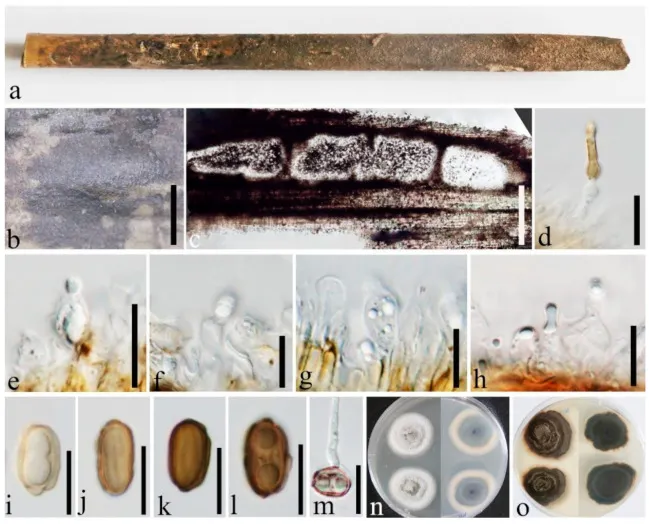
Roussoella tuberculata (GMB1317, new country record). (a) Bamboo specimen; (b) black conidioma on host surface; (c) vertical sections of conidiomata; (d – h) conidiogenous cells and developing conidia; (i – l) conidia; m: germinating conidium; (m) germinating conidium; (n) cultures on PDA from above and below after two weeks; (o) cultures on PDA from above and below after four weeks. Scale bars: (b) = 500 µm, (c) = 200 µm, (d – f, m) = 15 µm, (h – l) = 10 µm.

Jenis
Pelat ilmiah
Kredit
© 2022 by the authors.
Lisensi
CC BY 4.0
Sumber media
Buka entri sumber

Gambar menunjukkan objek menurut identifikasi sumber, bukan verifikasi independen spesimen oleh Fungi. Tidak ada skala baru yang ditambahkan.

06 / Rujukan

Sumber profil

  1. [1] Taxonomic and Phylogenetic Characterizations Reveal Four New Species, Two New Asexual Morph Reports, and Six New Country Records of Bambusicolous Roussoella from China — Roussoella tuberculataBagian sumber: sec3dot2-jof-08-00532_paragraph_66
    Tanggal penghimpunan sumber: 2026-10-12
    Teks sumber: CC BY 4.0 · Dai DQ, Wijayawardene NN, Dayarathne MC, Kumla J, Han LS, Zhang GQ, Zhang X, Zhang TT, Chen HH.
  2. [2] Catalogue of Life Base2026-09-11 — Roussoella tuberculataBagian sumber: ColDP NameUsage.tsv ID 78XXY; accepted species; source 2073
    Tanggal penghimpunan sumber: 2026-10-12
  3. [3] Dokumentasi visual — Roussoella tuberculataBagian sumber: Individual media record; identification follows the source, not independent determination
    Tanggal penghimpunan sumber: 2026-10-12
    Media sumber: CC BY 4.0 · © 2022 by the authors.

Adaptasi teks: CC BY 4.0. Dai DQ, Wijayawardene NN, Dayarathne MC, Kumla J, Han LS, Zhang GQ, Zhang X, Zhang TT, Chen HH. — Taxonomic and Phylogenetic Characterizations Reveal Four New Species, Two New Asexual Morph Reports, and Six New Country Records of Bambusicolous Roussoella from China — Roussoella tuberculata

Uraian asli dan riwayat sumber

Riwayat atau halaman sumber

Ringkasan sumber

Notes: Our fresh collection (GMB1317) shares similar morphologies of R. tuberculata which was introduced by Dai et al. [ 17 ] from Thailand. Roussoella tuberculata is characterized by large, immersed, eustromatic conidiomata, which are rather flattened, phialidic, annellidic conidiogenous cells and conidia covered by small tubercules [ 17 ]. Usually, the conidia of Roussoella species comprise verrucose wall ornamentation [ 1, 39 ], while R. tuberculata has conidia with small and roughened tubercules.

Revisi sumber

Morfologi sumber

Notes: Our fresh collection (GMB1317) shares similar morphologies of R. tuberculata which was introduced by Dai et al. [ 17 ] from Thailand. Roussoella tuberculata is characterized by large, immersed, eustromatic conidiomata, which are rather flattened, phialidic, annellidic conidiogenous cells and conidia covered by small tubercules [ 17 ]. Usually, the conidia of Roussoella species comprise verrucose wall ornamentation [ 1, 39 ], while R. tuberculata has conidia with small and roughened tubercules. The above morphological identification is confirmed by our phylogenetic analyses and base-pair comparisons as well (100% MLBS, 1.00 BYPP, Figure 1). This is the first record of this species from China.

Revisi sumber

Ekologi sumber

Material examined: China, Yunnan Province, Jinghong, Mengla, Bamboo Garden, Xishuangbanna Topic Botany Garden (101°24′41.74″ N, 21°93′40.94″ E, 507.88 m), on dead culms of bamboo, 15 August 2020, Dong-Qin Dai, DDQ02000 (GMB1317); living culture, GMBCC1123 (new country record), GenBank accession number SSU: OM891834.

Revisi sumber

Struktur reproduksi sumber

Sexual morph: Undetermined. Description of asexual morph see Dai et al. [ 17 ]. Notes: Our fresh collection (GMB1317) shares similar morphologies of R. tuberculata which was introduced by Dai et al. [ 17 ] from Thailand. Roussoella tuberculata is characterized by large, immersed, eustromatic conidiomata, which are rather flattened, phialidic, annellidic conidiogenous cells and conidia covered by small tubercules [ 17 ]. Usually, the conidia of Roussoella species comprise verrucose wall ornamentation [ 1, 39 ], while R. tuberculata has conidia with small and roughened tubercules. The above morphological identification is confirmed by our phylogenetic analyses and base-pair comparisons as well (100% MLBS, 1.00 BYPP, Figure 1).

Revisi sumber

Rujukan halaman ini

Fungi. Roussoella tuberculata. Rilis data fungi-2026-10-12-expansion-2. https://fungi-atlas.mgadib.chatgpt.site/jamur/roussoella-tuberculata/.

Status: impor sumber; pemeriksaan editorial per profil belum selesai. Untuk klaim biologis, gunakan rujukan pada bagian terkait dan periksa konteks sumber aslinya.