Ciri dan struktur
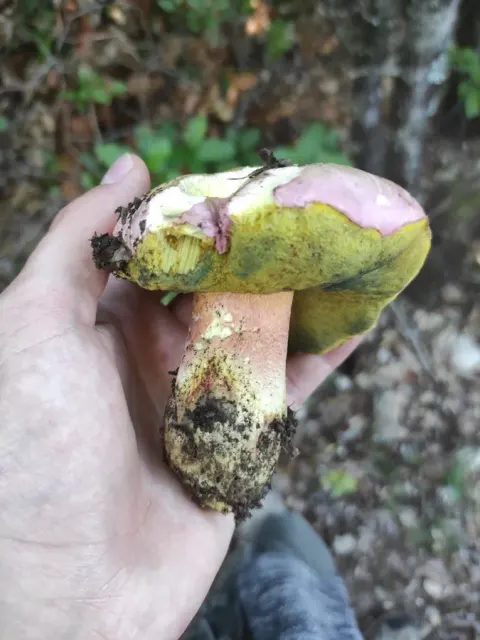
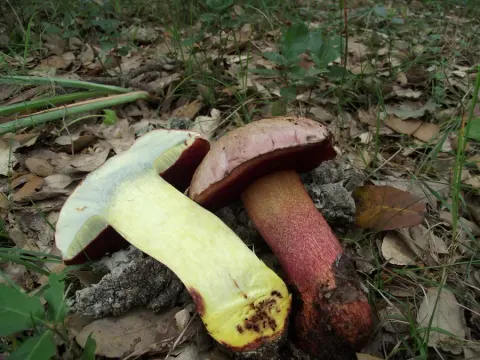
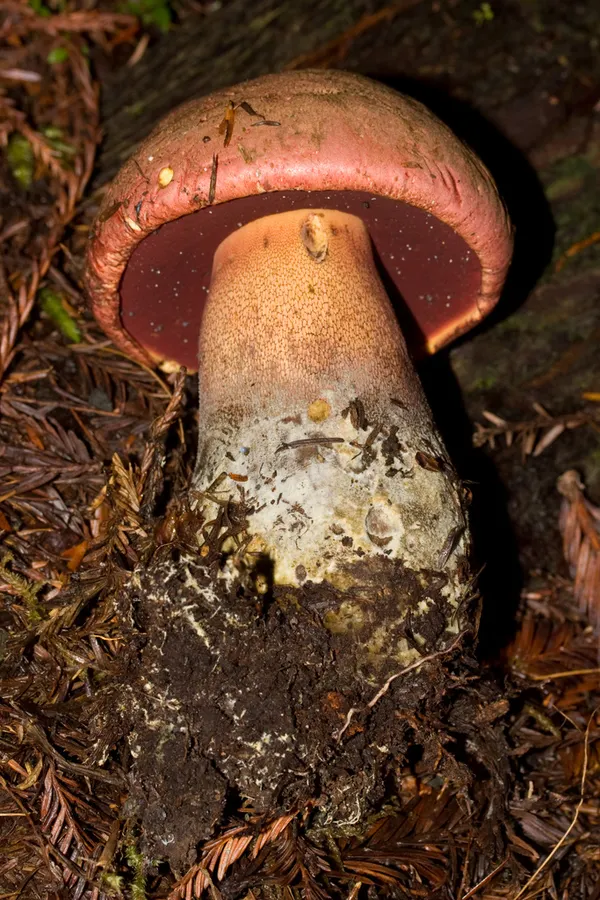
Colored various shades of olive- to reddish-brown, the cap may sometimes reach 25 cm in diameter and is convex in shape before flattening at maturity. The cap surface may be smooth or velvety when young, but may be scaled in older specimens; the margin of the cap is curved inwards in young specimens but rolls out and flattens as it matures. The cap may reach a thickness of 3 to 4 cm when mature. In cross section, the tubes and flesh are yellow. The tubes are between 0.5 to 1.5 cm long, while the angular pores are up to 1 mm in diameter; pores can range in color from dark red in young specimens to reddish brown in age. The pores will stain a blue color when cut or bruised. The solid, firm stem is 7–20 cm long and thick—up to 10 cm in diameter, at the base before tapering to 2–5 cm at the top. It is yellow or yellow-brown in color and bears a network of red reticulations on the upper 2/3 of its length. The spore print is olive-brown. The taste of the flesh is reportedly mild, and the odor indistinct, or "slightly fragrant". The spores are spindle-shaped or elliptical, thick-walled, smooth, and have dimensions of 13–16 by 5.5–6.5 μm. The basidia, the spore-bearing cells, are club-shaped (clavate), attached to 1 to 4 spores, and have dimensions of 35–90 by 9–12 μm. The cystidia (sterile, non-spore-bearing cells found interspersed among the basidia) in the hymenium have dimensions of 33–60 by 8–12 μm. Clamp connections are absent in the hyphae of B. pulcherrimus.
Habitat dan peran ekologis
Rubroboletus pulcherrimus is found in western North America, from New Mexico and California to Washington, and may feasibly occur in British Columbia, Canada. One source notes it grows at low altitudes in the Cascade Range and Olympic Mountains; Fruiting in autumn, it grows singly or in groups (although another source claims "never in groups") in humus in mixed woodlands. In the original publication describing the species, Thiers and Halling note that it is associated with forests containing tanbark oaks (Lithocarpus densiflora), Douglas-fir (Pseudotsuga menziesii), and grand fir (Abies grandis).
- Habitat atau konteks temuan
- hutan
- Substrat
- Informasi belum tersedia pada sumber rilis ini.
- Peran atau konteks
- Belum dikategorikan pada rilis ini.
Reproduksi
The cap may reach a thickness of 3 to 4 cm when mature. In cross section, the tubes and flesh are yellow. The tubes are between 0.5 to 1.5 cm long, while the angular pores are up to 1 mm in diameter; pores can range in color from dark red in young specimens to reddish brown in age. The pores will stain a blue color when cut or bruised. The solid, firm stem is 7–20 cm long and thick—up to 10 cm in diameter, at the base before tapering to 2–5 cm at the top. It is yellow or yellow-brown in color and bears a network of red reticulations on the upper 2/3 of its length. The spore print is olive-brown. The taste of the flesh is reportedly mild, and the odor indistinct, or "slightly fragrant". The spores are spindle-shaped or elliptical, thick-walled, smooth, and have dimensions of 13–16 by 5.5–6.5 μm.
Catatan identitas dan cakupan
- Nama diterima mengikuti Catalogue of Life Base2026-09-11; uraian mempertahankan konsep dan nama sumber aslinya.
- Original geographic, specimen and life-cycle scope retained; source import awaits individual editorial review.
- Impor dan terjemahan otomatis belum diperiksa editorial per profil. Struktur reproduktif yang disebutkan tidak membuktikan seluruh siklus hidup diketahui.
- Pengukuran pada uraian mengikuti spesimen, kultur, dan metode sumber; angka tidak diperluas ke semua populasi.
Catatan distribusi dalam narasi mengikuti sumbernya. Dokumentasi spesimen atau foto mengikuti catatan sumber. Bukti wilayah Indonesia dan penilaian konservasi tidak disimpulkan dari gambar.
Melihat dengan konteks
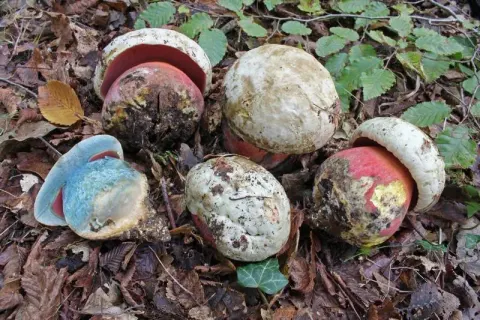
Dokumentasi Rubroboletus pulcherrimus menurut asosiasi foto pada record takson iNaturalist. Kredit: Ken-ichi Ueda. Identitas mengikuti sumber; bukan penentuan spesimen independen.
- Jenis
- Fotografi
- Kredit
- (c) Ken-ichi Ueda, some rights reserved (CC BY)
- Lisensi
- CC BY 4.0
- Sumber media
- Buka entri sumber
Dokumentasi tambahan
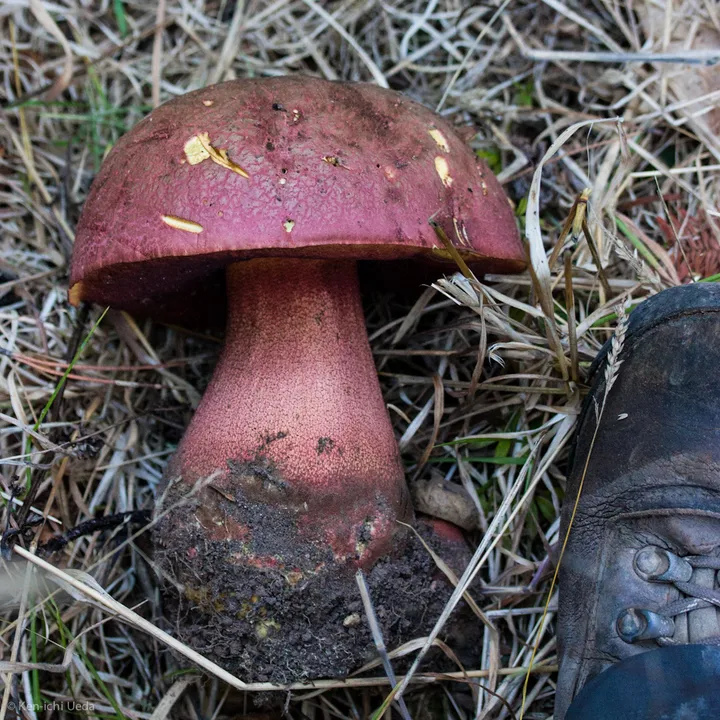
Foto yang diasosiasikan dengan Rubroboletus pulcherrimus pada iNaturalist. Identifikasi mengikuti sumber; bukan penentuan spesimen independen.
Kredit dan penggunaan
(c) Ken-ichi Ueda, some rights reserved (CC BY)
Ukuran dan format gambar disesuaikan tanpa pemotongan, retus, atau penambahan skala. Lisensi sumber dipertahankan.
Sumber profil
- [1] Rubroboletus pulcherrimus — Wikipedia (en)
- [2] Catalogue of Life Base2026-09-11 — Rubroboletus pulcherrimus
- [3] Dokumentasi visual — Rubroboletus pulcherrimus
- [4] Dokumentasi visual — Rubroboletus pulcherrimus
Rujukan halaman ini
Fungi. Rubroboletus pulcherrimus. Rilis data fungi-2026-10-12-expansion-2. https://fungi-atlas.mgadib.chatgpt.site/jamur/rubroboletus-pulcherrimus/.
Status: impor sumber; pemeriksaan editorial per profil belum selesai. Untuk klaim biologis, gunakan rujukan pada bagian terkait dan periksa konteks sumber aslinya.