Ciri dan struktur
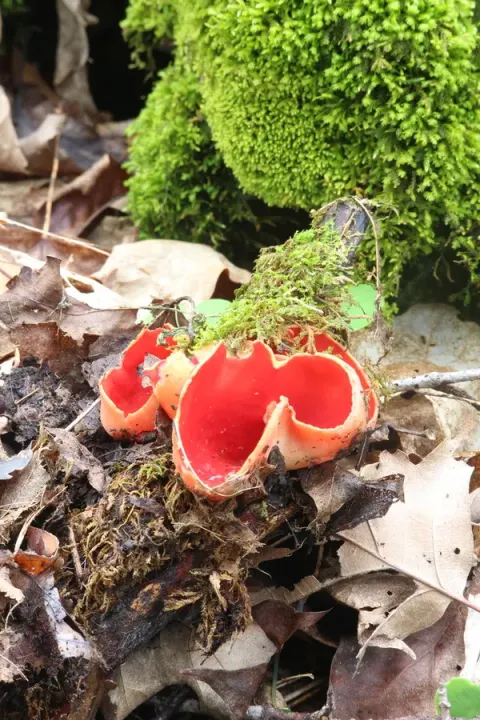
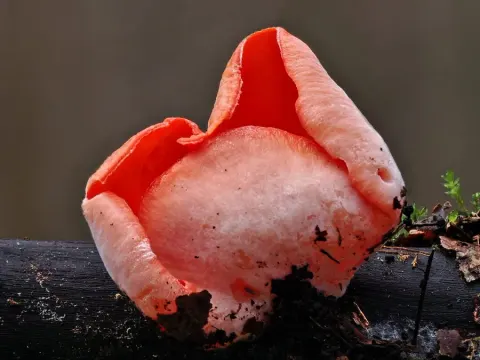
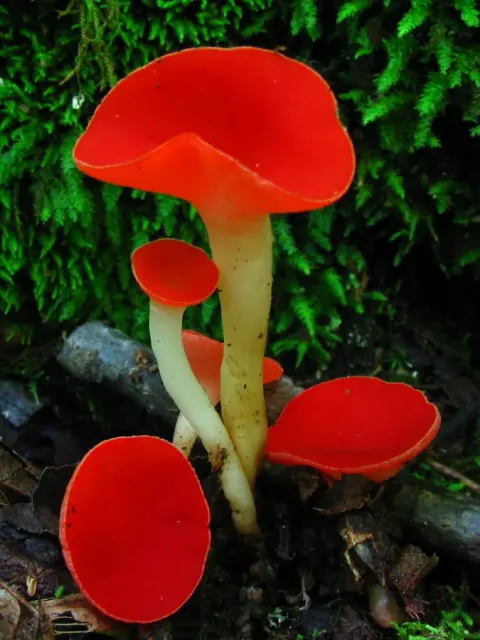
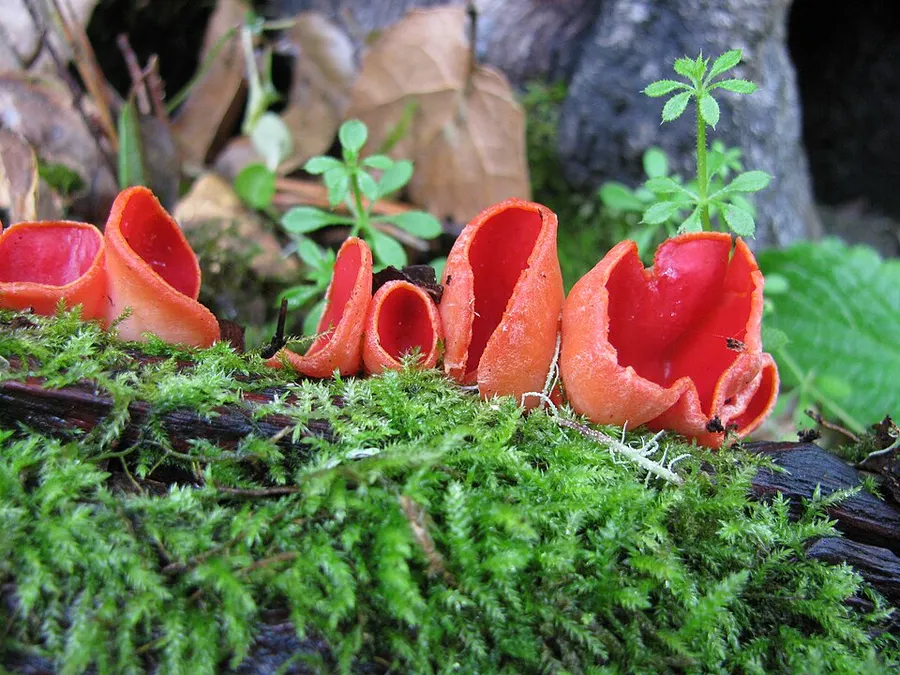
Initially spherical, the fruit bodies are later shallowly saucer- or cup-shaped with rolled-in rims, and measure 2–6 cm in diameter. The inner surface of the cup is deep red (fading to orange when dry) and smooth, while the outer surface is whitish and covered with a dense matted layer of tiny hairs (a tomentum). The stipe, when present, is stout and up to 4 cm long (if deeply buried) by 0.3–0.7 cm thick, and whitish, with a tomentum. The spores are 26–40 by 10–12 μm, elliptical, smooth, colorless, hyaline (translucent), and have small lipid droplets concentrated at either end. The droplets are refractive to light and visible with light microscopy. In older, dried specimens (such as herbarium material), the droplets may coalesce and hinder the identification of species. Depending on their geographical origin, the spores may have a delicate mucilaginous sheath or "envelope"; European specimens are devoid of an envelope while specimens from North America invariably have one. The asci are long and cylindrical, and taper into a short stem-like base; they measure 300–375 by 14–16 μm. Although in most Pezizales all of the ascospores are formed simultaneously through delimitation by an inner and outer membrane, in S. coccinea the ascospores located in the basal parts of the ascus develop faster. The paraphyses (sterile filamentous hyphae present in the hymenium) are about 3 μm wide (and only slightly thickened at the apex), and contain red pigment granules.
Habitat dan peran ekologis
Spesies A saprobik, A Hungarian study mencatat bahwa jamur ini ditemukan terutama pada cabang European hornbeam (Carpinus betulus) yang biasanya kurang dari 5 cm panjang. Fruit bodies tumbuh di batang di atas tanah cenderung lebih kecil daripada yang di atas kayu yang dikubur. Mushrooms that yang dilindungi dari angin juga tumbuh lebih besar daripada rekan-rekan mereka yang lebih terpapar. The fruit bodies are persistent and may last for several weeks if the weather is cool. The time required for the development of fruit bodies has been estimated to be about 24 weeks, although it was noted that "the maximum life span may well be more than 24 weeks because the decline of the colonies seemed to be associated more with sunny, windy weather rather than with old age." One field guide calls the fungus "a welcome sight after a long, desperate winter and ... the harbinger of a new year of mushrooming". Common over sebagian besar belahan bumi utara, S. coccinea terjadi di Barat Tengah, di lembah-lembah antara Pacific coast, Sierra Nevada, dan Range Cascade. Utara American distributionnya membentang ke utara ke berbagai lokasi di Canada and selatan ke Jalisco Mexican state. The fungus has also been collected from Chile in South America.
- Habitat atau konteks temuan
- Informasi belum tersedia pada sumber rilis ini.
- Substrat
- Informasi belum tersedia pada sumber rilis ini.
- Peran atau konteks
- Pengurai
Reproduksi
The spores are 26–40 by 10–12 μm, elliptical, smooth, colorless, hyaline (translucent), and have small lipid droplets concentrated at either end. The droplets are refractive to light and visible with light microscopy. In older, dried specimens (such as herbarium material), the droplets may coalesce and hinder the identification of species. Depending on their geographical origin, the spores may have a delicate mucilaginous sheath or "envelope"; European specimens are devoid of an envelope while specimens from North America invariably have one. The asci are long and cylindrical, and taper into a short stem-like base; they measure 300–375 by 14–16 μm. Although in most Pezizales all of the ascospores are formed simultaneously through delimitation by an inner and outer membrane, in S. coccinea the ascospores located in the basal parts of the ascus develop faster.
Catatan identitas dan cakupan
- Nama diterima mengikuti Catalogue of Life Base2026-09-11; uraian mempertahankan konsep dan nama sumber aslinya.
- Original geographic, specimen and life-cycle scope retained; source import awaits individual editorial review.
- Impor dan terjemahan otomatis belum diperiksa editorial per profil. Struktur reproduktif yang disebutkan tidak membuktikan seluruh siklus hidup diketahui.
- Pengukuran pada uraian mengikuti spesimen, kultur, dan metode sumber; angka tidak diperluas ke semua populasi.
Catatan distribusi dalam narasi mengikuti sumbernya. Dokumentasi spesimen atau foto mengikuti catatan sumber. Bukti wilayah Indonesia dan penilaian konservasi tidak disimpulkan dari gambar.
Melihat dengan konteks
Dokumentasi Sarcoscypha coccinea dari Wikimedia Commons. The cup-fungus Sarcoscypha coccinea (Jacq.) Sacc. Photographed in Tomales Bay SP, Heart’s Desire Beach woods, Marin CO, CA, USA. Identifikasi mengikuti record berkas sumber.
- Jenis
- Fotografi
- Kredit
- This image was created by user Ryane Snow (snowman) at Mushroom Observer , a source for mycological images. You can contact this user here .
- Lisensi
- CC BY-SA 3.0
- Sumber media
- Buka entri sumber
Sumber profil
- [1] Sarcoscypha coccinea — Wikipedia (en)
- [2] Catalogue of Life Base2026-09-11 — Sarcoscypha coccinea
- [3] Dokumentasi visual — Sarcoscypha coccinea
Rujukan halaman ini
Fungi. Sarcoscypha coccinea. Rilis data fungi-2026-10-12-expansion-2. https://fungi-atlas.mgadib.chatgpt.site/jamur/sarcoscypha-coccinea/.
Status: impor sumber; pemeriksaan editorial per profil belum selesai. Untuk klaim biologis, gunakan rujukan pada bagian terkait dan periksa konteks sumber aslinya.