Ciri dan struktur
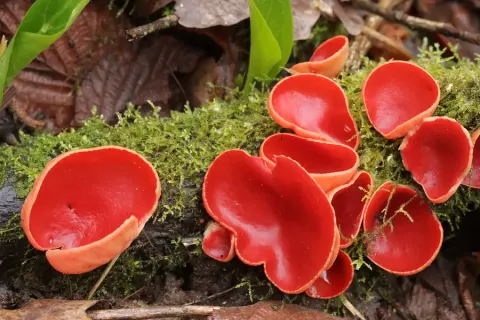
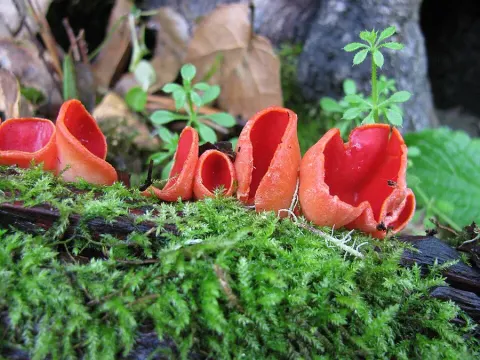
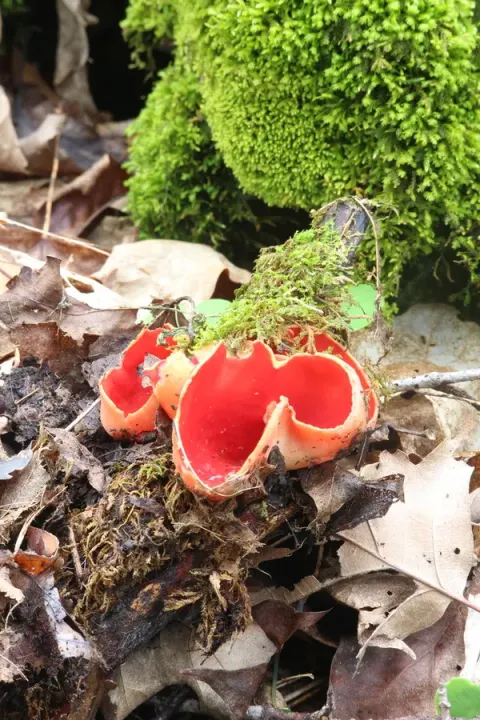
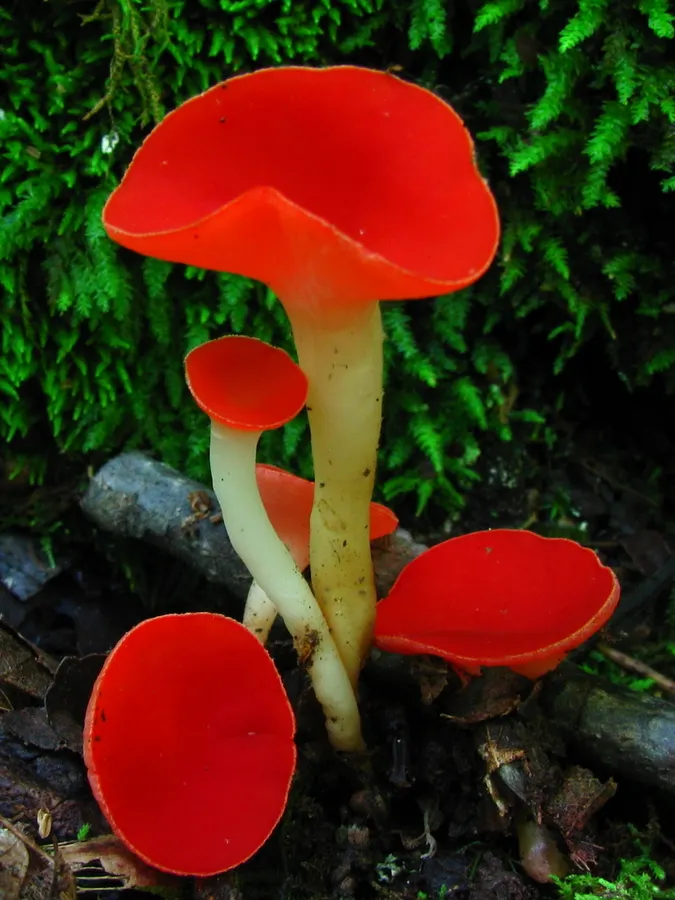
Depending on their age, the fruit bodies of S. occidentalis may range in shape from deep cups to saucers to discs in maturity, and they can reach diameters up to 2 cm. In young specimens, the edges of the cup are curled inwards, and crenulate (with small rounded scallops); the cup edges in older specimens become laciniate (with jagged edges cut into irregular segments). The cups rest atop a stem that is small to medium-sized, up to 30 mm long and 1.5–2 mm thick, and attached centrally or to the side to the underside of the cup. The base of the stem may be covered with translucent "hairs". The fertile spore-bearing inner surface of the cups, the hymenium, is bright red but fades to yellow or orange when dry. It is smooth or becomes so with time. The fruit bodies are fleshy to rubbery when fresh, but become leathery when dry. The flesh is thin and has no distinctive odor or taste, nor culinary value. Excipulum is a term used to refer to the tissue or tissues containing the hymenium of an ascomycete fruit body. The ectal excipulum (outer tissue layer) is thin (20–30 μm thickness), made of a tissue type known as texura porrecta, consisting of more or less parallel hyphae all in one direction, with wide lumina and non-thickened walls. The medullary excipulum (middle tissue layer) is thick (200–600 μm) and made of textura intricata, a tissue layer made of irregularly interwoven hyphae with distinct spaces between the hyphae. The asci (filamentous structures in which the ascospores develop) are cylindrical with gradually tapering bases, eight-spored, and measure 240–280 by 12–15 μm.
Habitat dan peran ekologis
Jamur ini ditemukan di Utara America east Pegunungan Rocky, dan di ketinggian yang lebih tinggi di Tengah America and Karibia. Hal ini juga telah dikumpulkan di Japan and Taiwan. Sebagai jamur saprobik, S. occidentalis adalah bagian dari komunitas jamur yang memainkan peran penting dalam ekosistem hutan dengan memecah molekul selulosa dan lignin yang kompleks dan tidak larut dari kayu dan sampah daun menjadi oligosaccharida yang lebih kecil yang dapat digunakan oleh berbagai mikroba. Fruit bodies dari S. coccinea dapat tumbuh secara terpisah, tersebar atau dikelompokkan bersama-sama di atas batang, ranting, dan fragmen kayu mati, biasanya agak terurai dan sebagian dikubur di atas 5 cm tanah dan sampah hutan. Ia lebih suka tanah yang lembab dan berbayar dan mengandung humus yang tinggi. Like all Sarcoscypha species, lebih suka kayu angiosperma, seperti kayu ek, mapel, dan bas; satu panduan lapangan mencatat preferensi untuk hickory shagbark.
- Habitat atau konteks temuan
- Informasi belum tersedia pada sumber rilis ini.
- Substrat
- Informasi belum tersedia pada sumber rilis ini.
- Peran atau konteks
- Pengurai
Reproduksi
Depending on their age, the fruit bodies of S. occidentalis may range in shape from deep cups to saucers to discs in maturity, and they can reach diameters up to 2 cm. In young specimens, the edges of the cup are curled inwards, and crenulate (with small rounded scallops); the cup edges in older specimens become laciniate (with jagged edges cut into irregular segments). The cups rest atop a stem that is small to medium-sized, up to 30 mm long and 1.5–2 mm thick, and attached centrally or to the side to the underside of the cup. The base of the stem may be covered with translucent "hairs". The fertile spore-bearing inner surface of the cups, the hymenium, is bright red but fades to yellow or orange when dry.
Catatan identitas dan cakupan
- Nama diterima mengikuti Catalogue of Life Base2026-09-11; uraian mempertahankan konsep dan nama sumber aslinya.
- Original geographic, specimen and life-cycle scope retained; source import awaits individual editorial review.
- Impor dan terjemahan otomatis belum diperiksa editorial per profil. Struktur reproduktif yang disebutkan tidak membuktikan seluruh siklus hidup diketahui.
- Pengukuran pada uraian mengikuti spesimen, kultur, dan metode sumber; angka tidak diperluas ke semua populasi.
Catatan distribusi dalam narasi mengikuti sumbernya. Dokumentasi spesimen atau foto mengikuti catatan sumber. Bukti wilayah Indonesia dan penilaian konservasi tidak disimpulkan dari gambar.
Melihat dengan konteks
Dokumentasi Sarcoscypha occidentalis menurut asosiasi foto pada record takson iNaturalist. Kredit: anonymous. Identitas mengikuti sumber; bukan penentuan spesimen independen.
- Jenis
- Fotografi
- Kredit
- (c) anonymous, some rights reserved (CC BY-SA)
- Lisensi
- CC BY-SA 4.0
- Sumber media
- Buka entri sumber
Dokumentasi tambahan
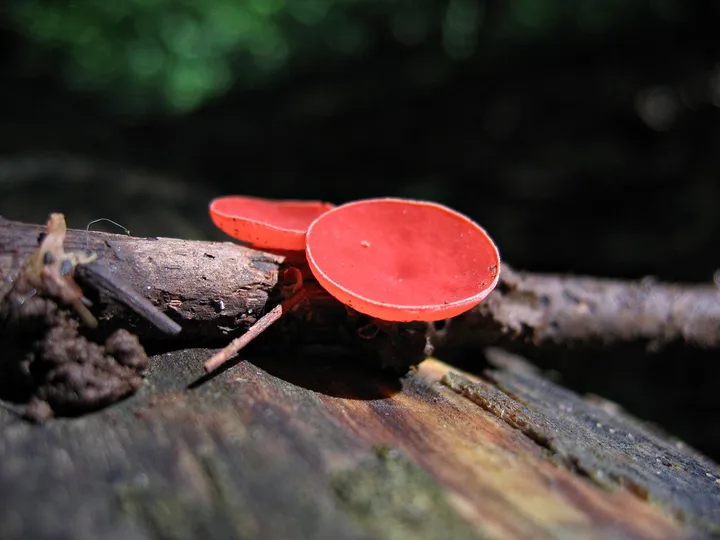
Foto yang diasosiasikan dengan Sarcoscypha occidentalis pada iNaturalist. Identifikasi mengikuti sumber; bukan penentuan spesimen independen.
Kredit dan penggunaan
(c) hríb, some rights reserved (CC BY-SA)
Ukuran dan format gambar disesuaikan tanpa pemotongan, retus, atau penambahan skala. Lisensi sumber dipertahankan.
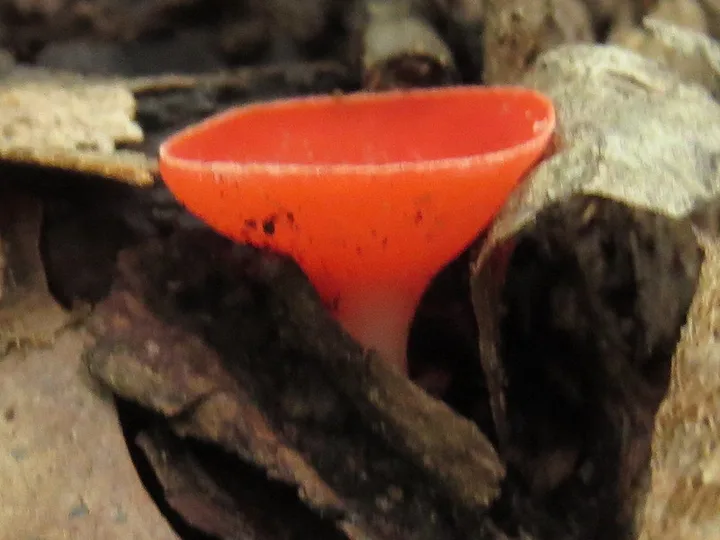
Foto yang diasosiasikan dengan Sarcoscypha occidentalis pada iNaturalist. Identifikasi mengikuti sumber; bukan penentuan spesimen independen.
Kredit dan penggunaan
(c) Theo Rickert, some rights reserved (CC BY), uploaded by Theo Rickert
Ukuran dan format gambar disesuaikan tanpa pemotongan, retus, atau penambahan skala. Lisensi sumber dipertahankan.
Sumber profil
- [1] Sarcoscypha occidentalis — Wikipedia (en)
- [2] Catalogue of Life Base2026-09-11 — Sarcoscypha occidentalis
- [3] Dokumentasi visual — Sarcoscypha occidentalis
- [4] Dokumentasi visual — Sarcoscypha occidentalis
- [5] Dokumentasi visual — Sarcoscypha occidentalis
Rujukan halaman ini
Fungi. Sarcoscypha occidentalis. Rilis data fungi-2026-10-12-expansion-2. https://fungi-atlas.mgadib.chatgpt.site/jamur/sarcoscypha-occidentalis/.
Status: impor sumber; pemeriksaan editorial per profil belum selesai. Untuk klaim biologis, gunakan rujukan pada bagian terkait dan periksa konteks sumber aslinya.