01 / Morfologi

Ciri dan struktur

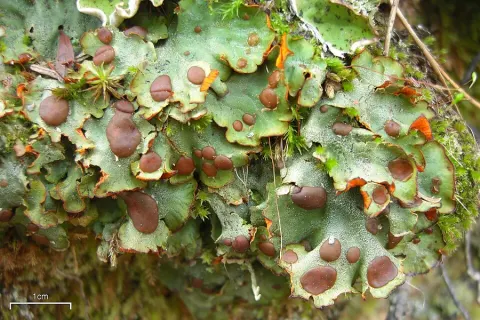
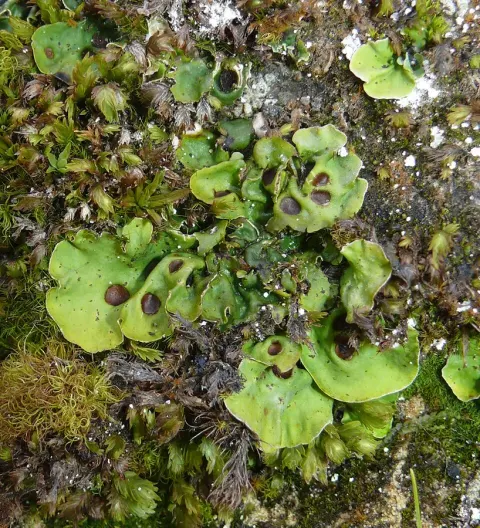
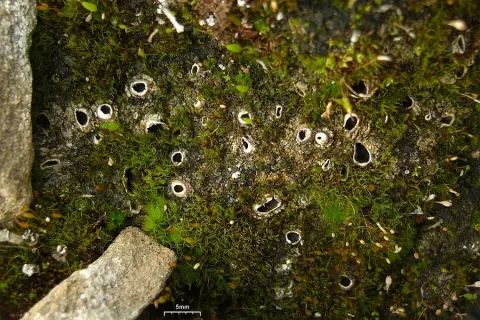
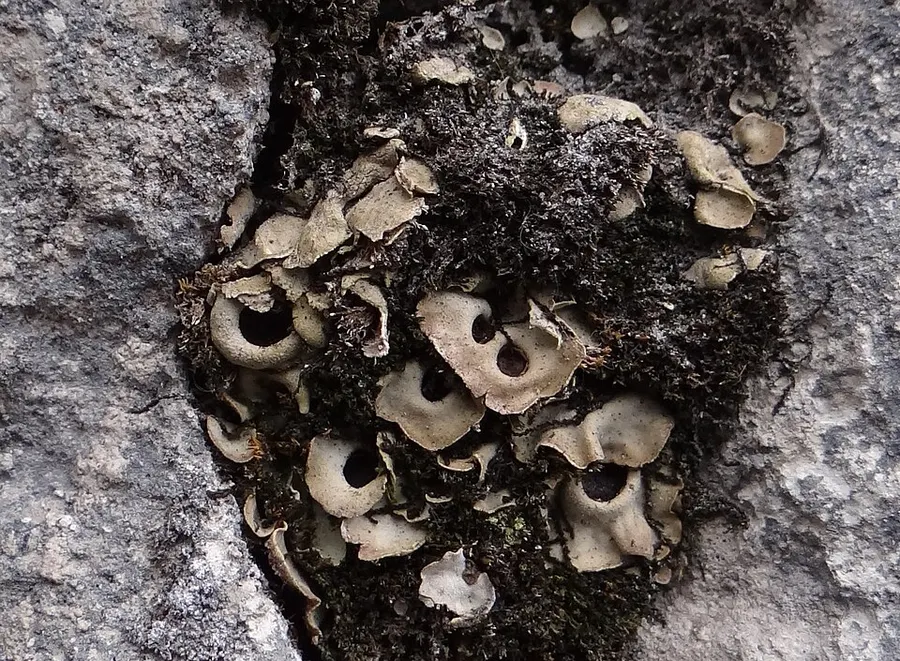
Solorina bispora is a small foliose (leaf-like) lichen that forms patches 5–10 mm wide. The thallus (main body) consists of rounded or irregular small surrounded by darker tissue. The upper surface appears pale greyish-green, sometimes with brownish tints, and often has a whitish, powdery coating (). When wet, the surface becomes bright green. The lower surface is white with indistinct veining and scattered pale root-like structures called rhizines. The species produces abundant reproductive structures (apothecia), which are brown to blackish disc-shaped organs partially embedded in the thallus. These measure 2 – 5 mm across and lack a rim of tissue () around their edge. Inside the apothecia, each spore sac (ascus) contains two dark brown spores. The spores are divided into two cells by a central wall (septum) and measure 60–105 by 25–60 micrometres, with a distinctive net-like (reticulation) pattern on their surface. Like other lichens, S. lbispora is a symbiotic organism containing photosynthetic partners: its primary photobiont is a green alga (Coccomyxa), while it also contains colonies of cyanobacteria (Nostoc) in specialised structures called cephalodia. These cephalodia are usually internal and visible as dark spots on the lower surface, though they occasionally develop externally. The species does not produce any unique lichen products and shows no colour changes when tested with common chemical spot tests used in lichen identification.

Sebagian uraian ditampilkan dalam bahasa sumber; terjemahannya belum tersedia atau belum lolos pemeriksaan.

Rujukan: [1]

Pengukuran mengikuti objek, spesimen atau kultur, dan metode yang disebutkan sumber. Baca uraian asli untuk konteks lengkap.

02 / Kehidupan

Habitat dan peran ekologis

Solorina bispora grows predominantly in calcareous environments, particularly in rock crevices and on humus-rich soils. The species has been documented across several European countries, including France, Iceland, Norway, Spain, Sweden, Austria, and Switzerland. It occurs across a wide elevational range, typically from 750 to 2,700 metres above sea level. In North America, S. bispora has been recorded from Alaska, the Arctic, the Pacific Northwest, and the Rocky Mountains. It is uncommon in Ontario. Its circumpolar distribution includes South Greenland and Svalbard. The lichen can be found in various montane and subalpine habitats. In Spain, it has been recorded growing in rock crevices within Pinus nigra and Fagus sylvatica forests. In Sweden, it has been documented in mountain meadows and rock crevices. Specimens have also been collected from calcareous grasslands and on soil among mosses. In Nepal, Solorina bispora has been reported from 3,600 to 4,200 m elevation in a compilation of published records. At lower elevations, it tends to occur in sheltered, north-facing rock crevices within forested areas, while at higher elevations it can be found in more exposed alpine environments.

Sebagian uraian ditampilkan dalam bahasa sumber; terjemahannya belum tersedia atau belum lolos pemeriksaan.

Rujukan: [1]

Habitat atau konteks temuan
hutan
Substrat
tanah
Peran atau konteks
Pembentuk liken
Temukan hubungan serupa
03 / Siklus hidup

Reproduksi

The species produces abundant reproductive structures (apothecia), which are brown to blackish disc-shaped organs partially embedded in the thallus. These measure 2 – 5 mm across and lack a rim of tissue () around their edge. Inside the apothecia, each spore sac (ascus) contains two dark brown spores. The spores are divided into two cells by a central wall (septum) and measure 60–105 by 25–60 micrometres, with a distinctive net-like (reticulation) pattern on their surface.

Sebagian uraian ditampilkan dalam bahasa sumber; terjemahannya belum tersedia atau belum lolos pemeriksaan.

Rujukan: [1]

Sinonim menurut acuan taksonomi rilis: Solorina bispora subsp. macrospora; Solorina bispora var. macrospora; Solorina bispora var. monospora; Solorina macrospora; Solorina monospora; Solorina saccata var. bispora
04 / Batas informasi

Catatan identitas dan cakupan

  • Nama diterima mengikuti Catalogue of Life Base2026-09-11; uraian mempertahankan konsep dan nama sumber aslinya.
  • Original geographic, specimen and life-cycle scope retained; source import awaits individual editorial review.
  • Impor dan terjemahan otomatis belum diperiksa editorial per profil. Struktur reproduktif yang disebutkan tidak membuktikan seluruh siklus hidup diketahui.
  • Pengukuran pada uraian mengikuti spesimen, kultur, dan metode sumber; angka tidak diperluas ke semua populasi.

Catatan distribusi dalam narasi mengikuti sumbernya. Dokumentasi spesimen atau foto mengikuti catatan sumber. Bukti wilayah Indonesia dan penilaian konservasi tidak disimpulkan dari gambar.

05 / Dokumentasi

Melihat dengan konteks

Dokumentasi Solorina bispora dari Wikimedia Commons. Solorina bispora (location: Poland, West Tatra Mountains, Kobylarzowy Żleb) Identifikasi mengikuti record berkas sumber.

Jenis
Fotografi
Kredit
Jerzy Opioła
Sumber media
Buka entri sumber

Gambar menunjukkan objek menurut identifikasi sumber, bukan verifikasi independen spesimen oleh Fungi. Tidak ada skala baru yang ditambahkan.

06 / Rujukan

Sumber profil

  1. [1] Solorina bispora — Wikipedia (en)Bagian sumber: Frozen revision 1342819754
    Tanggal penghimpunan sumber: 2026-10-12
    Teks sumber: CC BY-SA4.0 · Wikipedia contributors
  2. [2] Catalogue of Life Base2026-09-11 — Solorina bisporaBagian sumber: ColDP NameUsage.tsv ID 9YLDP; accepted species; source 2073
    Tanggal penghimpunan sumber: 2026-10-12
  3. [3] Dokumentasi visual — Solorina bisporaBagian sumber: Individual media record; identification follows the source, not independent determination
    Tanggal penghimpunan sumber: 2026-10-12
    Media sumber: CC BY-SA 4.0 · Jerzy Opioła

Adaptasi teks: CC BY-SA 4.0. Wikipedia contributors — Solorina bispora — Wikipedia (en)

Uraian asli dan riwayat sumber

Riwayat atau halaman sumber

Ringkasan sumber

Solorina bispora is a species of foliose lichen in the family Peltigeraceae. It has a circumpolar distribution, occurring in arctic and alpine environments where it grows on humus-rich soils and in rock crevices.

Revisi sumber

Morfologi sumber

Solorina bispora is a small foliose (leaf-like) lichen that forms patches 5–10 mm wide. The thallus (main body) consists of rounded or irregular small surrounded by darker tissue. The upper surface appears pale greyish-green, sometimes with brownish tints, and often has a whitish, powdery coating (). When wet, the surface becomes bright green. The lower surface is white with indistinct veining and scattered pale root-like structures called rhizines. The species produces abundant reproductive structures (apothecia), which are brown to blackish disc-shaped organs partially embedded in the thallus. These measure 2 – 5 mm across and lack a rim of tissue () around their edge. Inside the apothecia, each spore sac (ascus) contains two dark brown spores. The spores are divided into two cells by a central wall (septum) and measure 60–105 by 25–60 micrometres, with a distinctive net-like (reticulation) pattern on their surface. Like other lichens, S. lbispora is a symbiotic organism containing photosynthetic partners: its primary photobiont is a green alga (Coccomyxa), while it also contains colonies of cyanobacteria (Nostoc) in specialised structures called cephalodia. These cephalodia are usually internal and visible as dark spots on the lower surface, though they occasionally develop externally. The species does not produce any unique lichen products and shows no colour changes when tested with common chemical spot tests used in lichen identification.

Revisi sumber

Ekologi sumber

Solorina bispora grows predominantly in calcareous environments, particularly in rock crevices and on humus-rich soils. The species has been documented across several European countries, including France, Iceland, Norway, Spain, Sweden, Austria, and Switzerland. It occurs across a wide elevational range, typically from 750 to 2,700 metres above sea level. In North America, S. bispora has been recorded from Alaska, the Arctic, the Pacific Northwest, and the Rocky Mountains. It is uncommon in Ontario. Its circumpolar distribution includes South Greenland and Svalbard. The lichen can be found in various montane and subalpine habitats. In Spain, it has been recorded growing in rock crevices within Pinus nigra and Fagus sylvatica forests. In Sweden, it has been documented in mountain meadows and rock crevices. Specimens have also been collected from calcareous grasslands and on soil among mosses. In Nepal, Solorina bispora has been reported from 3,600 to 4,200 m elevation in a compilation of published records. At lower elevations, it tends to occur in sheltered, north-facing rock crevices within forested areas, while at higher elevations it can be found in more exposed alpine environments.

Revisi sumber

Struktur reproduksi sumber

The species produces abundant reproductive structures (apothecia), which are brown to blackish disc-shaped organs partially embedded in the thallus. These measure 2 – 5 mm across and lack a rim of tissue () around their edge. Inside the apothecia, each spore sac (ascus) contains two dark brown spores. The spores are divided into two cells by a central wall (septum) and measure 60–105 by 25–60 micrometres, with a distinctive net-like (reticulation) pattern on their surface.

Revisi sumber

Rujukan halaman ini

Fungi. Solorina bispora. Rilis data fungi-2026-10-12-expansion-2. https://fungi-atlas.mgadib.chatgpt.site/jamur/solorina-bispora/.

Status: impor sumber; pemeriksaan editorial per profil belum selesai. Untuk klaim biologis, gunakan rujukan pada bagian terkait dan periksa konteks sumber aslinya.