Ciri dan struktur
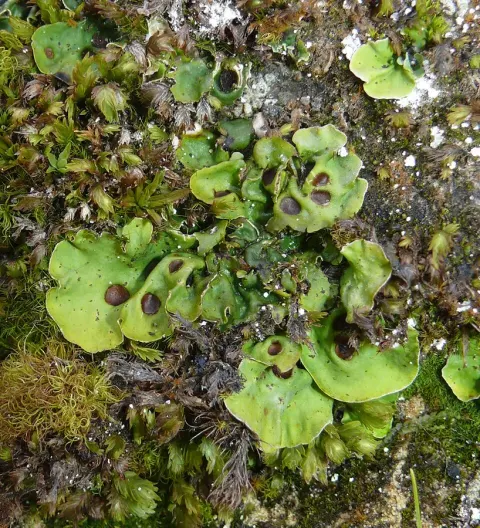
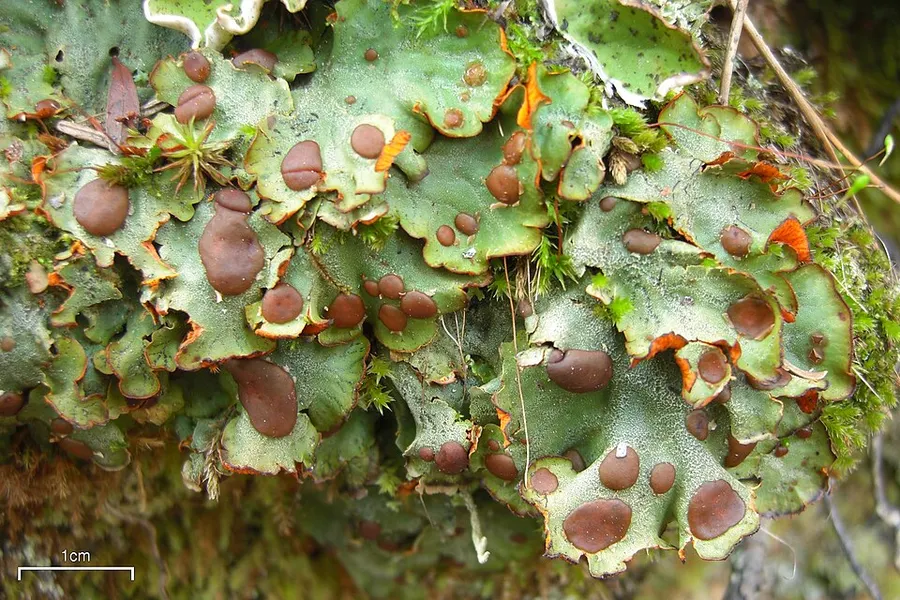
The foliose thallus of Solorina crocea forms large rosettes comprising thick, rounded lobes; it typically measures up to 6 cm broad, although measurements up to 10 cm have been recorded. It is usually tightly pressed to its growing surface. The lobes comprising the thallus are 5 – 15 mm wide with slightly upturned edges; their outline varies from irregular to rounded. The upper thallus surface, when moist, is olive green; in less hydrated conditions it becomes reddish brown. The lower thallus surface is bright orange with a tomentose texture and a somewhat reticulate pattern of brownish veins. Lacking a cortex (an outer layer of compacted hyphae), it resembles a mat of orange-coloured, entangled threads. The medulla is orange. Isidia and soredia are absent. The distinctive colouration of the upper and lower surface make this lichen readily identifiable, although in the field the colour difference may not be easy to discern if the lichen is tightly attached to its substrate. The brown to reddish-brown apothecia measure 2 – 10 mm in diameter. They are either more or less level with the cortex or somewhat convex, rather than in concave depressions, as is the case with some other Solorina species. The photobiont partners of Solorina crocea are arranged in two distinct layers in the thallus. A more or less continuous layer with green algae lies above a patchy cyanobacterial layer. There are six to eight ascospores in each ascus of Solorina crocea. They are brown with an ellipsoid shape, and contain a single transverse septum that divides the spore into two compartments. Based on a sampling of European specimens, the ascospores were measured to be an average of 11.0 μm wide (ranging from 8.4 to 21.2 μm) by 39.0 μm long (ranging from 26.6 to 51.1 μm).
Habitat dan peran ekologis
In North America its range extends from polar regions in alpine to subalpine habitats south to California and New Mexico. European countries in which the lichen has been recorded include Andorra, Austria, Bulgaria, Spain, Iceland, and Finland. In the UK, it occurs in the Scottish Highlands, and it is represented by a single record from Ireland. Its distribution in Italy is limited to the high-altitude Alps and the northern Apennines. In India, it is known from the Himalayas regions (Himachal Pradesh and Sikkim). Its range extends to the Eastern Himalayas, as it has been recorded from Xizang in Tibet at an altitude of 4820 m. In New Zealand, it has been collected from Mount Peel at an altitude of 1350 m. Recorded habitats for the lichen include boulder fields, leached windswept ridges, and areas of solifluction. In Iceland, Solorina crocea occurs in Salix herbacea snowbeds and north-facing slopes with abundant grasses and sedges. Generally, the lichen occurs on the bare ground in sandy soil. It grows in soils that are both acid-rich and base-rich as a result of seepage from late-lying snow patches.
- Habitat atau konteks temuan
- Informasi belum tersedia pada sumber rilis ini.
- Substrat
- Informasi belum tersedia pada sumber rilis ini.
- Peran atau konteks
- Pembentuk liken
Reproduksi
The foliose thallus of Solorina crocea forms large rosettes comprising thick, rounded lobes; it typically measures up to 6 cm broad, although measurements up to 10 cm have been recorded. It is usually tightly pressed to its growing surface. The lobes comprising the thallus are 5 – 15 mm wide with slightly upturned edges; their outline varies from irregular to rounded. The upper thallus surface, when moist, is olive green; in less hydrated conditions it becomes reddish brown. The lower thallus surface is bright orange with a tomentose texture and a somewhat reticulate pattern of brownish veins. Lacking a cortex (an outer layer of compacted hyphae), it resembles a mat of orange-coloured, entangled threads.
Catatan identitas dan cakupan
- Nama diterima mengikuti Catalogue of Life Base2026-09-11; uraian mempertahankan konsep dan nama sumber aslinya.
- Original geographic, specimen and life-cycle scope retained; source import awaits individual editorial review.
- Impor dan terjemahan otomatis belum diperiksa editorial per profil. Struktur reproduktif yang disebutkan tidak membuktikan seluruh siklus hidup diketahui.
- Pengukuran pada uraian mengikuti spesimen, kultur, dan metode sumber; angka tidak diperluas ke semua populasi.
Catatan distribusi dalam narasi mengikuti sumbernya. Dokumentasi spesimen atau foto mengikuti catatan sumber. Bukti wilayah Indonesia dan penilaian konservasi tidak disimpulkan dari gambar.
Melihat dengan konteks
Dokumentasi Solorina crocea dari Wikimedia Commons. Solorina crocea (L.) Ach. 20090531.7 Wells Gray Provincial Park, BC Identifikasi mengikuti record berkas sumber.
- Jenis
- Fotografi
- Kredit
- Jason Hollinger
- Lisensi
- CC BY 2.0
- Sumber media
- Buka entri sumber
Dokumentasi tambahan
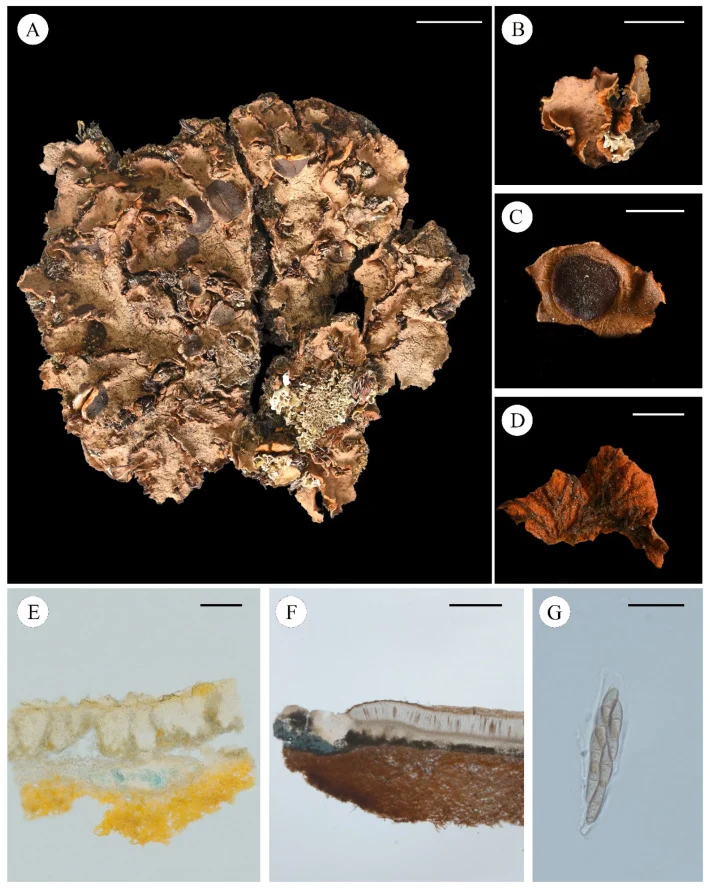
Solorina crocea ((A): Bruce McCune 18613 KUN, (B – G): Theodoer Esslinger 11831 KUN); (A), foliose thallus when dry; (B), smooth margin of the lobe; (C), upper surface of the apothecium; (D), bright orange lower surface distinctly brownish veined; (E), transversal sections of the thallus; (F), transversal sections of the apothecium; (G), ascus. Scale bars: 10 mm (A); 5 mm (B); 3 mm (C, D); 100 µm (E); 400 µm (F); 40 µm (G).
Kredit dan penggunaan
© 2025 by the authors.
Ukuran dan format gambar disesuaikan tanpa pemotongan, retus, atau penambahan skala. Lisensi sumber dipertahankan.
Sumber profil
- [1] Solorina crocea — Wikipedia (en)
- [2] Catalogue of Life Base2026-09-11 — Solorina crocea
- [3] Dokumentasi visual — Solorina crocea
- [4] Dokumentasi visual — Solorina crocea
Rujukan halaman ini
Fungi. Solorina crocea. Rilis data fungi-2026-10-12-expansion-2. https://fungi-atlas.mgadib.chatgpt.site/jamur/solorina-crocea/.
Status: impor sumber; pemeriksaan editorial per profil belum selesai. Untuk klaim biologis, gunakan rujukan pada bagian terkait dan periksa konteks sumber aslinya.