Ciri dan struktur
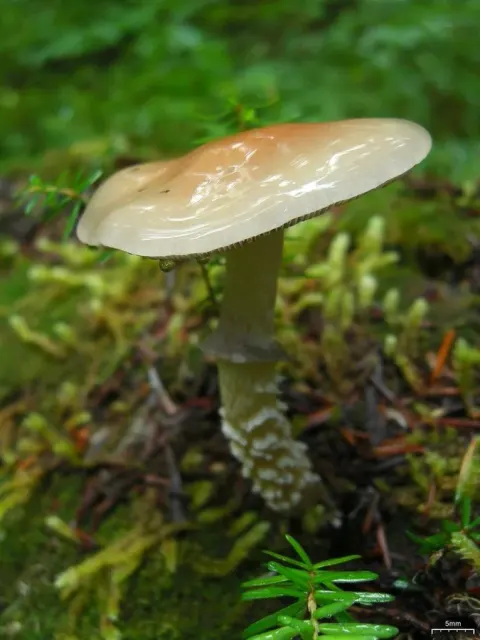
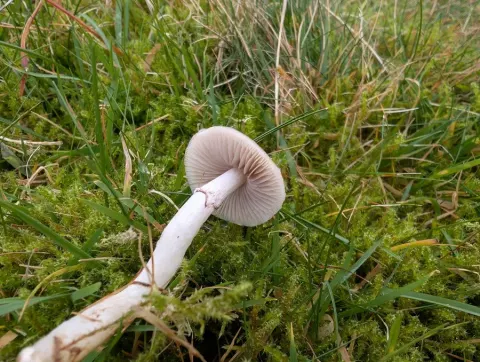
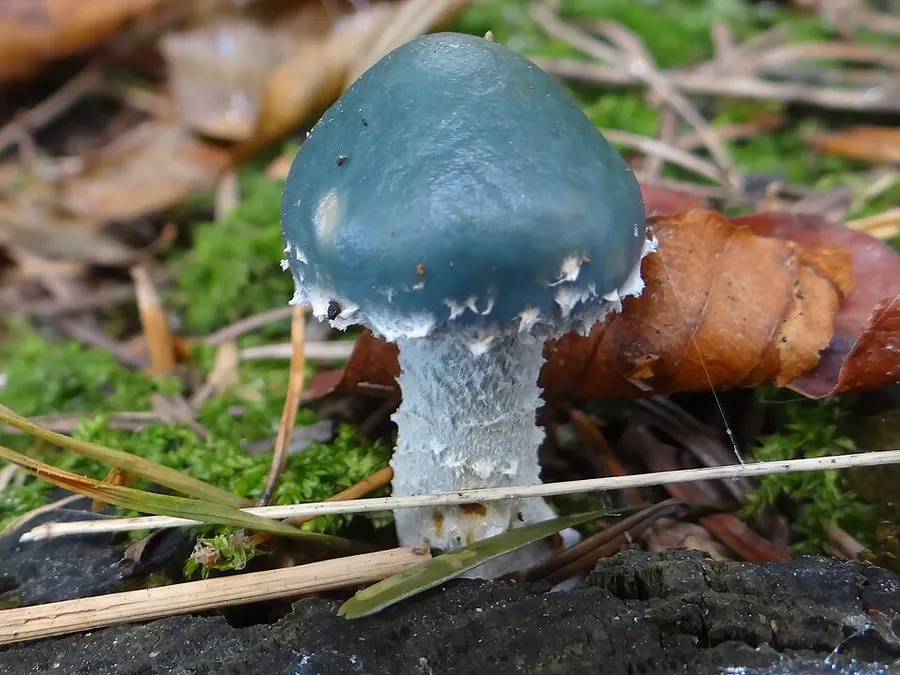
Fruitbodies have conical to flattened caps measuring 2 – 7.5 cm in diameter. They usually have a low, broad umbo. The colour of the cap depends on its age, ranging from pale blue-green to yellowish-bluish green. There is often a whitish zone around the margin, which invariably has bluish-green tints. When moist, the cap is sticky with a cuticle that may be readily peeled; dry caps are smooth and shiny. Gills are initially pale purplish-brown, becoming darker brown in age as the spores mature. They have an adnate or sinuate attachment to the stipe. The stipe has a short-lived annular (ring) zone; above this zone the stipe is smooth, while below it is fibrous and scaly. The flesh is colourless, although it may have tinges of blue in the cap and stipe, and lacks any distinctive odour or flavour. Stropharia cyanea fruit bodies are of unknown edibility. The spore print is brown. Spores typically measure 8.0–9.0 by 4.0–5.5 μm, and have an ellipsoid to oblong to ovoid shape, depending on the viewing angle. Basidia (spore-bearing cells) are narrowly club-shaped, four-spored, and have dimensions of 24–40 by 7–12 μm. The cheilochrysocystidia (found on the gill edge) are club-shaped, measuring 30–55 by 4–40 μm, with a neck that is 2–5 μm wide. Pleurochrysocystidia (on the gill face) are 40–60 by 5–18 μm with a 2–4 μm-wide neck. Clamp connections are abundant in all tissues of S. caerulea. The fungus produces acanthocytes, spiny cells produced on short branches on the mycelium.
Habitat dan peran ekologis
Stropharia caerulea is a saprophytic fungus that fruits singly or in groups. It grows in or on meadows, roadsides, hedgerows, gardens, and woodchip mulch. In Europe it is often found in beech woods in alkaline soil. It is a common species found throughout Europe, where it fruits from July to November. Although also found in North America, generally fruiting from August to October, the full extent of its distribution there is unknown. Fruitbodies of Stropharia caerulea form mycelial cords–rootlike structures consisting of a dense mass of hyphae–which create extensive underground networks that move nutrients and allow the fungus to "forage" for resources. These cords are often associated with stems and rhizomes of the common nettle (Urtica dioica). These mycelial systems' development and the species's interactions with other cord-forming wood decomposer basidiomycetes have been investigated. The mycelia of Stropharia caerulea form a fractal structure characterized by a dense, relatively slowly extending front, a formation associated with finding relatively homogeneously distributed nutrients–equivalent to short-range foraging. An increase in the supply of soil nitrogen or phosphorus increases the fractal branching of the mycelia, allowing increased uptake of nutrients.
- Habitat atau konteks temuan
- Informasi belum tersedia pada sumber rilis ini.
- Substrat
- Informasi belum tersedia pada sumber rilis ini.
- Peran atau konteks
- Belum dikategorikan pada rilis ini.
Reproduksi
Fruitbodies have conical to flattened caps measuring 2 – 7.5 cm in diameter. They usually have a low, broad umbo. The colour of the cap depends on its age, ranging from pale blue-green to yellowish-bluish green. There is often a whitish zone around the margin, which invariably has bluish-green tints. When moist, the cap is sticky with a cuticle that may be readily peeled; dry caps are smooth and shiny. Gills are initially pale purplish-brown, becoming darker brown in age as the spores mature. They have an adnate or sinuate attachment to the stipe. The stipe has a short-lived annular (ring) zone; above this zone the stipe is smooth, while below it is fibrous and scaly. The flesh is colourless, although it may have tinges of blue in the cap and stipe, and lacks any distinctive odour or flavour.
Catatan identitas dan cakupan
- Nama diterima mengikuti Catalogue of Life Base2026-09-11; uraian mempertahankan konsep dan nama sumber aslinya.
- Original geographic, specimen and life-cycle scope retained; source import awaits individual editorial review.
- Impor dan terjemahan otomatis belum diperiksa editorial per profil. Struktur reproduktif yang disebutkan tidak membuktikan seluruh siklus hidup diketahui.
- Pengukuran pada uraian mengikuti spesimen, kultur, dan metode sumber; angka tidak diperluas ke semua populasi.
Catatan distribusi dalam narasi mengikuti sumbernya. Dokumentasi spesimen atau foto mengikuti catatan sumber. Bukti wilayah Indonesia dan penilaian konservasi tidak disimpulkan dari gambar.
Melihat dengan konteks
Dokumentasi Stropharia caerulea dari Wikimedia Commons. Stropharia caerulea (location: Poland, Jaworz (Beskid Wyspowy) Identifikasi mengikuti record berkas sumber.
- Jenis
- Fotografi
- Kredit
- Jerzy Opioła
- Lisensi
- CC BY-SA 4.0
- Sumber media
- Buka entri sumber
Sumber profil
- [1] Stropharia caerulea — Wikipedia (en)
- [2] Catalogue of Life Base2026-09-11 — Stropharia caerulea
- [3] Dokumentasi visual — Stropharia caerulea
Rujukan halaman ini
Fungi. Stropharia caerulea. Rilis data fungi-2026-10-12-expansion-2. https://fungi-atlas.mgadib.chatgpt.site/jamur/stropharia-caerulea/.
Status: impor sumber; pemeriksaan editorial per profil belum selesai. Untuk klaim biologis, gunakan rujukan pada bagian terkait dan periksa konteks sumber aslinya.