01 / Morfologi

Ciri dan struktur

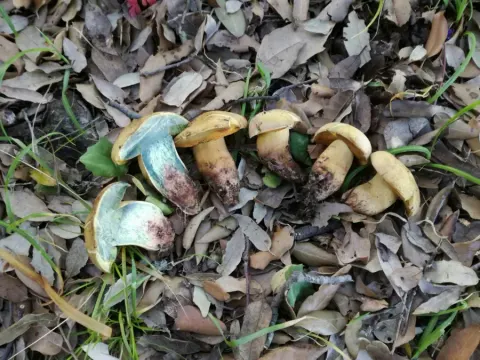
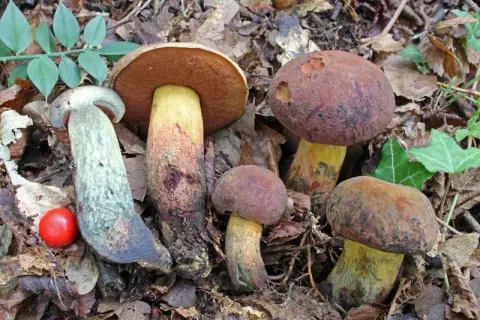
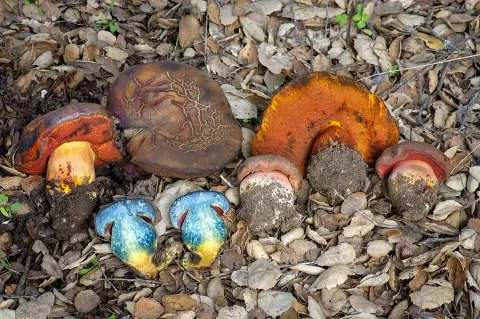
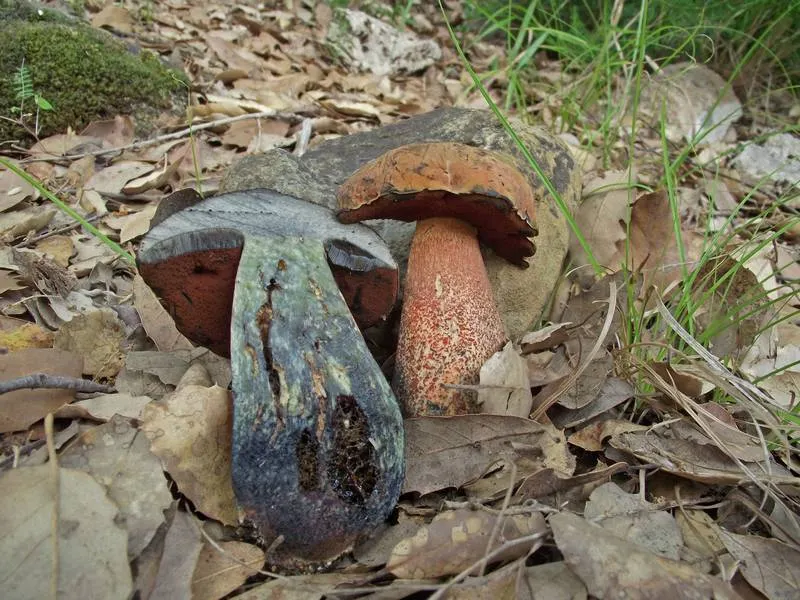
The fruit bodies have caps (pilei) 4–12 cm across, initially hemispherical to convex before flattening, with a distinctly velvety to tomentose surface. Cap colours vary from pale olive-buff in young specimens to deep crimson-red or brownish-red in mature or wet conditions. The stipe measures 4–12 cm long by 0.8–3 cm thick, cylindrical to slightly swollen or tapered at the base, and bears a variable reticulation (net-like pattern) of crimson network on an orange-red ground; the lower stipe often shows fine dark granules or a brown tomentum. The pore surface consists of small, round pores that are bright yellow at first, soon turning vivid scarlet-red, and bruise blue when pressed. The flesh is pale yellow but almost immediately turns indigo-blue on exposure. Spore prints are olive-brown. Microscopically, spores are elongated—about 13–15 × 5–5.7 μm—and the stipe base context shows a strong amyloid reaction.

Sebagian uraian ditampilkan dalam bahasa sumber; terjemahannya belum tersedia atau belum lolos pemeriksaan.

Rujukan: [1]

Pengukuran mengikuti objek, spesimen atau kultur, dan metode yang disebutkan sumber. Baca uraian asli untuk konteks lengkap.

02 / Kehidupan

Habitat dan peran ekologis

Suillellus mendax forms ectomycorrhizal associations with beech (Fagus), oak (Quercus) and sweet chestnut (Castanea). So far, it has been molecularly verified from Italy, France, and the island of Cyprus.

Sebagian uraian ditampilkan dalam bahasa sumber; terjemahannya belum tersedia atau belum lolos pemeriksaan.

Rujukan: [1]

Habitat atau konteks temuan
Informasi belum tersedia pada sumber rilis ini.
Substrat
Informasi belum tersedia pada sumber rilis ini.
Peran atau konteks
Mitra tumbuhan
Temukan hubungan serupa
03 / Siklus hidup

Reproduksi

The fruit bodies have caps (pilei) 4–12 cm across, initially hemispherical to convex before flattening, with a distinctly velvety to tomentose surface. Cap colours vary from pale olive-buff in young specimens to deep crimson-red or brownish-red in mature or wet conditions. The stipe measures 4–12 cm long by 0.8–3 cm thick, cylindrical to slightly swollen or tapered at the base, and bears a variable reticulation (net-like pattern) of crimson network on an orange-red ground; the lower stipe often shows fine dark granules or a brown tomentum. The pore surface consists of small, round pores that are bright yellow at first, soon turning vivid scarlet-red, and bruise blue when pressed. The flesh is pale yellow but almost immediately turns indigo-blue on exposure.

Sebagian uraian ditampilkan dalam bahasa sumber; terjemahannya belum tersedia atau belum lolos pemeriksaan.

Rujukan: [1]

Sinonim menurut acuan taksonomi rilis: Boletus mendax
04 / Batas informasi

Catatan identitas dan cakupan

  • Nama diterima mengikuti Catalogue of Life Base2026-09-11; uraian mempertahankan konsep dan nama sumber aslinya.
  • Original geographic, specimen and life-cycle scope retained; source import awaits individual editorial review.
  • Impor dan terjemahan otomatis belum diperiksa editorial per profil. Struktur reproduktif yang disebutkan tidak membuktikan seluruh siklus hidup diketahui.
  • Pengukuran pada uraian mengikuti spesimen, kultur, dan metode sumber; angka tidak diperluas ke semua populasi.

Catatan distribusi dalam narasi mengikuti sumbernya. Dokumentasi spesimen atau foto mengikuti catatan sumber. Bukti wilayah Indonesia dan penilaian konservasi tidak disimpulkan dari gambar.

05 / Dokumentasi

Melihat dengan konteks

Dokumentasi Suillellus mendax menurut asosiasi foto pada record takson iNaturalist. Kredit: Davide Puddu. Identitas mengikuti sumber; bukan penentuan spesimen independen.

Jenis
Fotografi
Kredit
(c) Davide Puddu, some rights reserved (CC BY), uploaded by Davide Puddu
Lisensi
CC BY 4.0
Sumber media
Buka entri sumber

Gambar menunjukkan objek menurut identifikasi sumber, bukan verifikasi independen spesimen oleh Fungi. Tidak ada skala baru yang ditambahkan.

06 / Rujukan

Sumber profil

  1. [1] Suillellus mendax — Wikipedia (en)Bagian sumber: Frozen revision 1288936063
    Tanggal penghimpunan sumber: 2026-10-12
    Teks sumber: CC BY-SA4.0 · Wikipedia contributors
  2. [2] Catalogue of Life Base2026-09-11 — Suillellus mendaxBagian sumber: ColDP NameUsage.tsv ID 7B53P; accepted species; source 2073
    Tanggal penghimpunan sumber: 2026-10-12
  3. [3] Dokumentasi visual — Suillellus mendaxBagian sumber: Individual media record; identification follows the source, not independent determination
    Tanggal penghimpunan sumber: 2026-10-12
    Media sumber: CC BY 4.0 · (c) Davide Puddu, some rights reserved (CC BY), uploaded by Davide Puddu

Adaptasi teks: CC BY-SA 4.0. Wikipedia contributors — Suillellus mendax — Wikipedia (en)

Uraian asli dan riwayat sumber

Riwayat atau halaman sumber

Ringkasan sumber

Suillellus mendax is a species of bolete fungus found in Europe that forms beneficial relationships with beech, oak, and sweet chestnut trees. First described scientifically in 2013, the fungus produces mushrooms with olive-buff to crimson-red caps, bright yellow pores that turn scarlet-red, and stipes adorned with a crimson network pattern on an orange-red background. Its species epithet mendax, meaning "false" or "deceptive" in Latin, alludes to its close resemblance to the widespread Suillellus luridus, from which it differs by its preference for acidic soils, velvety cap texture, and more elongated spores.

Revisi sumber

Morfologi sumber

The fruit bodies have caps (pilei) 4–12 cm across, initially hemispherical to convex before flattening, with a distinctly velvety to tomentose surface. Cap colours vary from pale olive-buff in young specimens to deep crimson-red or brownish-red in mature or wet conditions. The stipe measures 4–12 cm long by 0.8–3 cm thick, cylindrical to slightly swollen or tapered at the base, and bears a variable reticulation (net-like pattern) of crimson network on an orange-red ground; the lower stipe often shows fine dark granules or a brown tomentum. The pore surface consists of small, round pores that are bright yellow at first, soon turning vivid scarlet-red, and bruise blue when pressed. The flesh is pale yellow but almost immediately turns indigo-blue on exposure. Spore prints are olive-brown. Microscopically, spores are elongated—about 13–15 × 5–5.7 μm—and the stipe base context shows a strong amyloid reaction.

Revisi sumber

Ekologi sumber

Suillellus mendax forms ectomycorrhizal associations with beech (Fagus), oak (Quercus) and sweet chestnut (Castanea). So far, it has been molecularly verified from Italy, France, and the island of Cyprus.

Revisi sumber

Struktur reproduksi sumber

The fruit bodies have caps (pilei) 4–12 cm across, initially hemispherical to convex before flattening, with a distinctly velvety to tomentose surface. Cap colours vary from pale olive-buff in young specimens to deep crimson-red or brownish-red in mature or wet conditions. The stipe measures 4–12 cm long by 0.8–3 cm thick, cylindrical to slightly swollen or tapered at the base, and bears a variable reticulation (net-like pattern) of crimson network on an orange-red ground; the lower stipe often shows fine dark granules or a brown tomentum. The pore surface consists of small, round pores that are bright yellow at first, soon turning vivid scarlet-red, and bruise blue when pressed. The flesh is pale yellow but almost immediately turns indigo-blue on exposure.

Revisi sumber

Rujukan halaman ini

Fungi. Suillellus mendax. Rilis data fungi-2026-10-12-expansion-2. https://fungi-atlas.mgadib.chatgpt.site/jamur/suillellus-mendax/.

Status: impor sumber; pemeriksaan editorial per profil belum selesai. Untuk klaim biologis, gunakan rujukan pada bagian terkait dan periksa konteks sumber aslinya.