01 / Morfologi

Ciri dan struktur

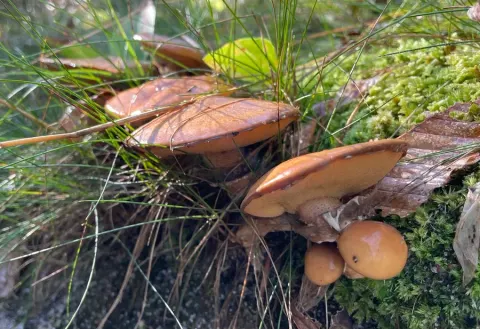
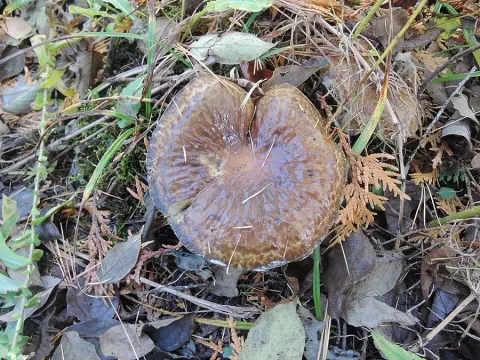
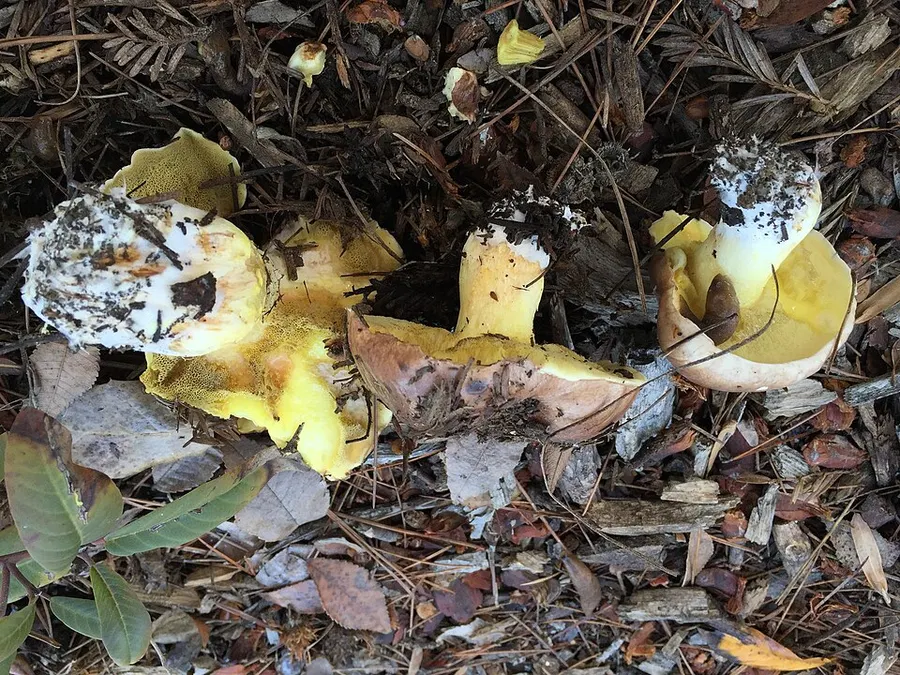
The cap ranges in shape from hemispheric to broadly convex, and has a diameter of 6 to 12 cm. The cap color is deep brown in mature specimens and lighter shades of brown in younger mushrooms. Young specimens have a sticky layer of gluten on the cap that dries out in maturity. The edge of the cap is rolled inwards in young specimens. The flesh of the cap is whitish and does not change color when bruised or cut. The tubes on the underside of the cap are light yellow to bright orange-yellow; the tube mouths are usually less than 1 mm wide. The stipe is usually between 2 and 4 cm long, less frequently reaching up to 8 cm. It is either the same width throughout or slightly larger (bulbous) at the base. The color of the upper portion of the stipe is pale to light yellow, while the lower portion may be light brown or covered with streaks of glutinous material like that on the cap. The stipe surface is covered with fine glands that are initially slightly darker than the color of the stipe surface, but deepen to brown or nearly black after drying. The color of the spore print was not determined from the initial collections, but is thought to be yellow-brown to brown based on the accumulated spore deposit seen on the surface of the caps of neighboring fruit bodies. The elongate spores are oblong in face view, with dimensions of 6.1–14.7 by 2.4–3.7 μm. Most spores have a single large drop of oil in them. The spore-bearing cells, the basidia, are club-shaped, two- or four-spored, and measure 20.2–26.2 by 5.2–6.7 μm.

Sebagian uraian ditampilkan dalam bahasa sumber; terjemahannya belum tersedia atau belum lolos pemeriksaan.

Rujukan: [1]

Pengukuran mengikuti objek, spesimen atau kultur, dan metode yang disebutkan sumber. Baca uraian asli untuk konteks lengkap.

02 / Kehidupan

Habitat dan peran ekologis

Fruit bodies tumbuh bersama dalam kelompok kecil di tanah bersama dengan bishop pine (Pinus muricata). Dalam studi filogenetik multigene Suillus, S. quiescens juga disampel dalam hubungan California in dengan Monterey pine (Pinus radiata), selain bishop pine. IUCN Red List assessment melaporkan bahwa itu adalah ektomikoriza dengan pinus dua dan tiga jarum dan juga terjadi dengan pinus lodgepole (Pinus contorta) di utara California and Oregon coast; berdasarkan sampel lingkungan, penilaian menganggap kemungkinan itu terjadi dengan Ponderosa pine (P. ponderosa) dan Jeffrey pine (P. jeffreyi) juga, sambil mencatat bahwa lebih banyak data diperlukan tentang ekologi spesies. S. quiescens adalah yang paling umum Suillus species di Pulau Santa Cruz, lokasinya tipe, dan juga telah dikumpulkan di Santa Rosa Island and Point Reyes National Seashore in California. Santa Cruz and Santa Rosa, two of the four islands that make up the northern Channel Islands, have a Mediterranean climate with cool, wet winters and warm, dry summers. Most species dari Suillus do tidak memiliki spora yang bertahan di tanah untuk jangka waktu yang lama, tetapi spora dari S. quiescens dapat mentolerir kondisi kering dan panas khas California.

Sebagian uraian ditampilkan dalam bahasa sumber; terjemahannya belum tersedia atau belum lolos pemeriksaan.

Rujukan: [1]

Habitat atau konteks temuan
Informasi belum tersedia pada sumber rilis ini.
Substrat
tanah
Peran atau konteks
Mitra tumbuhan
Temukan hubungan serupa
03 / Siklus hidup

Reproduksi

The cap ranges in shape from hemispheric to broadly convex, and has a diameter of 6 to 12 cm. The cap color is deep brown in mature specimens and lighter shades of brown in younger mushrooms. Young specimens have a sticky layer of gluten on the cap that dries out in maturity. The edge of the cap is rolled inwards in young specimens. The flesh of the cap is whitish and does not change color when bruised or cut. The tubes on the underside of the cap are light yellow to bright orange-yellow; the tube mouths are usually less than 1 mm wide. The stipe is usually between 2 and 4 cm long, less frequently reaching up to 8 cm. It is either the same width throughout or slightly larger (bulbous) at the base.

Sebagian uraian ditampilkan dalam bahasa sumber; terjemahannya belum tersedia atau belum lolos pemeriksaan.

Rujukan: [1]

04 / Batas informasi

Catatan identitas dan cakupan

  • Nama diterima mengikuti Catalogue of Life Base2026-09-11; uraian mempertahankan konsep dan nama sumber aslinya.
  • Original geographic, specimen and life-cycle scope retained; source import awaits individual editorial review.
  • Impor dan terjemahan otomatis belum diperiksa editorial per profil. Struktur reproduktif yang disebutkan tidak membuktikan seluruh siklus hidup diketahui.
  • Pengukuran pada uraian mengikuti spesimen, kultur, dan metode sumber; angka tidak diperluas ke semua populasi.

Catatan distribusi dalam narasi mengikuti sumbernya. Dokumentasi spesimen atau foto mengikuti catatan sumber. Bukti wilayah Indonesia dan penilaian konservasi tidak disimpulkan dari gambar.

05 / Dokumentasi

Melihat dengan konteks

Dokumentasi Suillus quiescens dari Wikimedia Commons. Fruit bodies of the bolete fungus Suillus quiescens T.D. Bruns & Vellinga. Collection made on Stanford University, Stanford, CA. "Notes: Identity was confirmed using ITS DNA sequences which matched to the type collection." Identifikasi mengikuti record berkas sumber.

Jenis
Fotografi
Kredit
Kabir (mykophile)
Sumber media
Buka entri sumber

Gambar menunjukkan objek menurut identifikasi sumber, bukan verifikasi independen spesimen oleh Fungi. Tidak ada skala baru yang ditambahkan.

06 / Rujukan

Sumber profil

  1. [1] Suillus quiescens — Wikipedia (en)Bagian sumber: Frozen revision 1337390503
    Tanggal penghimpunan sumber: 2026-10-12
    Teks sumber: CC BY-SA4.0 · Wikipedia contributors
  2. [2] Catalogue of Life Base2026-09-11 — Suillus quiescensBagian sumber: ColDP NameUsage.tsv ID 53F7G; accepted species; source 2073
    Tanggal penghimpunan sumber: 2026-10-12
  3. [3] Dokumentasi visual — Suillus quiescensBagian sumber: Individual media record; identification follows the source, not independent determination
    Tanggal penghimpunan sumber: 2026-10-12
    Media sumber: CC BY-SA 3.0 · Kabir (mykophile)

Adaptasi teks: CC BY-SA 4.0. Wikipedia contributors — Suillus quiescens — Wikipedia (en)

Uraian asli dan riwayat sumber

Riwayat atau halaman sumber

Ringkasan sumber

Suillus quiescens is a pored mushroom in the genus Suillus (family Suillaceae) that forms ectomycorrhizae with pines. It was first collected in 2002 on Santa Cruz Island off the coast of California in association with bishop pine (Pinus muricata), and was formally described in 2010. The species has been recorded from coastal and montane sites in California and Oregon, and has also been introduced to New Zealand in association with non-native Monterey pine (Pinus radiata). It may be under-reported because it can persist in soil as a dormant spore bank, and because it can be mistaken for the look-alike Suillus brevipes.

Revisi sumber

Morfologi sumber

The cap ranges in shape from hemispheric to broadly convex, and has a diameter of 6 to 12 cm. The cap color is deep brown in mature specimens and lighter shades of brown in younger mushrooms. Young specimens have a sticky layer of gluten on the cap that dries out in maturity. The edge of the cap is rolled inwards in young specimens. The flesh of the cap is whitish and does not change color when bruised or cut. The tubes on the underside of the cap are light yellow to bright orange-yellow; the tube mouths are usually less than 1 mm wide. The stipe is usually between 2 and 4 cm long, less frequently reaching up to 8 cm. It is either the same width throughout or slightly larger (bulbous) at the base. The color of the upper portion of the stipe is pale to light yellow, while the lower portion may be light brown or covered with streaks of glutinous material like that on the cap. The stipe surface is covered with fine glands that are initially slightly darker than the color of the stipe surface, but deepen to brown or nearly black after drying. The color of the spore print was not determined from the initial collections, but is thought to be yellow-brown to brown based on the accumulated spore deposit seen on the surface of the caps of neighboring fruit bodies. The elongate spores are oblong in face view, with dimensions of 6.1–14.7 by 2.4–3.7 μm. Most spores have a single large drop of oil in them. The spore-bearing cells, the basidia, are club-shaped, two- or four-spored, and measure 20.2–26.2 by 5.2–6.7 μm.

Revisi sumber

Ekologi sumber

Fruit bodies grow together in small groups on the ground in association with bishop pine (Pinus muricata). In a multigene phylogenetic study of Suillus, S. quiescens was also sampled in California in association with Monterey pine (Pinus radiata), in addition to bishop pine. The IUCN Red List assessment reports that it is ectomycorrhizal with two- and three-needle pines and also occurs with lodgepole pine (Pinus contorta) on the northern California and Oregon coast; based on environmental samples, the assessment considers it likely to occur with Ponderosa pine (P. ponderosa) and Jeffrey pine (P. jeffreyi) as well, while noting that more data are needed on the species' ecology. S. quiescens is the most common Suillus species on Santa Cruz Island, its type locality, and it has also been collected at Santa Rosa Island and Point Reyes National Seashore in California. Santa Cruz and Santa Rosa, two of the four islands that make up the northern Channel Islands, have a Mediterranean climate with cool, wet winters and warm, dry summers. Most species of Suillus do not have spores that survive in the soil for extended periods of time, but the spores of S. quiescens can tolerate the dry conditions and heat typical of California.

Revisi sumber

Struktur reproduksi sumber

The cap ranges in shape from hemispheric to broadly convex, and has a diameter of 6 to 12 cm. The cap color is deep brown in mature specimens and lighter shades of brown in younger mushrooms. Young specimens have a sticky layer of gluten on the cap that dries out in maturity. The edge of the cap is rolled inwards in young specimens. The flesh of the cap is whitish and does not change color when bruised or cut. The tubes on the underside of the cap are light yellow to bright orange-yellow; the tube mouths are usually less than 1 mm wide. The stipe is usually between 2 and 4 cm long, less frequently reaching up to 8 cm. It is either the same width throughout or slightly larger (bulbous) at the base.

Revisi sumber

Rujukan halaman ini

Fungi. Suillus quiescens. Rilis data fungi-2026-10-12-expansion-2. https://fungi-atlas.mgadib.chatgpt.site/jamur/suillus-quiescens/.

Status: impor sumber; pemeriksaan editorial per profil belum selesai. Untuk klaim biologis, gunakan rujukan pada bagian terkait dan periksa konteks sumber aslinya.