01 / Morfologi

Ciri dan struktur

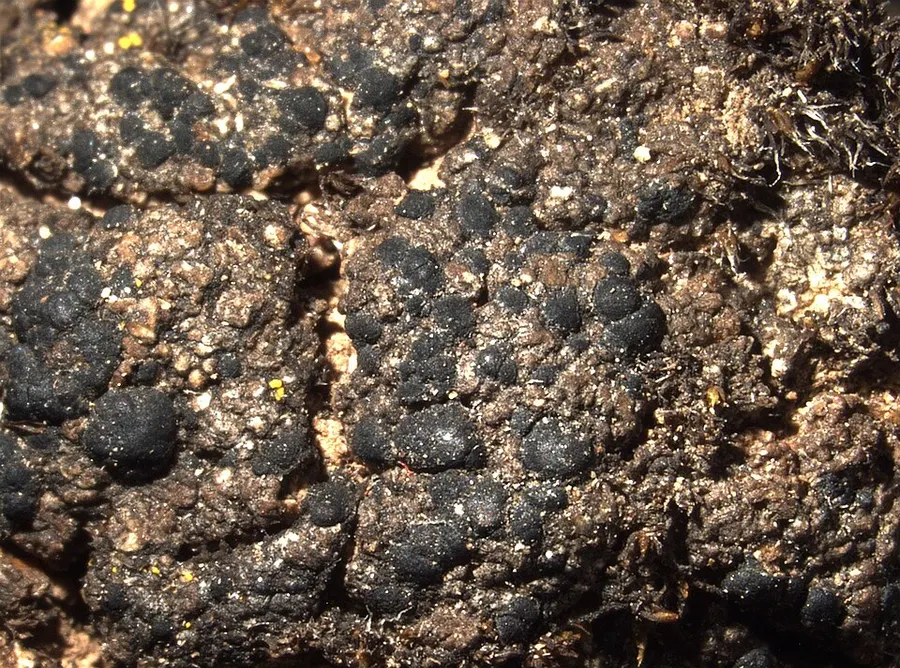
The thallus of Toninia squalida is composed of small, scale-like units () to about 3 mm across that often multiply and coalesce into a more or less continuous crust. Individual squamules are shallowly concave to slightly convex. Their upper surface is brown to dark brown, sometimes with a greyish cast; it is matte rather than frosted (not ) and may show fine cracking. The margins are the same colour as the surface and there are no pseudocyphellae (the tiny pores some lichens have for gas exchange). In section, the upper is 25–100 micrometres (μm) thick and includes a 20–30 μm (a thin skin of dead outer hyphae); calcium oxalate crystals are absent. The lower cortex is pale brown and only weakly developed. The (green-algal partner) forms a patchy, discontinuous layer, and the medulla lacks crystals. The fruiting bodies (apothecia) are up to 1.5 mm in diameter, with that are flat to slightly convex and again not pruinose. The (the ring of fungal tissue forming the margin) is indistinct: the rim is dark brown and may appear greenish, while the inner part is pale brown to colourless. Routine spot tests on these pigments give K– reactions; the rim may turn violet with the N (nitric acid) test, and the (the thin, often green film on top of the disc) is K– but N+ (violet). The spore-bearing layer (hymenium) is clear and 70–80 μm tall, underlain by a colourless to pale brown . Ascospores are needle-like (), measuring 17–45 × 3–5 μm, and are divided by 3–7 cross-walls (septa). No secondary metabolites (lichen products) were detected using thin-layer chromatography.

Sebagian uraian ditampilkan dalam bahasa sumber; terjemahannya belum tersedia atau belum lolos pemeriksaan.

Rujukan: [1]

Pengukuran mengikuti objek, spesimen atau kultur, dan metode yang disebutkan sumber. Baca uraian asli untuk konteks lengkap.

02 / Kehidupan

Habitat dan peran ekologis

Toninia squalida is chiefly terricolous, favouring base-rich soils and humus; it also occurs on weathered, slightly calcareous or other base-rich siliceous rocks in dry, upland situations. Young thalli are often intermixed with cyanobacteria or nest within small cyanolichen patches. In Britain it is a scarce alpine species of calcareous rocks, typically nestled among mosses along damp seepage lines; confirmed records are concentrated in the Scottish Highlands, including Ben Lawers and Caenlochan. Globally the species ranges broadly across the Northern Hemisphere, extending from temperate uplands into arctic and subarctic zones. It is listed across numerous sectors of the Pan-Arctic, and North American records include Alaskan sites where it grows on soil over rock.

Sebagian uraian ditampilkan dalam bahasa sumber; terjemahannya belum tersedia atau belum lolos pemeriksaan.

Rujukan: [1]

Habitat atau konteks temuan
Informasi belum tersedia pada sumber rilis ini.
Substrat
tanah
Peran atau konteks
Pembentuk liken
Temukan hubungan serupa
03 / Siklus hidup

Reproduksi

The fruiting bodies (apothecia) are up to 1.5 mm in diameter, with that are flat to slightly convex and again not pruinose. The (the ring of fungal tissue forming the margin) is indistinct: the rim is dark brown and may appear greenish, while the inner part is pale brown to colourless. Routine spot tests on these pigments give K– reactions; the rim may turn violet with the N (nitric acid) test, and the (the thin, often green film on top of the disc) is K– but N+ (violet). The spore-bearing layer (hymenium) is clear and 70–80 μm tall, underlain by a colourless to pale brown . Ascospores are needle-like (), measuring 17–45 × 3–5 μm, and are divided by 3–7 cross-walls (septa). No secondary metabolites (lichen products) were detected using thin-layer chromatography.

Sebagian uraian ditampilkan dalam bahasa sumber; terjemahannya belum tersedia atau belum lolos pemeriksaan.

Rujukan: [1]

Sinonim menurut acuan taksonomi rilis: Biatora squalida; Bilimbia squalida; Lecidea atrorufa var. squarrosa; Lecidea squalida; Lichen peltatus squalida; Lichen peltatus var. squarrosa; Patellaria squalida; Psora squalida; Scolecites squalidus; Syncomista squarrosa; Toninia havaasii; Toninia squarrosa
04 / Batas informasi

Catatan identitas dan cakupan

  • Nama diterima mengikuti Catalogue of Life Base2026-09-11; uraian mempertahankan konsep dan nama sumber aslinya.
  • Original geographic, specimen and life-cycle scope retained; source import awaits individual editorial review.
  • Impor dan terjemahan otomatis belum diperiksa editorial per profil. Struktur reproduktif yang disebutkan tidak membuktikan seluruh siklus hidup diketahui.
  • Pengukuran pada uraian mengikuti spesimen, kultur, dan metode sumber; angka tidak diperluas ke semua populasi.

Catatan distribusi dalam narasi mengikuti sumbernya. Dokumentasi spesimen atau foto mengikuti catatan sumber. Bukti wilayah Indonesia dan penilaian konservasi tidak disimpulkan dari gambar.

05 / Dokumentasi

Melihat dengan konteks

Dokumentasi Toninia squalida dari Wikimedia Commons. The squamulose lichen 'Toninia squalida Identifikasi mengikuti record berkas sumber.

Jenis
Fotografi
Kredit
Per Luigi Nimis
Sumber media
Buka entri sumber

Gambar menunjukkan objek menurut identifikasi sumber, bukan verifikasi independen spesimen oleh Fungi. Tidak ada skala baru yang ditambahkan.

06 / Rujukan

Sumber profil

  1. [1] Toninia squalida — Wikipedia (en)Bagian sumber: Frozen revision 1322644189
    Tanggal penghimpunan sumber: 2026-10-12
    Teks sumber: CC BY-SA4.0 · Wikipedia contributors
  2. [2] Catalogue of Life Base2026-09-11 — Toninia squalidaBagian sumber: ColDP NameUsage.tsv ID 7CGBS; accepted species; source 2073
    Tanggal penghimpunan sumber: 2026-10-12
  3. [3] Dokumentasi visual — Toninia squalidaBagian sumber: Individual media record; identification follows the source, not independent determination
    Tanggal penghimpunan sumber: 2026-10-12
    Media sumber: CC BY-SA 4.0 · Per Luigi Nimis

Adaptasi teks: CC BY-SA 4.0. Wikipedia contributors — Toninia squalida — Wikipedia (en)

Uraian asli dan riwayat sumber

Riwayat atau halaman sumber

Ringkasan sumber

Toninia squalida is a species of lichen in the family Ramalinaceae. It forms small brown scale-like structures that often merge into crusts, typically growing on calcareous rocks or base-rich soils in upland and arctic regions. The species was first described in 1810 by the Swedish lichenologist Erik Acharius as Lecidea squalida, and was transferred to the genus Toninia by Abramo Bartolommeo Massalongo in 1852. Found across the Northern Hemisphere from temperate mountains to arctic zones, it is a scarce alpine species in Britain, mainly recorded from the Scottish Highlands.

Revisi sumber

Morfologi sumber

The thallus of Toninia squalida is composed of small, scale-like units () to about 3 mm across that often multiply and coalesce into a more or less continuous crust. Individual squamules are shallowly concave to slightly convex. Their upper surface is brown to dark brown, sometimes with a greyish cast; it is matte rather than frosted (not ) and may show fine cracking. The margins are the same colour as the surface and there are no pseudocyphellae (the tiny pores some lichens have for gas exchange). In section, the upper is 25–100 micrometres (μm) thick and includes a 20–30 μm (a thin skin of dead outer hyphae); calcium oxalate crystals are absent. The lower cortex is pale brown and only weakly developed. The (green-algal partner) forms a patchy, discontinuous layer, and the medulla lacks crystals. The fruiting bodies (apothecia) are up to 1.5 mm in diameter, with that are flat to slightly convex and again not pruinose. The (the ring of fungal tissue forming the margin) is indistinct: the rim is dark brown and may appear greenish, while the inner part is pale brown to colourless. Routine spot tests on these pigments give K– reactions; the rim may turn violet with the N (nitric acid) test, and the (the thin, often green film on top of the disc) is K– but N+ (violet). The spore-bearing layer (hymenium) is clear and 70–80 μm tall, underlain by a colourless to pale brown . Ascospores are needle-like (), measuring 17–45 × 3–5 μm, and are divided by 3–7 cross-walls (septa). No secondary metabolites (lichen products) were detected using thin-layer chromatography.

Revisi sumber

Ekologi sumber

Toninia squalida is chiefly terricolous, favouring base-rich soils and humus; it also occurs on weathered, slightly calcareous or other base-rich siliceous rocks in dry, upland situations. Young thalli are often intermixed with cyanobacteria or nest within small cyanolichen patches. In Britain it is a scarce alpine species of calcareous rocks, typically nestled among mosses along damp seepage lines; confirmed records are concentrated in the Scottish Highlands, including Ben Lawers and Caenlochan. Globally the species ranges broadly across the Northern Hemisphere, extending from temperate uplands into arctic and subarctic zones. It is listed across numerous sectors of the Pan-Arctic, and North American records include Alaskan sites where it grows on soil over rock.

Revisi sumber

Struktur reproduksi sumber

The fruiting bodies (apothecia) are up to 1.5 mm in diameter, with that are flat to slightly convex and again not pruinose. The (the ring of fungal tissue forming the margin) is indistinct: the rim is dark brown and may appear greenish, while the inner part is pale brown to colourless. Routine spot tests on these pigments give K– reactions; the rim may turn violet with the N (nitric acid) test, and the (the thin, often green film on top of the disc) is K– but N+ (violet). The spore-bearing layer (hymenium) is clear and 70–80 μm tall, underlain by a colourless to pale brown . Ascospores are needle-like (), measuring 17–45 × 3–5 μm, and are divided by 3–7 cross-walls (septa). No secondary metabolites (lichen products) were detected using thin-layer chromatography.

Revisi sumber

Rujukan halaman ini

Fungi. Toninia squalida. Rilis data fungi-2026-10-12-expansion-2. https://fungi-atlas.mgadib.chatgpt.site/jamur/toninia-squalida/.

Status: impor sumber; pemeriksaan editorial per profil belum selesai. Untuk klaim biologis, gunakan rujukan pada bagian terkait dan periksa konteks sumber aslinya.