Ciri dan struktur
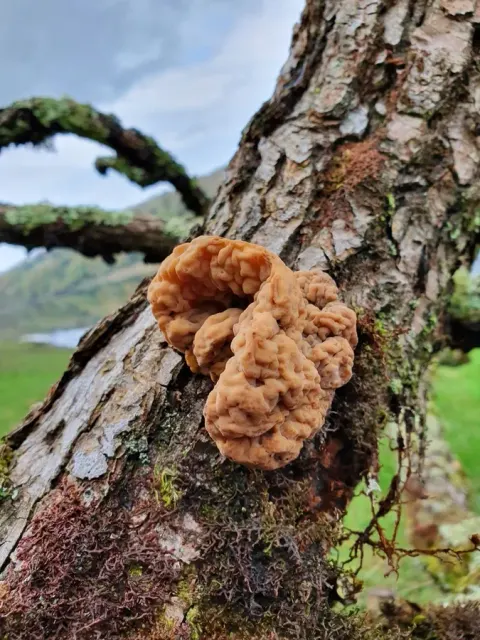
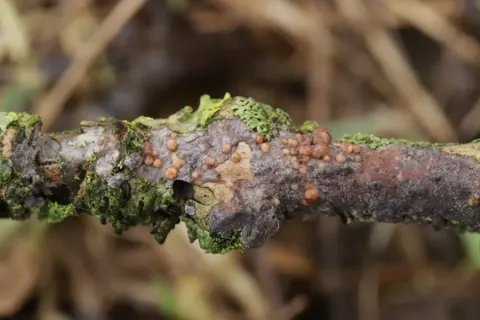
Basidiomata small, gyrose to cerebriform, 0.6–1.0 cm in diameter, firm gelatinous and thick, pale orange when fresh, yellow orange when dry, flat on the substrate. Hyphae smooth, thin-walled, slender, 2.0–3.5 μm in diameter, often with clamp connections. Haustoria rare, small, globose or subglobose, 2.0–4.0 μm in diameter, with single hyphae. Hyphidia rare, smooth, thin-walled, 2.0–4.0 μm, branched. Probasidial initials mostly subglobose to globose, sometimes broadly ellipsoid. Basidia, when mature, subglobose to globose, four-celled, occasionally two-celled, thin-walled, 31.0–38.0 μm × 29.0–37.0 μm, with longitudinally cruciate-septate, without stalk-like base; sterigmata up to 110.0 μm long, not swollen at apex. Basidiospores globose to subglobose, 16.0–22.0 μm × 15–20.0 μm, L = 18.3 ± 1.3 μm, W = 17.8 ± 1.4 μm, Q = 0.9–1.3 (n = 25), with a distinct apiculus. Conidia present, ellipsoid, fusiform to cylindrical, 8.0–17.0 μm × 2.0–5.0 μm, L = 10.7 ± 2.2 μm, W = 3.5 ± 0.5 μm, Q = 2–5.8 (n = 40), hyaline, clamped, arranged in cluster. Terminally and laterally swollen cells appearing abundant in the subhymenium, citriniform, pyriform or broadly ellipsoid, 9.0–20.0 μm × 5.6–13.0 μm, L = 14.2 ± 2.8 μm, W = 8.8 ± 1.8 μm, Q = 1.1–2.8 (n = 40).
Habitat dan peran ekologis
On wood of deciduous tree, in forest dominated by Rosaceae, Moraceae, Lauraceae, and Theaceae.
- Habitat atau konteks temuan
- hutan
- Substrat
- kayu
- Peran atau konteks
- Belum dikategorikan pada rilis ini.
Reproduksi
Basidiomata small, gyrose to cerebriform, 0.6–1.0 cm in diameter, firm gelatinous and thick, pale orange when fresh, yellow orange when dry, flat on the substrate. Hyphae smooth, thin-walled, slender, 2.0–3.5 μm in diameter, often with clamp connections. Haustoria rare, small, globose or subglobose, 2.0–4.0 μm in diameter, with single hyphae. Hyphidia rare, smooth, thin-walled, 2.0–4.0 μm, branched. Probasidial initials mostly subglobose to globose, sometimes broadly ellipsoid. Basidia, when mature, subglobose to globose, four-celled, occasionally two-celled, thin-walled, 31.0–38.0 μm × 29.0–37.0 μm, with longitudinally cruciate-septate, without stalk-like base; sterigmata up to 110.0 μm long, not swollen at apex.
Catatan identitas dan cakupan
- Nama diterima mengikuti Catalogue of Life Base2026-09-11; uraian mempertahankan konsep dan nama sumber aslinya.
- Preserve original treatment localities, hosts and substrate scope. Materials examined describe documented specimens, not the full global range.
- Impor dan terjemahan otomatis belum diperiksa editorial per profil. Struktur reproduktif yang disebutkan tidak membuktikan seluruh siklus hidup diketahui.
- Pengukuran pada uraian mengikuti spesimen, kultur, dan metode sumber; angka tidak diperluas ke semua populasi.
Catatan distribusi dalam narasi mengikuti sumbernya. Dokumentasi spesimen atau foto mengikuti catatan sumber. Bukti wilayah Indonesia dan penilaian konservasi tidak disimpulkan dari gambar.
Melihat dengan konteks
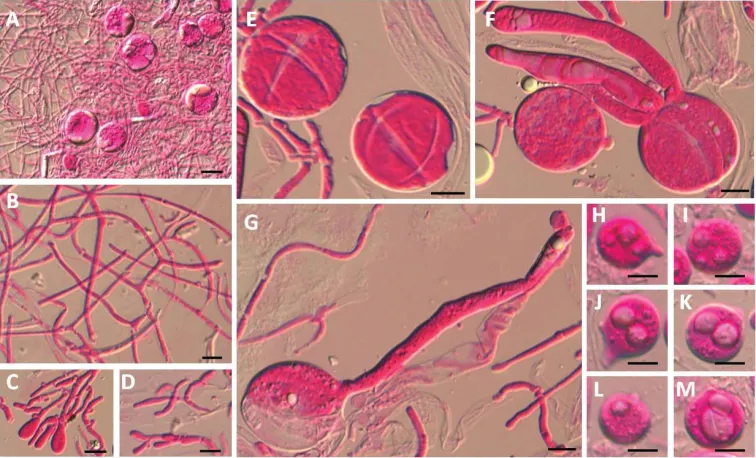
Microscopic structure of Tremella salmonea (HMAS 279588). A Section through hymenium B Hyphae from context C Swollen cells D Conidia in cluster E–G Mature basidia H–M Basidiospres. Scale bars: 10 μm (A–M).
- Jenis
- Pelat ilmiah
- Kredit
- Ying Zhao, Xin-zhan Liu, Feng-yan Bai
- Lisensi
- CC BY 4.0
- Sumber media
- Buka entri sumber
Dokumentasi tambahan
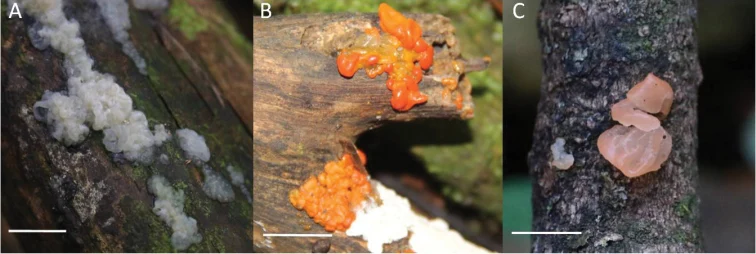
Macromorphology of Tremella basidiomata. A T. cheejenii B T. erythrina C T. salmonea. Scale bars: 1 cm.
Kredit dan penggunaan
Ying Zhao, Xin-zhan Liu, Feng-yan Bai
Ukuran dan format gambar disesuaikan tanpa pemotongan, retus, atau penambahan skala. Lisensi sumber dipertahankan.
Sumber profil
- [1] Four new species of Tremella (Tremellales, Basidiomycota) based on morphology and DNA sequence data — Tremella salmonea
- [2] Catalogue of Life Base2026-09-11 — Tremella salmonea
- [3] Dokumentasi visual — Tremella salmonea
- [4] Dokumentasi visual — Tremella salmonea
Rujukan halaman ini
Fungi. Tremella salmonea. Rilis data fungi-2026-10-12-expansion-2. https://fungi-atlas.mgadib.chatgpt.site/jamur/tremella-salmonea/.
Status: impor sumber; pemeriksaan editorial per profil belum selesai. Untuk klaim biologis, gunakan rujukan pada bagian terkait dan periksa konteks sumber aslinya.