Ciri dan struktur
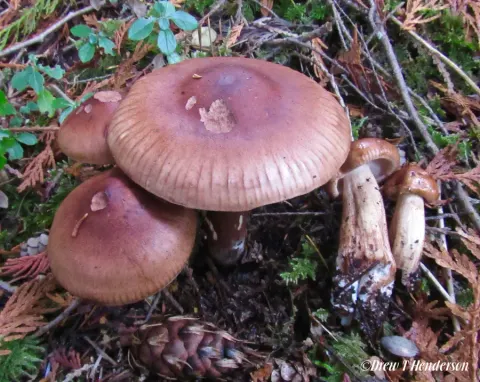
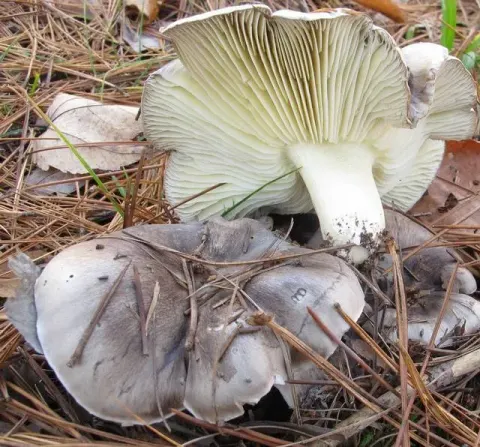
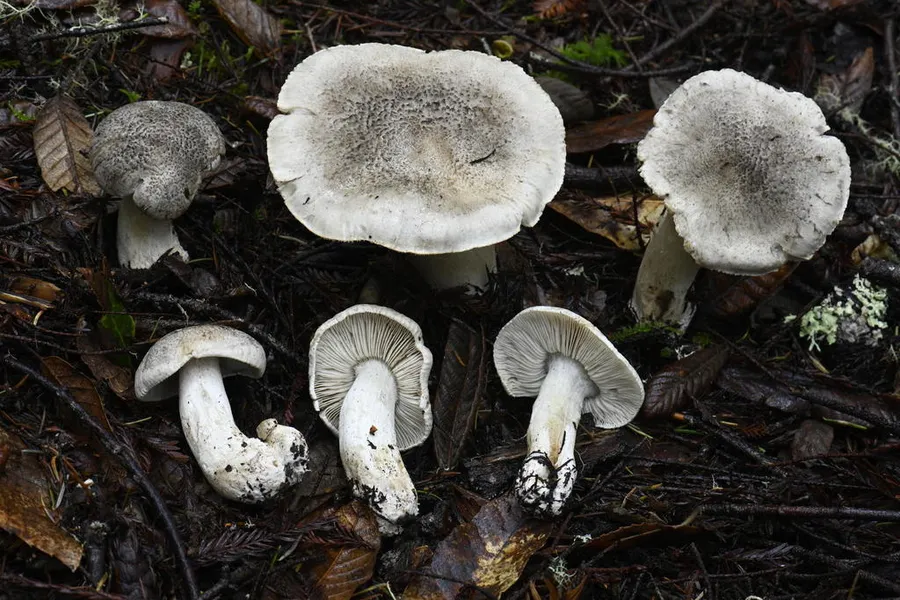
The fruit body is a medium-sized mushroom, with a cap ranging from 5 – 15 cm in diameter. The cap is initially hemispherical before flattening with maturity, and has a broad, shallow umbo. The cap margin is initially curled inwards but uncurls as it matures. The cap surface is silvery-grey and covered with concentrically patterned darker grey, brown or blackish scales that grow paler toward the cap margin, Secretan noting its resemblance to the cap of Sarcodon imbricatus. The gills are free (unattached to the stalk), white and thick, may have a yellow or greenish tint, and may drip water, as may the top of the stalk when broken. With age, the gill edges can become jagged and rough. The gill spacing is rather variable, ranging from distant to crowded; typically, between 100–120 gills extend fully from the stalk to the edge of the cap, with a variable number of lamellulae (shorter gills not extending fully from stalk to cap margin). The stout stalk may be white, pale grey or pale brown, and is thicker at the base. The texture of the stalk surface ranges from fibrillose (appearing to be made of coarse fibres arranged longitudinally) to more or less smooth, and the stalk base will stain dirty brown to yellow when bruised. It is 3 – 12 cm high and 1.5 – 3 cm wide, with the base 2.5 – 4 cm in diameter, and bruises a dirty yellow. There is no ring or volva. The flesh is whitish and has a pleasant mealy smell and taste. Variety filamentosum has a mealy odour and taste reminiscent of cucumber. The spore print is white, and the oval to oblong spores are 7.5–9.5 μm long by 5.0–7.0 μm wide.
Habitat dan peran ekologis
Tricholoma pardinum is found across Europe, where it is more common in the south. It is abundant in the Jura Mountains in eastern France. The species is found in Belgium and Germany, but has not been recorded from the Netherlands or the British Isles. A historical record from Estonia has been discarded because no herbarium specimens could be found. In Asia, it has been recorded from İzmir Province in southwestern Turkey, China, and Sado Island in Japan. It is found widely across temperate North America, where Santa Cruz County and Sierra Nevada in central California in the west of the continent, and the central Appalachians in the east form the southern limits of its distribution. T. pardinum is commonly associated with conifers in the Rocky Mountains and Pacific Northwest, and with tanoak (Lithocarpus densiflorus) and madrone (Arbutus spp.) in California. The mushroom can be abundant in some years, especially warmer years with higher rainfall, yet missing or rare for several years in between. In Europe, it is found on chalky soil in woodland with beech and fir in summer and autumn, where it prefers areas of some elevation. Although it may be found in groups or fairy rings, it most commonly occurs singly.
- Habitat atau konteks temuan
- hutan
- Substrat
- Informasi belum tersedia pada sumber rilis ini.
- Peran atau konteks
- Belum dikategorikan pada rilis ini.
Reproduksi
The spore print is white, and the oval to oblong spores are 7.5–9.5 μm long by 5.0–7.0 μm wide. Spores are smooth, hyaline (translucent), nonamyloid, and have a prominent hilum. The basidia (spore-bearing cells) are cylindrical to club shaped, four spored, and measure 39–50 by 8.0–9.6 μm. The cystidia present on the gill edge (cheilocystidia) are thin walled, hyaline, have a short stalk and a spherical apical portion, and measure 29–41 by 12–21 μm; cystidia are absent from the gill face. The cap cuticle ranges in cellular form from a cutis (in which the hyphae are bent over, running parallel to the cap surface) to a trichoderm (with hyphae emerging roughly parallel, like hairs, perpendicular to the cap surface); the hyphae comprising the cuticle are cylindrical, and measure 2.0–9.0 μm wide with a club-shaped tip up to 11 μm wide.
Catatan identitas dan cakupan
- Nama diterima mengikuti Catalogue of Life Base2026-09-11; uraian mempertahankan konsep dan nama sumber aslinya.
- Original geographic, specimen and life-cycle scope retained; source import awaits individual editorial review.
- Impor dan terjemahan otomatis belum diperiksa editorial per profil. Struktur reproduktif yang disebutkan tidak membuktikan seluruh siklus hidup diketahui.
- Pengukuran pada uraian mengikuti spesimen, kultur, dan metode sumber; angka tidak diperluas ke semua populasi.
Catatan distribusi dalam narasi mengikuti sumbernya. Dokumentasi spesimen atau foto mengikuti catatan sumber. Bukti wilayah Indonesia dan penilaian konservasi tidak disimpulkan dari gambar.
Melihat dengan konteks
Dokumentasi Tricholoma pardinum menurut asosiasi foto pada record takson iNaturalist. Kredit: Alan Rockefeller. Identitas mengikuti sumber; bukan penentuan spesimen independen.
- Jenis
- Fotografi
- Kredit
- (c) Alan Rockefeller, some rights reserved (CC BY), uploaded by Alan Rockefeller
- Lisensi
- CC BY 4.0
- Sumber media
- Buka entri sumber
Sumber profil
- [1] Tricholoma pardinum — Wikipedia (en)
- [2] Catalogue of Life Base2026-09-11 — Tricholoma pardinum
- [3] Dokumentasi visual — Tricholoma pardinum
Rujukan halaman ini
Fungi. Tricholoma pardinum. Rilis data fungi-2026-10-12-expansion-2. https://fungi-atlas.mgadib.chatgpt.site/jamur/tricholoma-pardinum/.
Status: impor sumber; pemeriksaan editorial per profil belum selesai. Untuk klaim biologis, gunakan rujukan pada bagian terkait dan periksa konteks sumber aslinya.