01 / Morfologi

Ciri dan struktur

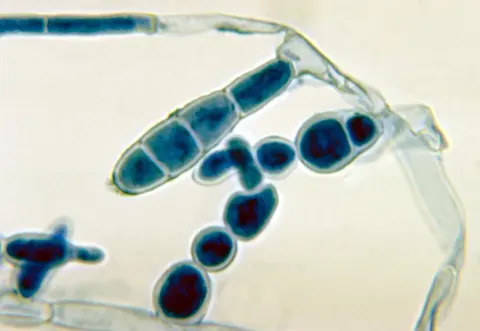
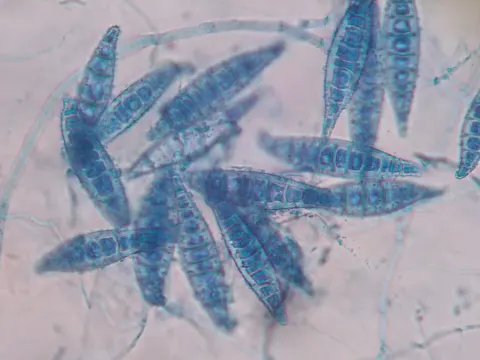
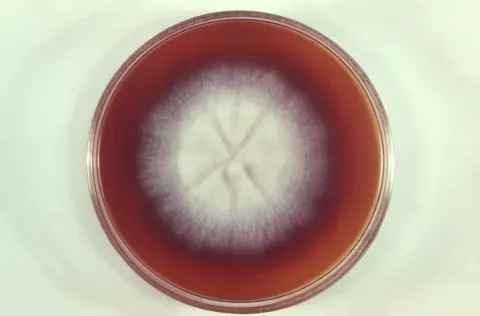
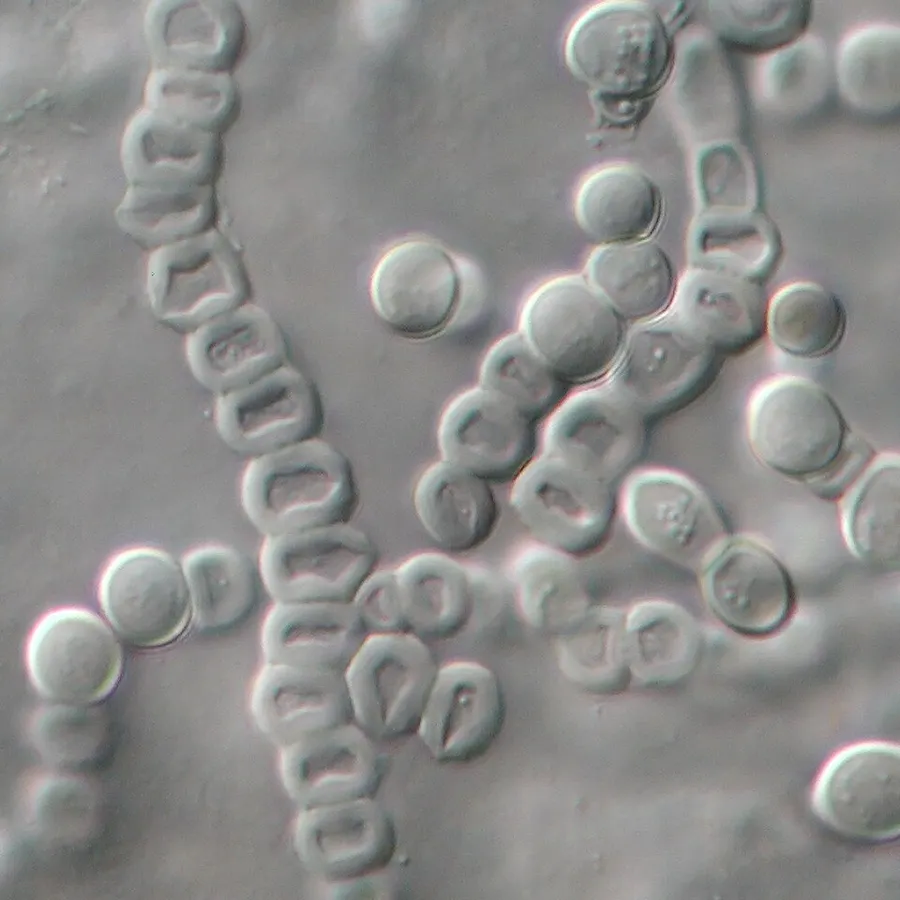
Trichophyton verrucosum is very slow-growing compared to other dermatophytes. In culture, it is characterized by being flat, white/cream colour, having an occasional dome, with a glabrous texture, known as the variant album, however other variations are also found: T. verrucosum var. ochraceum has a flat, yellow, glabrous colony; T. verrucosum var. discoides has a gray-white, flat, and tomentose colony; and T. verrucosum var. autotrophicum is rarely seen and is associated with sheep. Under a microscope, macronidia are rare, and have a rat-tail or string bean shape, while micronidia are tear-shaped and have been only observed in laboratories when grown under enriched conditions. It lacks a teleomorph (sexual) stage. At 37 °C (the only dermatophyte with an optimum growth temperature this high), chlamydospores become thick-walled and found in long chains. Macronidia are more commonly produced on BCP-milk solids-yeast extract agar, and only on colonies over 7 days old. Under refrigeration, it will die. Regions infected with T. verrucosum will fluoresce under a blacklight in cattle, but not in humans.

Sebagian uraian ditampilkan dalam bahasa sumber; terjemahannya belum tersedia atau belum lolos pemeriksaan.

Rujukan: [1]

Pengukuran mengikuti objek, spesimen atau kultur, dan metode yang disebutkan sumber. Baca uraian asli untuk konteks lengkap.

02 / Kehidupan

Habitat dan peran ekologis

Trichophyton verrucosum is very slow-growing compared to other dermatophytes. In culture, it is characterized by being flat, white/cream colour, having an occasional dome, with a glabrous texture, known as the variant album, however other variations are also found: T. verrucosum var. ochraceum has a flat, yellow, glabrous colony; T. verrucosum var. discoides has a gray-white, flat, and tomentose colony; and T. verrucosum var. autotrophicum is rarely seen and is associated with sheep. Under a microscope, macronidia are rare, and have a rat-tail or string bean shape, while micronidia are tear-shaped and have been only observed in laboratories when grown under enriched conditions. It lacks a teleomorph (sexual) stage. At 37 °C (the only dermatophyte with an optimum growth temperature this high), chlamydospores become thick-walled and found in long chains. Macronidia are more commonly produced on BCP-milk solids-yeast extract agar, and only on colonies over 7 days old. Under refrigeration, it will die. Regions infected with T. verrucosum will fluoresce under a blacklight in cattle, but not in humans. Trichophyton verrucosum is thought to have evolved from a soil-dwelling ancestor that migrated to its contemporary cattle host, losing many features that it previously required for survival in soil habitats through genetic drift, including vitamin prototrophy, urease activity, and the ability to perforate hair.

Sebagian uraian ditampilkan dalam bahasa sumber; terjemahannya belum tersedia atau belum lolos pemeriksaan.

Rujukan: [1]

Habitat atau konteks temuan
kultur yang didokumentasikan
Substrat
tanah
Peran atau konteks
Belum dikategorikan pada rilis ini.
Temukan hubungan serupa
03 / Siklus hidup

Reproduksi

Trichophyton verrucosum is very slow-growing compared to other dermatophytes. In culture, it is characterized by being flat, white/cream colour, having an occasional dome, with a glabrous texture, known as the variant album, however other variations are also found: T. verrucosum var. ochraceum has a flat, yellow, glabrous colony; T. verrucosum var. discoides has a gray-white, flat, and tomentose colony; and T. verrucosum var. autotrophicum is rarely seen and is associated with sheep. Under a microscope, macronidia are rare, and have a rat-tail or string bean shape, while micronidia are tear-shaped and have been only observed in laboratories when grown under enriched conditions. It lacks a teleomorph (sexual) stage.

Sebagian uraian ditampilkan dalam bahasa sumber; terjemahannya belum tersedia atau belum lolos pemeriksaan.

Rujukan: [1]

Sinonim menurut acuan taksonomi rilis: Achorion album; Achorion ochraceum; Arthrosporia alba; Arthrosporia ochracea; Ectotrichophyton album; Ectotrichophyton verrucosum; Favotrichophyton album; Favotrichophyton album var. singulare; Favotrichophyton discoides; Favotrichophyton ochraceum; Favotrichophyton singulare; Favotrichophyton verrucosum; Grubyella alba; Grubyella discoides; Grubyella ochracea; Trichophyton album; Trichophyton discoides; Trichophyton faviforme var. discoides; Trichophyton faviforme var. ochraceum; Trichophyton ochraceum; Trichophyton singulare; Trichophyton verrucosum var. autotrophicum; Trichophyton verrucosum var. discoides; Trichophyton verrucosum var. ochraceum
04 / Batas informasi

Catatan identitas dan cakupan

  • Nama diterima mengikuti Catalogue of Life Base2026-09-11; uraian mempertahankan konsep dan nama sumber aslinya.
  • Original geographic, specimen and life-cycle scope retained; source import awaits individual editorial review.
  • Impor dan terjemahan otomatis belum diperiksa editorial per profil. Struktur reproduktif yang disebutkan tidak membuktikan seluruh siklus hidup diketahui.
  • Pengukuran pada uraian mengikuti spesimen, kultur, dan metode sumber; angka tidak diperluas ke semua populasi.

Catatan distribusi dalam narasi mengikuti sumbernya. Dokumentasi spesimen atau foto mengikuti catatan sumber. Bukti wilayah Indonesia dan penilaian konservasi tidak disimpulkan dari gambar.

05 / Dokumentasi

Melihat dengan konteks

Dokumentasi Trichophyton verrucosum dari Wikimedia Commons. Chlamydospores of Trichophyton verrucosum grown for 7 d on Bromocresol purple milk solids glucose agar at 37 C. Identifikasi mengikuti record berkas sumber.

Jenis
Fotografi
Kredit
Medmyco
Sumber media
Buka entri sumber

Gambar menunjukkan objek menurut identifikasi sumber, bukan verifikasi independen spesimen oleh Fungi. Tidak ada skala baru yang ditambahkan.

06 / Rujukan

Sumber profil

  1. [1] Trichophyton verrucosum — Wikipedia (en)Bagian sumber: Frozen revision 1377808597
    Tanggal penghimpunan sumber: 2026-10-12
    Teks sumber: CC BY-SA4.0 · Wikipedia contributors
  2. [2] Catalogue of Life Base2026-09-11 — Trichophyton verrucosumBagian sumber: ColDP NameUsage.tsv ID 58HJ3; accepted species; source 2073
    Tanggal penghimpunan sumber: 2026-10-12
  3. [3] Dokumentasi visual — Trichophyton verrucosumBagian sumber: Individual media record; identification follows the source, not independent determination
    Tanggal penghimpunan sumber: 2026-10-12
    Media sumber: CC BY-SA 4.0 · Medmyco

Adaptasi teks: CC BY-SA 4.0. Wikipedia contributors — Trichophyton verrucosum — Wikipedia (en)

Uraian asli dan riwayat sumber

Riwayat atau halaman sumber

Ringkasan sumber

Trichophyton verrucosum is very slow-growing compared to other dermatophytes. In culture, it is characterized by being flat, white/cream colour, having an occasional dome, with a glabrous texture, known as the variant album, however other variations are also found: T. verrucosum var. ochraceum has a flat, yellow, glabrous colony; T. verrucosum var. discoides has a gray-white, flat, and tomentose colony; and T. verrucosum var. autotrophicum is rarely seen and is associated with sheep. Under a microscope, macronidia are rare, and have a rat-tail or string bean shape, while micronidia are tear-shaped and have been only observed in laboratories when grown under enriched conditions.

Revisi sumber

Morfologi sumber

Trichophyton verrucosum is very slow-growing compared to other dermatophytes. In culture, it is characterized by being flat, white/cream colour, having an occasional dome, with a glabrous texture, known as the variant album, however other variations are also found: T. verrucosum var. ochraceum has a flat, yellow, glabrous colony; T. verrucosum var. discoides has a gray-white, flat, and tomentose colony; and T. verrucosum var. autotrophicum is rarely seen and is associated with sheep. Under a microscope, macronidia are rare, and have a rat-tail or string bean shape, while micronidia are tear-shaped and have been only observed in laboratories when grown under enriched conditions. It lacks a teleomorph (sexual) stage. At 37 °C (the only dermatophyte with an optimum growth temperature this high), chlamydospores become thick-walled and found in long chains. Macronidia are more commonly produced on BCP-milk solids-yeast extract agar, and only on colonies over 7 days old. Under refrigeration, it will die. Regions infected with T. verrucosum will fluoresce under a blacklight in cattle, but not in humans.

Revisi sumber

Ekologi sumber

Trichophyton verrucosum is very slow-growing compared to other dermatophytes. In culture, it is characterized by being flat, white/cream colour, having an occasional dome, with a glabrous texture, known as the variant album, however other variations are also found: T. verrucosum var. ochraceum has a flat, yellow, glabrous colony; T. verrucosum var. discoides has a gray-white, flat, and tomentose colony; and T. verrucosum var. autotrophicum is rarely seen and is associated with sheep. Under a microscope, macronidia are rare, and have a rat-tail or string bean shape, while micronidia are tear-shaped and have been only observed in laboratories when grown under enriched conditions. It lacks a teleomorph (sexual) stage. At 37 °C (the only dermatophyte with an optimum growth temperature this high), chlamydospores become thick-walled and found in long chains. Macronidia are more commonly produced on BCP-milk solids-yeast extract agar, and only on colonies over 7 days old. Under refrigeration, it will die. Regions infected with T. verrucosum will fluoresce under a blacklight in cattle, but not in humans. Trichophyton verrucosum is thought to have evolved from a soil-dwelling ancestor that migrated to its contemporary cattle host, losing many features that it previously required for survival in soil habitats through genetic drift, including vitamin prototrophy, urease activity, and the ability to perforate hair.

Revisi sumber

Struktur reproduksi sumber

Trichophyton verrucosum is very slow-growing compared to other dermatophytes. In culture, it is characterized by being flat, white/cream colour, having an occasional dome, with a glabrous texture, known as the variant album, however other variations are also found: T. verrucosum var. ochraceum has a flat, yellow, glabrous colony; T. verrucosum var. discoides has a gray-white, flat, and tomentose colony; and T. verrucosum var. autotrophicum is rarely seen and is associated with sheep. Under a microscope, macronidia are rare, and have a rat-tail or string bean shape, while micronidia are tear-shaped and have been only observed in laboratories when grown under enriched conditions. It lacks a teleomorph (sexual) stage.

Revisi sumber

Rujukan halaman ini

Fungi. Trichophyton verrucosum. Rilis data fungi-2026-10-12-expansion-2. https://fungi-atlas.mgadib.chatgpt.site/jamur/trichophyton-verrucosum/.

Status: impor sumber; pemeriksaan editorial per profil belum selesai. Untuk klaim biologis, gunakan rujukan pada bagian terkait dan periksa konteks sumber aslinya.