Ciri dan struktur
Tuber aztecorum is a sister species to T. castilloi, but T. castilloi differs by having larger spores, 27–63 × 20–40 µm, is without an irregular thickness to the cell wall on peridial hyphae and is associated mainly with Quercus spp. Also resembles T. guevarai but T. guevarai has narrow spores that are 18–55 × 16–42 µm and cream-yellow fruiting bodies and rDNA variation. Ascomata 5–23 × 4–16 × 3–11 mm, subglobose, irregular, lobate or globose, light to orange brown or reddish-brown changing to dark brown when handled, finely verrucose or granulose, with 5–8 verrucae in 1 mm, solid, brittle, surface dry, base sessile. Peridium in cross-section undetachable <.5 mm wide, with one or several basal white to cream furrows or depressions that merge into veins. 5% KOH negative. Gleba marbled, white to greyish, white veins, some veins ending in the peridium. Odour fungoid to raw potato-like, taste not recorded. Peridium 110–350 µm thick. Outer layer (epicutis) a pseudoparenchyma 62–250 µm thick, of hyphae 5–30 µm diam., versiform, angular or isodiametric, in some areas hyphae arranged perpendicular to the epicutis, hyaline to reddish-brown in mass in KOH, thick-walled (2 µm), without intracellular content. Surface hairs versiform, single hair-like hyphae or cystidia 53–97 µm long × 4–5 µm at the base, tapered to the tip, some with septa, scattered or in clusters, brittle, thin-walled, hyaline in KOH. Other hyphae present are claviform, erect, cylindrical or sinuate with an irregular thickness to the cell wall that resembles knobs or “spines”. Some globose or constricted hyphae emerging from isodiametric hyphae, 3–10 µm wide.
Habitat dan peran ekologis
MEXICO, state of Mexico La Puerta, National Park Nevado de Toluca. Hypogeous, gregarious in volcanic rock soil in an Abies religiosa forest at 3065 m. N 19°11.662', W099°48.537'. 29 July 2010.
- Habitat atau konteks temuan
- hutan
- Substrat
- Informasi belum tersedia pada sumber rilis ini.
- Peran atau konteks
- Belum dikategorikan pada rilis ini.
Reproduksi
Tuber aztecorum is a sister species to T. castilloi, but T. castilloi differs by having larger spores, 27–63 × 20–40 µm, is without an irregular thickness to the cell wall on peridial hyphae and is associated mainly with Quercus spp. Also resembles T. guevarai but T. guevarai has narrow spores that are 18–55 × 16–42 µm and cream-yellow fruiting bodies and rDNA variation. Ascomata 5–23 × 4–16 × 3–11 mm, subglobose, irregular, lobate or globose, light to orange brown or reddish-brown changing to dark brown when handled, finely verrucose or granulose, with 5–8 verrucae in 1 mm, solid, brittle, surface dry, base sessile. Peridium in cross-section undetachable <.5 mm wide, with one or several basal white to cream furrows or depressions that merge into veins. 5% KOH negative.
Catatan identitas dan cakupan
- Nama diterima mengikuti Catalogue of Life Base2026-09-11; uraian mempertahankan konsep dan nama sumber aslinya.
- Preserve original treatment localities, hosts and substrate scope. Materials examined describe documented specimens, not the full global range.
- Impor dan terjemahan otomatis belum diperiksa editorial per profil. Struktur reproduktif yang disebutkan tidak membuktikan seluruh siklus hidup diketahui.
- Pengukuran pada uraian mengikuti spesimen, kultur, dan metode sumber; angka tidak diperluas ke semua populasi.
Catatan distribusi dalam narasi mengikuti sumbernya. Dokumentasi spesimen atau foto mengikuti catatan sumber. Bukti wilayah Indonesia dan penilaian konservasi tidak disimpulkan dari gambar.
Melihat dengan konteks
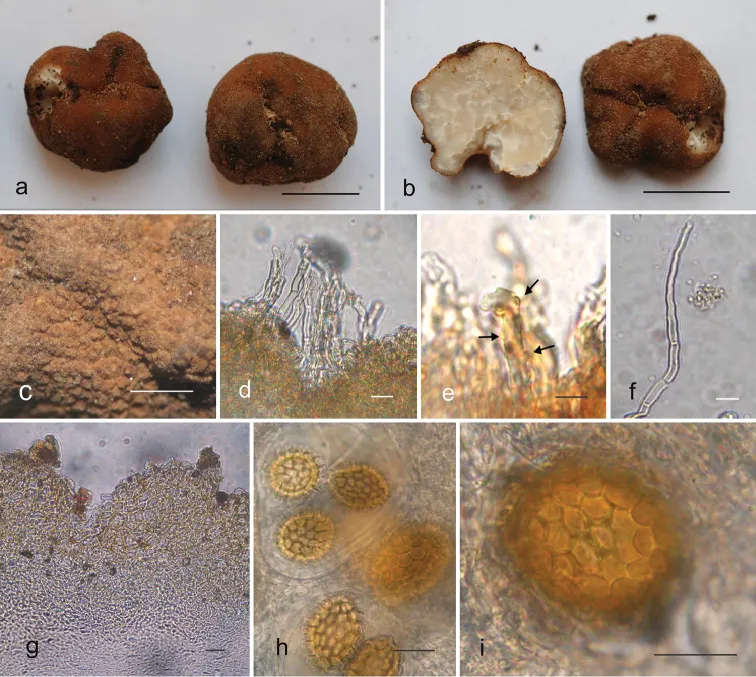
a–i Tuber aztecorum (holotype ITCV 993). a; Two ascomata showing the peridial surface (bar = 1 cm) b Ascoma in cross-section showing peridial surface and glebal surface (bar = 1 cm) c Peridial surface magnified showing the verrucose surface (bar = 1 mm) d Clusters of erect hyphae emanating from the peridial surface (bar =10 µm) e A single surface hair-like hypha (bar = 10 µm) f Cystidium (bar = 10 µm) g Cross section of peridium showing pseudoparenchyma-like epicutis (bar = 20 µm) h Ascospores within asci in surface view showing the alveoli (bar = 20 µm) i Ascospore within asci in surface view showing the alveoli magnified (bar = 20 µm).
- Jenis
- Pelat ilmiah
- Kredit
- Gonzalo Guevara-Guerrero, Gregory Bonito, Matthew E. Smith, Rosanne Healy, Arthur C. Grupe II, Efrén Cázares, Michael A. Castellano, James M. Trappe
- Lisensi
- CC BY 4.0
- Sumber media
- Buka entri sumber
Sumber profil
- [1] Tuber aztecorum sp. nov., a truffle species from Mexico belonging to the Maculatum clade (Tuberaceae, Pezizales) — Tuber aztecorum
- [2] Catalogue of Life Base2026-09-11 — Tuber aztecorum
- [3] Dokumentasi visual — Tuber aztecorum
Rujukan halaman ini
Fungi. Tuber aztecorum. Rilis data fungi-2026-10-12-expansion-2. https://fungi-atlas.mgadib.chatgpt.site/jamur/tuber-aztecorum/.
Status: impor sumber; pemeriksaan editorial per profil belum selesai. Untuk klaim biologis, gunakan rujukan pada bagian terkait dan periksa konteks sumber aslinya.