Ciri dan struktur
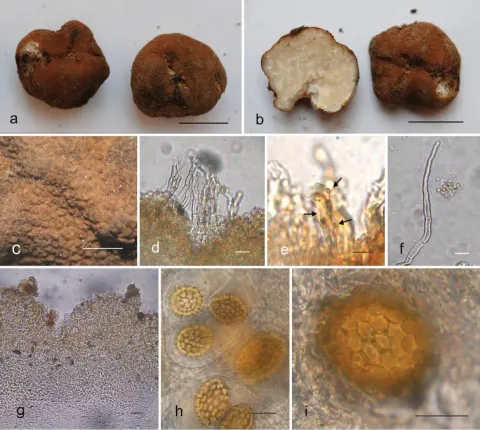
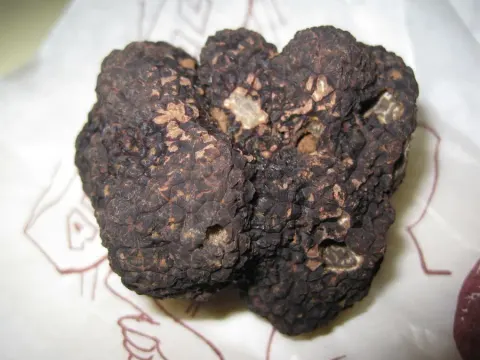
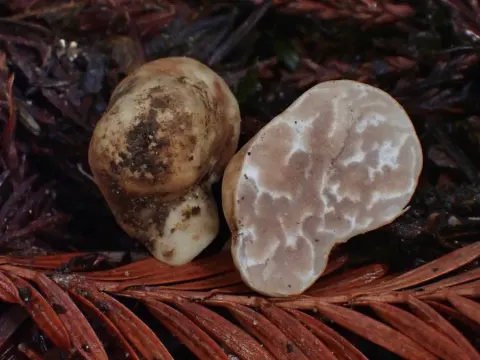
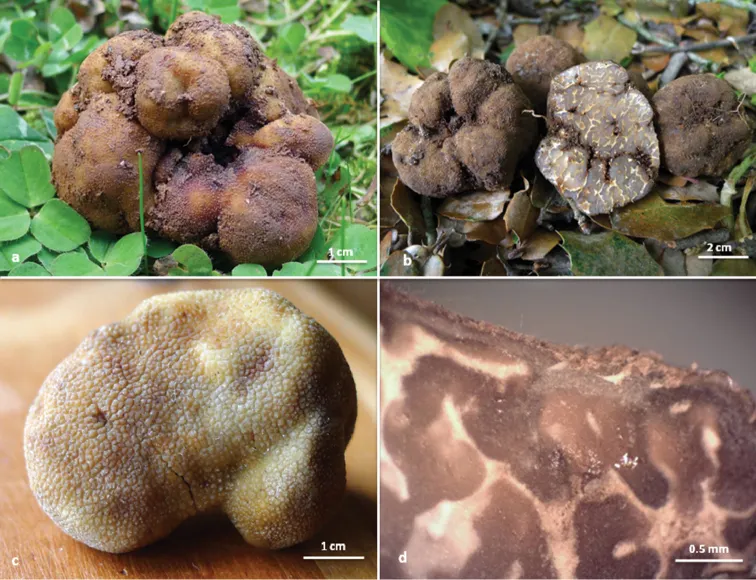
Ascomata 0.6–7(–10) cm in diam., subglobose, ovoid to irregularly lobed, usually with shallow basal cavity, surface with fissures and small, dense, almost flat trihedral to polyhedral warts, yellowish-brown to dark brown. Ascospores 25.0–37.0 × 18.2–25.6 μm in (1–)2–8-spored asci, ellipsoid to subfusiform on average, Qm =1.4, crested to incompletely reticulate. Hair-like, hyaline to light yellow-brown hyphae protruding from peridium surface. T. panniferum, the closest phylogenetically-related species, produces smaller ascospores (23–26 × 18–20 μm), broadly ellipsoid to subglobose on average, with isolated warts; moreover, the peridium surface is woolly-felted due to the presence of dense rusty brown hair-like hyphae. Ascomata 0.6–7(–10) cm in diameter, tuberous, subglobose, ovoid to irregularly lobed, usually depressed with a shallow - occasionally prominent - basal cavity (excavated), covered up with whitish to yellowish rhizomorphs, fragile, initially greyish to yellowish-brown [fawn (29), sienna (11), fulvous (12)], darkening in maturity to brown [snuff brown (17), umber (18), bay (19), to date brown (24)] or with some shades of purple tinges [purplish date (22), purplish chestnut (21) to brown vinaceous (25)], sometimes with darker black [fuscous black (38)] spots, surface rarely almost smooth, usually rough, with fissures and small, dense, almost flat trihedral to polyhedral warts. Gleba with one of more cavities, initially pinkish-grey [vinaceous buff (31), clay pink (30)], then greyish-brown [milky coffee (28)], yellowish-brown [fulvous (12)], brown [snuff brown (17), umber (18), bay (19)], to purplish-brown in maturity [purplish date (22) to purplish chestnut (21)], with bay (19) to rusty tawny (14) coloured areas close to the cavity, marbled with relatively few and thick white veins, that sometimes are reddening (Fig. 1).
Habitat dan peran ekologis
Hypogeous, in soil, appearing solitary or in small groups from March to June, under Quercus sp., Q. coccifera or Q. ilex L. or under Carpinus sp. or in mixed stands of Quercus sp. and Pinus nigra J.F. Arnold or of Q. ilex and Pinus halepensis Miller or of Quercus robur L., Corylus sp., Carpinus sp. and Acer sp. It seems to be rather common in continental (northern and central) Greece, while it also occurs in the regions of Eastern Stara Planina and the Black Sea coast of Bulgaria.
- Habitat atau konteks temuan
- Informasi belum tersedia pada sumber rilis ini.
- Substrat
- tanah
- Peran atau konteks
- Belum dikategorikan pada rilis ini.
Reproduksi
Ascomata 0.6–7(–10) cm in diam., subglobose, ovoid to irregularly lobed, usually with shallow basal cavity, surface with fissures and small, dense, almost flat trihedral to polyhedral warts, yellowish-brown to dark brown. Ascospores 25.0–37.0 × 18.2–25.6 μm in (1–)2–8-spored asci, ellipsoid to subfusiform on average, Qm =1.4, crested to incompletely reticulate. Hair-like, hyaline to light yellow-brown hyphae protruding from peridium surface. T. panniferum, the closest phylogenetically-related species, produces smaller ascospores (23–26 × 18–20 μm), broadly ellipsoid to subglobose on average, with isolated warts; moreover, the peridium surface is woolly-felted due to the presence of dense rusty brown hair-like hyphae.
Catatan identitas dan cakupan
- Nama diterima mengikuti Catalogue of Life Base2026-09-11; uraian mempertahankan konsep dan nama sumber aslinya.
- Preserve original treatment localities, hosts and substrate scope. Materials examined describe documented specimens, not the full global range.
- Impor dan terjemahan otomatis belum diperiksa editorial per profil. Struktur reproduktif yang disebutkan tidak membuktikan seluruh siklus hidup diketahui.
- Pengukuran pada uraian mengikuti spesimen, kultur, dan metode sumber; angka tidak diperluas ke semua populasi.
Catatan distribusi dalam narasi mengikuti sumbernya. Dokumentasi spesimen atau foto mengikuti catatan sumber. Bukti wilayah Indonesia dan penilaian konservasi tidak disimpulkan dari gambar.
Melihat dengan konteks
T. pulchrosporum sp. nov.: a ascomata in situ (holotype) b ascomata in situ (paratype) c detail of peridium surface (paratype) d section of peridium (paratype).
- Jenis
- Pelat ilmiah
- Kredit
- Elias Polemis, Georgios Konstantinidis, Vassiliki Fryssouli, Monica Slavova, Triantafyllos Tsampazis, Vasileios Nakkas, Boris Assyov, Vasileios Kaounas, Georgios I. Zervakis
- Lisensi
- CC BY 4.0
- Sumber media
- Buka entri sumber
Dokumentasi tambahan
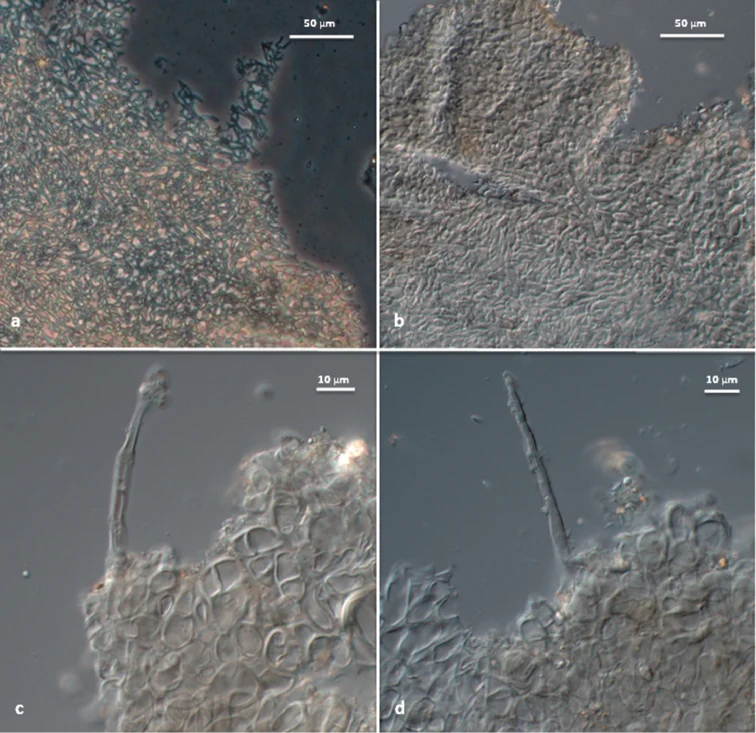
T. pulchrosporum sp. nov.: a, b peridium structure c, d hair-like hyphae on peridium surface.
Kredit dan penggunaan
Elias Polemis, Georgios Konstantinidis, Vassiliki Fryssouli, Monica Slavova, Triantafyllos Tsampazis, Vasileios Nakkas, Boris Assyov, Vasileios Kaounas, Georgios I. Zervakis
Ukuran dan format gambar disesuaikan tanpa pemotongan, retus, atau penambahan skala. Lisensi sumber dipertahankan.
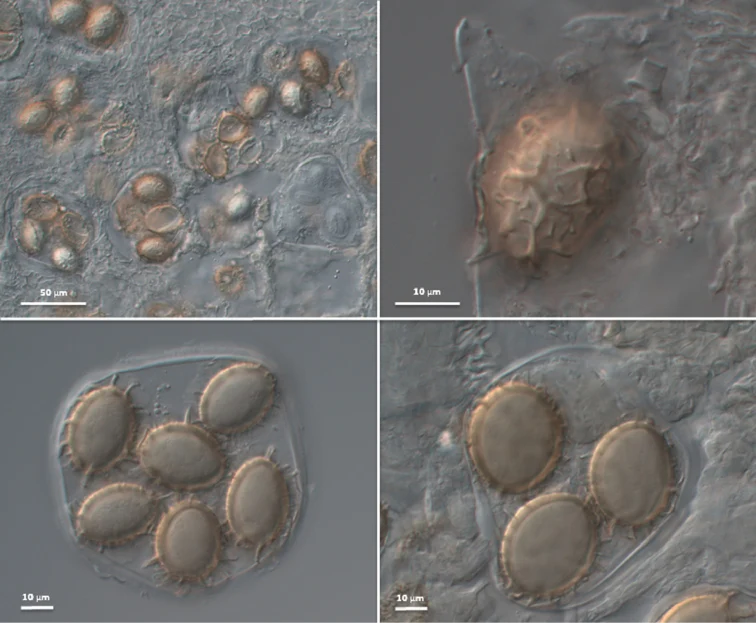
T. pulchrosporum sp. nov.: asci and ascospores.
Kredit dan penggunaan
Elias Polemis, Georgios Konstantinidis, Vassiliki Fryssouli, Monica Slavova, Triantafyllos Tsampazis, Vasileios Nakkas, Boris Assyov, Vasileios Kaounas, Georgios I. Zervakis
Ukuran dan format gambar disesuaikan tanpa pemotongan, retus, atau penambahan skala. Lisensi sumber dipertahankan.
Sumber profil
- [1] Tuber pulchrosporum sp. nov., a black truffle of the Aestivum clade (Tuberaceae, Pezizales) from the Balkan peninsula — Tuber pulchrosporum
- [2] Catalogue of Life Base2026-09-11 — Tuber pulchrosporum
- [3] Dokumentasi visual — Tuber pulchrosporum
- [4] Dokumentasi visual — Tuber pulchrosporum
- [5] Dokumentasi visual — Tuber pulchrosporum
Rujukan halaman ini
Fungi. Tuber pulchrosporum. Rilis data fungi-2026-10-12-expansion-2. https://fungi-atlas.mgadib.chatgpt.site/jamur/tuber-pulchrosporum/.
Status: impor sumber; pemeriksaan editorial per profil belum selesai. Untuk klaim biologis, gunakan rujukan pada bagian terkait dan periksa konteks sumber aslinya.