Ciri dan struktur
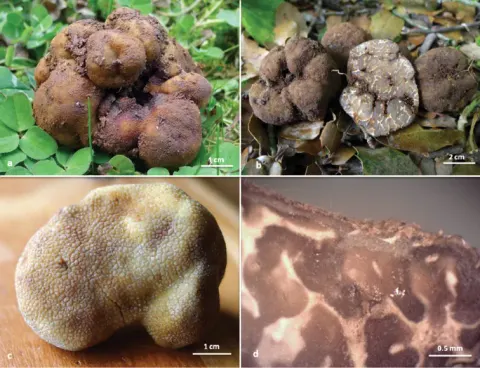
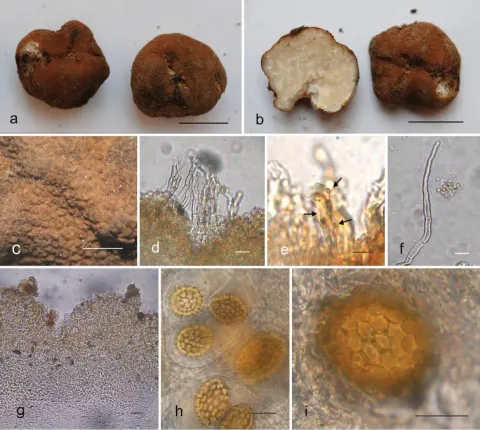
The fruit bodies of T. oregonense are hypogeous (growing in the ground), typically 0.5–5 cm broad, although specimens up to 7.5 cm have been recorded. Smaller specimens are spherical or nearly so, and have random furrows; larger specimens are more irregular in shape, lobed and deeply furrowed. Young fruit bodies have a white peridium, as the truffle matures it develops red to reddish-brown or orangish-brown patches; with age it becomes orange-brown to reddish-brown overall and often develops cracks on the surface. The peridium is 0.2–0.4 mm thick, and the surface texture ranges from relatively smooth to covered with tiny "hairs" that are more dense in the furrows, and more scattered on the exposed lobes. The gleba is solid; in youth the fertile tissue is whitish and marbled with mostly narrow, white, hypha-stuffed veins that emerge throughout the peridium to its surface. In maturity, the fertile tissue is light brown to brown from the color of the spores, but the marbling veins remain white. The odor and flavor of the flesh are mild in youth, but soon become strong, pungent and complex, or "truffly". The spores are ellipsoid to somewhat spindle-shaped with narrowed ends, and light brownish in color. The size of the spores varies depending upon the type of asci in which they develop: in one-spored asci they measure 42.5–62.5 by 17.5–30 μm; in two-spored asci they are 32.5–50 by 15–25 μm; in three-spored asci they are 27.5–45 by 15–25 μm; in four-spored asci they are 25–38.5 by 13–28 μm; in five-spored asci 28–34 by 22–25 μm (all sizes excluding surface ornamentation). The spore walls are 2–3 μm thick and are covered with a honeycomb-like (alveolate) network.
Habitat dan peran ekologis
Like all Tuber species, T. oregonense adalah mikoriza. Jamur tumbuh di barat Kaskade Mountains from Puget selatan Sound region Washington, selatan ke barat daya Oregon at ketinggian dari permukaan laut dekat sampai 425 m di hutan murni Pseudotsuga menziesii hingga 100 tahun, atau Pseudotsuga mixed dengan Tsuga heterophylla, Picea sitchensis, atau Alnus species. Spesies ini telah dipanen secara komersial di Pasifik Northwest since pada tahun 1980-an. dan sering ditemukan di perkebunan Christmas tree sejak usia lima tahun. Festival Truffle Oregon, yang diadakan di Eugene yearly sejak 2006 untuk bertepatan dengan penuaan truffle pada akhir Januari, menampilkan kegiatan seperti seminar penanaman dan kunjungan berburu truffle. Fruit bodies diproduksi dari September through pertengahan Maret. Jamur ini merupakan komponen penting dari diet tupai terbang utara, dan mencakup sebagian besar diet mereka pada waktu tertentu tahun. Some individuals telah mengklaim telah berhasil menanam jeruk di peternakan Christmas tree di Oregon. Techniques reportedly melibatkan menjinakkan tanah di bawah pohon pohon Douglas muda dengan bubur yang terdiri dari jeruk tanah yang dicampur dengan air, atau kotoran hewan yang diberi makan jeruk, tetapi tidak ada bukti konkret menunjukkan metode ini dapat digunakan untuk membangun patch jeruk baru atau untuk meningkatkan produktivitas patch yang ada.
- Habitat atau konteks temuan
- hutan
- Substrat
- Informasi belum tersedia pada sumber rilis ini.
- Peran atau konteks
- Mitra tumbuhan
Reproduksi
The fruit bodies of T. oregonense are hypogeous (growing in the ground), typically 0.5–5 cm broad, although specimens up to 7.5 cm have been recorded. Smaller specimens are spherical or nearly so, and have random furrows; larger specimens are more irregular in shape, lobed and deeply furrowed. Young fruit bodies have a white peridium, as the truffle matures it develops red to reddish-brown or orangish-brown patches; with age it becomes orange-brown to reddish-brown overall and often develops cracks on the surface. The peridium is 0.2–0.4 mm thick, and the surface texture ranges from relatively smooth to covered with tiny "hairs" that are more dense in the furrows, and more scattered on the exposed lobes.
Catatan identitas dan cakupan
- Nama diterima mengikuti Catalogue of Life Base2026-09-11; uraian mempertahankan konsep dan nama sumber aslinya.
- Original geographic, specimen and life-cycle scope retained; source import awaits individual editorial review.
- Impor dan terjemahan otomatis belum diperiksa editorial per profil. Struktur reproduktif yang disebutkan tidak membuktikan seluruh siklus hidup diketahui.
- Pengukuran pada uraian mengikuti spesimen, kultur, dan metode sumber; angka tidak diperluas ke semua populasi.
Catatan distribusi dalam narasi mengikuti sumbernya. Dokumentasi spesimen atau foto mengikuti catatan sumber. Bukti wilayah Indonesia dan penilaian konservasi tidak disimpulkan dari gambar.
Melihat dengan konteks
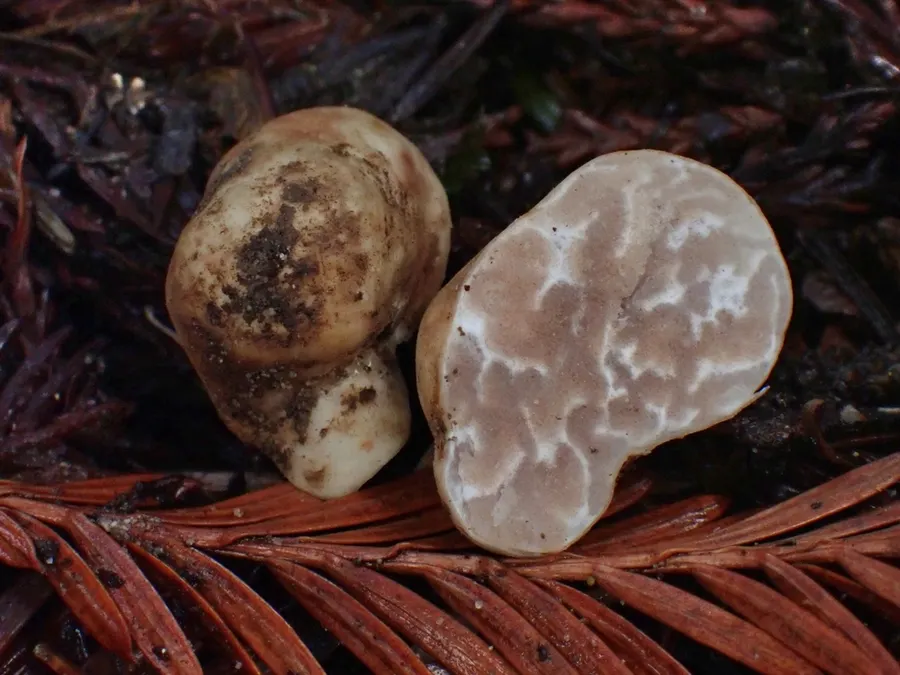
Dokumentasi Tuber oregonense menurut asosiasi foto pada record takson iNaturalist. Kredit: Mandy Hackney. Identitas mengikuti sumber; bukan penentuan spesimen independen.
- Jenis
- Fotografi
- Kredit
- (c) Mandy Hackney, some rights reserved (CC BY), uploaded by Mandy Hackney
- Lisensi
- CC BY 4.0
- Sumber media
- Buka entri sumber
Dokumentasi tambahan
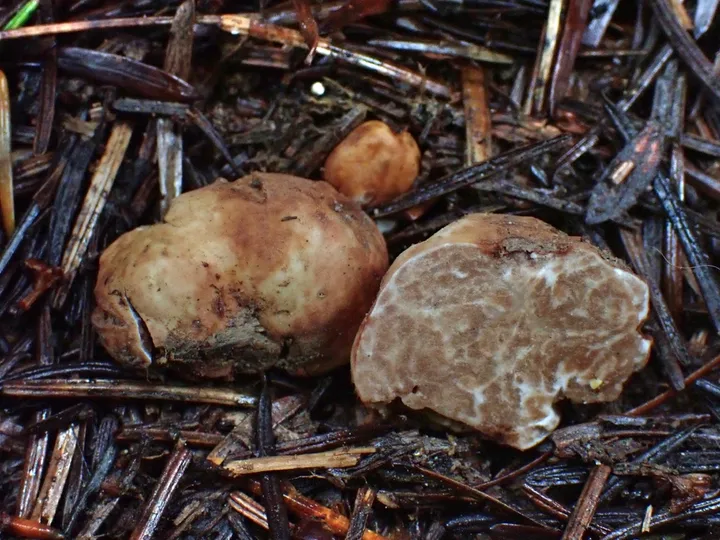
Foto yang diasosiasikan dengan Tuber oregonense pada iNaturalist. Identifikasi mengikuti sumber; bukan penentuan spesimen independen.
Kredit dan penggunaan
(c) Mandy Hackney, some rights reserved (CC BY), uploaded by Mandy Hackney
Ukuran dan format gambar disesuaikan tanpa pemotongan, retus, atau penambahan skala. Lisensi sumber dipertahankan.
Sumber profil
- [1] Tuber oregonense — Wikipedia (en)
- [2] Catalogue of Life Base2026-09-11 — Tuber oregonense
- [3] Dokumentasi visual — Tuber oregonense
- [4] Dokumentasi visual — Tuber oregonense
Rujukan halaman ini
Fungi. Tuber oregonense. Rilis data fungi-2026-10-12-expansion-2. https://fungi-atlas.mgadib.chatgpt.site/jamur/tuber-oregonense/.
Status: impor sumber; pemeriksaan editorial per profil belum selesai. Untuk klaim biologis, gunakan rujukan pada bagian terkait dan periksa konteks sumber aslinya.